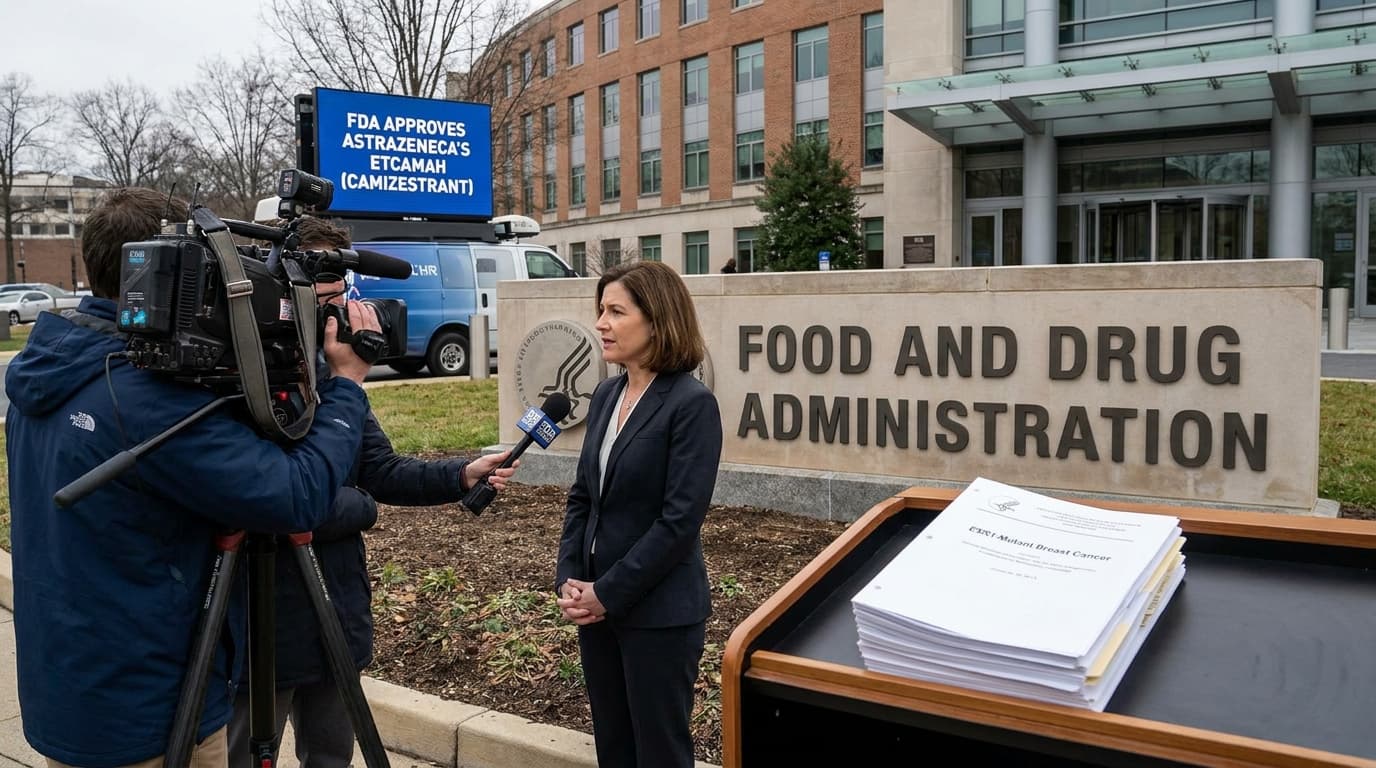
The FDA has approved AstraZeneca’s camizestrant, which will be sold as Etcamah, for certain patients with HR+/HER2- advanced breast cancer whose ESR1 mutations are detected during aromatase inhibitor and CDK4/6 inhibitor therapy. The drug is intended to be used in combination with a CDK4/6 blocker such as Eli Lilly’s Verzenio, Pfizer’s Ibrance and Novartis’ Kisqali.
The decision stands out because it reverses the direction signaled by an advisory committee meeting in May, when an independent panel voted 6-3 against approval. The core regulatory issue was not whether Etcamah had activity, but whether AstraZeneca had generated enough evidence to support a treatment switch at the point when ESR1 mutations emerge rather than waiting for disease progression.
That makes this approval more than a label expansion for AstraZeneca. It gives the company a product in a defined molecular subset and suggests the FDA was willing to accept an earlier intervention approach even though overall survival data remain immature.
The data
The approval is based on the late-stage SERENA-6 study. In that trial, patients were switched either to an Etcamah regimen or kept on their current treatments during testing for ESR1 mutations. Panelists objected that this was a relatively early switch point, because such changes normally happen upon disease progression.
Even with that debate, AstraZeneca said patients in the Etcamah arm saw a significant 56% reduction in the risk of death or disease progression compared with controls on standard of care. Time to second progression was also significantly longer in patients receiving Etcamah.
The unresolved point is overall survival. BioSpace reported that those data remain immature, and some members of the expert panel considered that a critical gap. Stanley Lipkowitz, deputy director of the Center for Cancer Research at the National Cancer Institute, said at the time, “The data for changing the paradigm just isn’t there. If there were an OS benefit, I would have voted yes.”
The road here
The advisory committee debate centered on precedent as much as on this single application. Panelists were asked whether SERENA-6 showed a clinically meaningful benefit in this patient subset, but some experts also argued that an approval could encourage other companies to move switch points earlier for targeted therapies using less mature evidence.
The FDA nevertheless signed off on the application, creating a regulatory example for molecularly guided treatment changes before radiographic progression. That does not settle the broader scientific question, but it does give AstraZeneca a first commercial foothold while the field continues to debate the timing of intervention.
What to watch
For Leerink Partners, the approval opens only “modest revenues” for Etcamah of around $750 million. The firm said clinicians it consulted had highlighted that SERENA-6 did not definitively answer whether treating at the point of ESR1 mutation emergence ahead of radiographic progression is beneficial versus treating on progression.
The larger commercial opportunity may depend on the phase 3 SERENA-4 study, which is positioning the Etcamah regimen as a first-line option. Leerink said that setting could lift peak revenue projections to approximately $2.9 billion. Data from SERENA-4 are expected in the second half of this year.