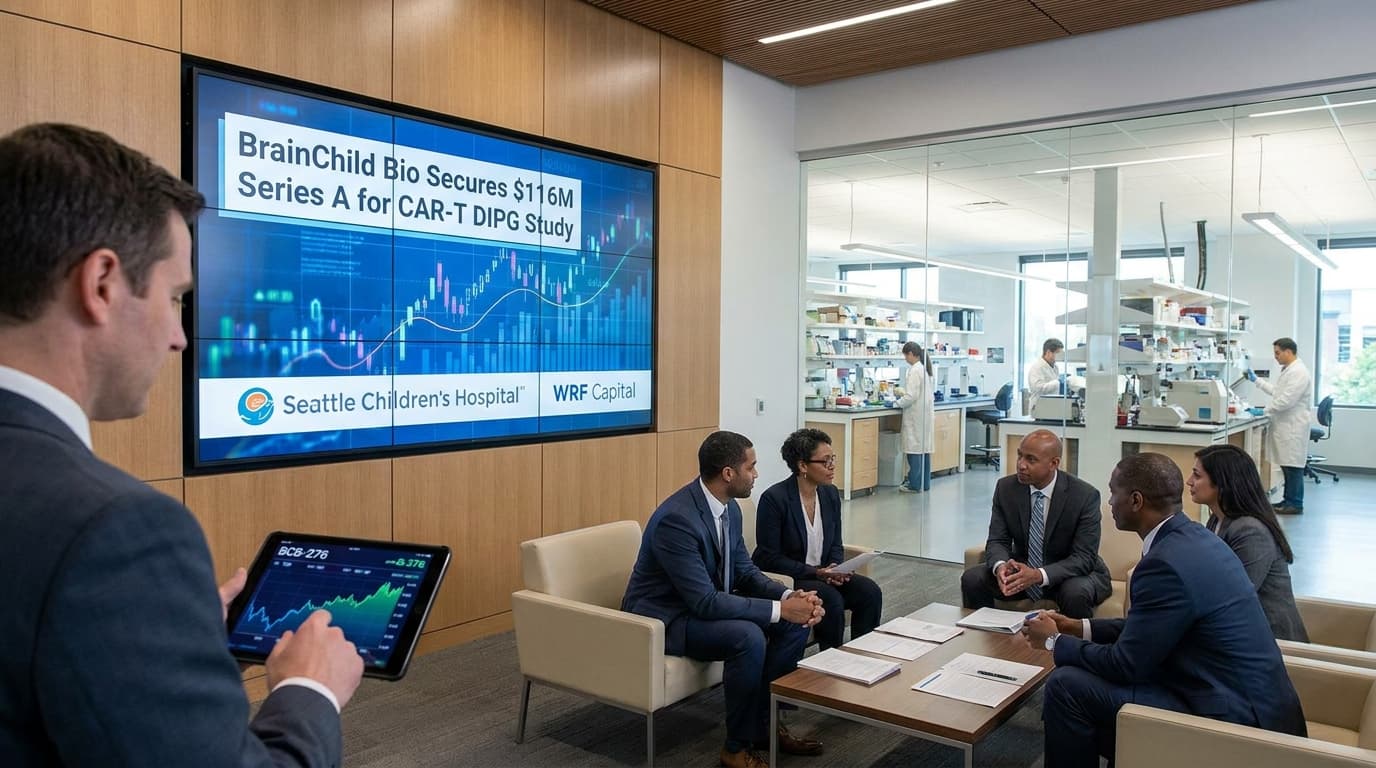
BrainChild Bio has closed a large series A round to push its CAR-T platform deeper into cancers of the central nervous system, with the company saying the money will support its lead program in diffuse intrinsic pontine glioma and help move a glioblastoma candidate toward the clinic. Fierce Biotech reported the financing as $116 million, while BioSpace reported $119 million, and the source coverage does not reconcile that difference.
The company was launched in late 2023 from Seattle Children’s Hospital around work led by pediatric oncologist Michael Jensen, M.D. According to Fierce, the syndicate included Seattle Children’s and new investor WRF Capital, while BioSpace said the round was led by an undisclosed private family fund and foundation, with Seattle Children’s Hospital and WRF Capital also participating.
The signal for investors is not only that capital is still available for clinical-stage cell therapy, but that it is being directed to narrower, high-unmet-need indications where trial design may be more manageable. BrainChild is using DIPG as its first indication, then pairing that with a larger glioblastoma opportunity that management said broadens the commercial story.
The data
BrainChild’s lead candidate, BCB-276, is an autologous CAR-T therapy for DIPG. BioSpace said the therapy targets B7-H3, which the company describes on its website as “universally expressed” in DIPG, and that it is administered directly to the cerebrospinal fluid so it can directly access the tumor bed.
Fierce described BrainChild’s approach more broadly as taking T cells from patients, genetically modifying them to attack cancer and then reinfusing them into the central nervous system. Unlike approved CAR-T products that are typically dosed once, BrainChild’s cells are intended for multiple-dose regimens, according to CEO Steven Brugger in the Fierce report.
The ongoing ILLUMINATE study is designed as a phase 2 trial for newly diagnosed DIPG. BioSpace reported that the open-label, single-arm study aims to enroll 75 patients, with topline data expected in 2028. Fierce separately reported that BrainChild now has enough cash to finish what it called a phase 2 trial of BCB-276 in DIPG.
Fierce also reported that the company has had cooperation from the FDA on trial design, with the agency allowing BrainChild to compare BCB-276 to natural history data rather than requiring a placebo arm. Jensen told Fierce that this strategy is especially important in a patient population like DIPG.
The commercial picture
DIPG is a rare but acute starting point. Fierce reported 250 to 300 new cases each year, while BioSpace said the disease affects around 300 children in the U.S. every year. Both accounts present the disease as an area of severe unmet need: Fierce said radiation is the most common treatment and “entirely palliative,” while BioSpace said the only treatment option currently is palliative focal radiation.
That small initial population helps explain the financing logic. A single-company effort in DIPG can stay operationally focused, while success there could support expansion into larger CNS tumors. BrainChild’s second program, BCB-214, is being developed for glioblastoma. BioSpace said BCB-214 targets B7-H3, EGFR and IL13Rα2, a combination intended to address tumor heterogeneity and the immunosuppressive environment around tumors.
Fierce added that the company plans to launch a phase 1 glioblastoma trial next year and framed glioblastoma as a much larger market with 15,000 new cases per year that includes adults. Brugger told Fierce, “We’re kids first, but not kids only,” a line that captures the company’s business case: begin in pediatric disease, but build toward a broader solid-tumor cell therapy franchise.
The road here
The company’s scientific pitch is that CNS tumors may present a somewhat more tractable setting for CAR-T than many other solid tumors. Fierce reported that Jensen said glioblastomas lack the tough collagen matrix seen in some other tumors and may be easier for CAR-T cells to locate because the chemicals they exude are contained behind the blood-brain barrier. He also said BrainChild studies have shown cells injected into the opposite half of the brain moving through the corpus collosum to find tumors on the other side.
That does not make the category de-risked. Fierce noted that all FDA-approved CAR-T therapies so far are used for blood cancers, while progress in solid tumors has been slower, with the first solid tumor CAR-T approved only a few months ago in China by CARsgen Therapeutics. BrainChild’s financing therefore reads as a targeted bet that route of administration, tumor biology and a constrained initial indication can make CNS tumors a more investable entry point than the broader solid-tumor CAR-T field has been to date.