Artificial intelligence is increasingly being described in biopharma not as a narrow productivity tool but as operating infrastructure that touches R&D, manufacturing and corporate integration.
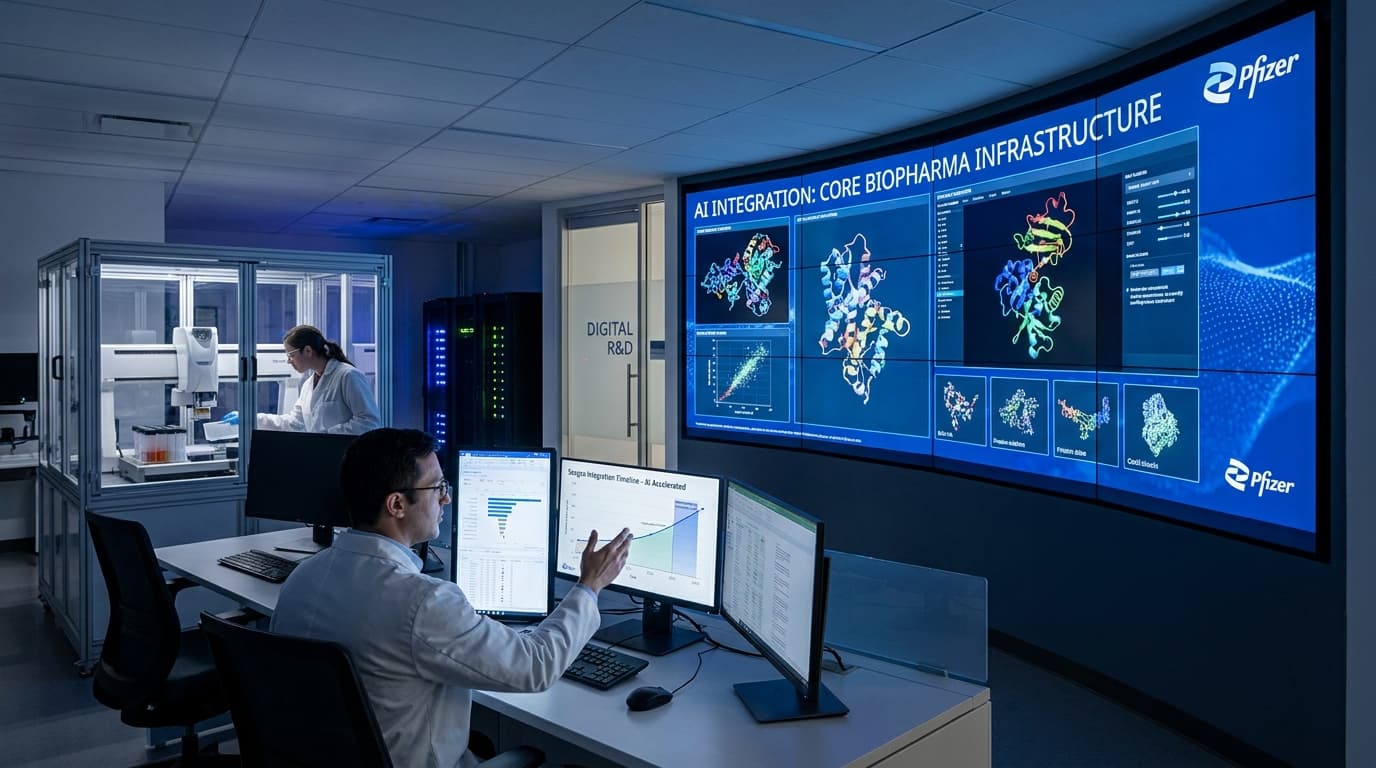
In a BioSpace deep dive, Pfizer CEO Albert Bourla said in early August that AI helped the company integrate Seagen, which Pfizer acquired for $43 billion in 2023. Bourla called AI a “structural transformation opportunity” for accelerating Pfizer’s R&D pipeline, improving speed and productivity across the business and strengthening its competitive position. He added that Pfizer’s ambition is to build an AI-native R&D organization in which insights from target discovery through medical evidence continuously inform the next decision.
AstraZeneca’s Pam Cheng, EVP of global operations and chief sustainability officer, made a similar case on a recent sustainability call, saying AI is driving measurable efficiencies across R&D and operations. Cheng said it can help shorten drug development lead times, automate manufacturing processes and deliver earlier and more precise healthcare.
Where AI is showing up
The common thread in those comments is that large drugmakers are presenting AI as a system for improving decision quality and process efficiency rather than as a substitute for scientific teams. That framing matters commercially because it ties AI spending to time, throughput and execution bottlenecks that companies already know how to value.
The BioSpace report also points to a second shift: the blurring of boundaries between tech and pharma. As larger companies look to technology groups to address drug development bottlenecks, newer biotechs are being built with AI at their core and are becoming licensing targets for Lilly, Merck, Sanofi, AstraZeneca and others.
The funding and partnering picture
Insilico Medicine is presented as one of the clearest examples. According to BioSpace, the company has signed billions of dollars’ worth of deals, supported by a fast discovery engine and a menu of available programs for partnering. CEO Alex Zhavoronkov told BioSpace that more deals are expected.
That momentum has helped define a TechBio subgroup that includes Alphabet subsidiary Isomorphic Labs, Recursion Pharmaceuticals and Xaira Therapeutics. Many of these companies have disclosed little about public pipelines or clinical assets, with Insilico described as an outlier, but investor demand has remained strong. Xaira launched with $1 billion in 2024, and Isomorphic raised $2.1 billion in May, which BioSpace said was the second largest biotech round ever.
The signal is that AI in biopharma is separating into two investable stories. One is adoption inside established pharma, where executives are linking the technology to measurable operating gains. The other is platform-led TechBio, where capital is still flowing heavily even when public clinical proof points remain limited.