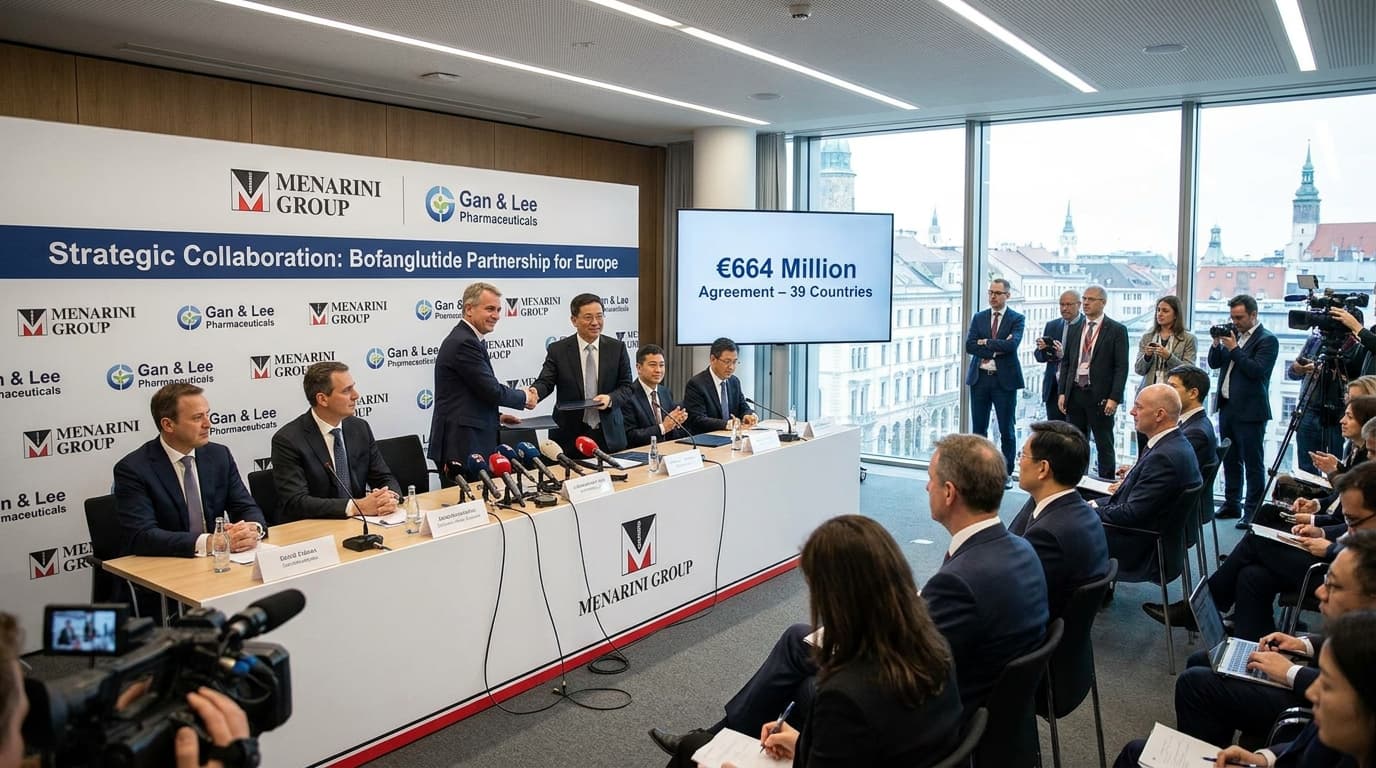
The Menarini Group has agreed to pay Gan & Lee Pharmaceuticals €62 million upfront to collaborate on the registration and commercialization of bofanglutide, a GLP-1 from the Chinese insulin maker. Gan & Lee is also eligible for milestone payments of up to €664 million, as well as double-digit royalties on sales.
Under the agreement, Menarini will take over regulatory submissions and commercialization in 39 countries: the 27 European Union countries, the U.K., Switzerland, Norway, Iceland, Liechtenstein and the Balkan countries. For Gan & Lee, the deal provides a regional commercialization partner as it tries to move bofanglutide beyond China and the U.S.; for Menarini, it adds a late-stage metabolic asset in a market where differentiated dosing remains one of the few clear ways for new GLP-1 entrants to stand out.
The asset
Bofanglutide is administered subcutaneously once every two weeks, which the source says requires half the administration frequency of once-weekly GLP-1s. Menarini CEO Elcin Barker Ergun said clinical results so far have shown weight reduction, secondary metabolic benefits and a safety profile consistent with expectations for the class, while arguing the dosing schedule offers an opportunity for differentiation.
Gan & Lee said bofanglutide completed a phase 3 study in China and a phase 2 study in the U.S. in patients who were overweight, obese or had Type 2 diabetes. According to the company, both studies met their primary endpoints and demonstrated weight loss and tolerability consistent with other GLP-1s.
The company also pointed back to a phase 2 trial announced two years ago in Type 2 diabetes, when Gan & Lee said bofanglutide outperformed Novo Nordisk’s Ozempic, or semaglutide, in reducing glycated hemoglobin and body weight. That earlier comparison gives the program a stronger commercial narrative, but the current deal still depends on new global data rather than prior China- or U.S.-specific studies alone.
The strategic picture
Gan & Lee plans to initiate a global phase 3 trial to support registration in Europe and other highly regulated markets. That means the Menarini agreement is less a near-term launch pact than a bet on carrying a regional filing and commercialization effort once a broader development package is assembled.
The structure also shows how European expansion for Chinese metabolic assets is increasingly being built through licensing rather than standalone market entry. Gan & Lee keeps economics through milestones and royalties, while Menarini uses its regional footprint to add a product that could broaden its presence in innovative primary and specialty care. In a crowded GLP-1 field, that kind of arrangement suggests commercial value may be shifting toward assets that can still claim a practical distinction, even when efficacy and safety are described as generally in line with the class.