A Nature study argues that aging biomarkers can be embedded directly into disease-focused clinical trials, using a published 12-week phase 2a study of rentosertib in idiopathic pulmonary fibrosis as a test case. The paper compared six proteomic aging clocks on longitudinal serum proteome data and found that all six consistently predicted lower biological age in treated arms.
That consistency matters because aging-clock readouts have often been criticized for poor agreement and weak interpretability, especially in epigenetic models. The authors present proteomic clocks as a more practical route for clinical development because proteins sit closer to active biology, which may make them more useful both for measuring biological age and for generating mechanistic clues.
The data
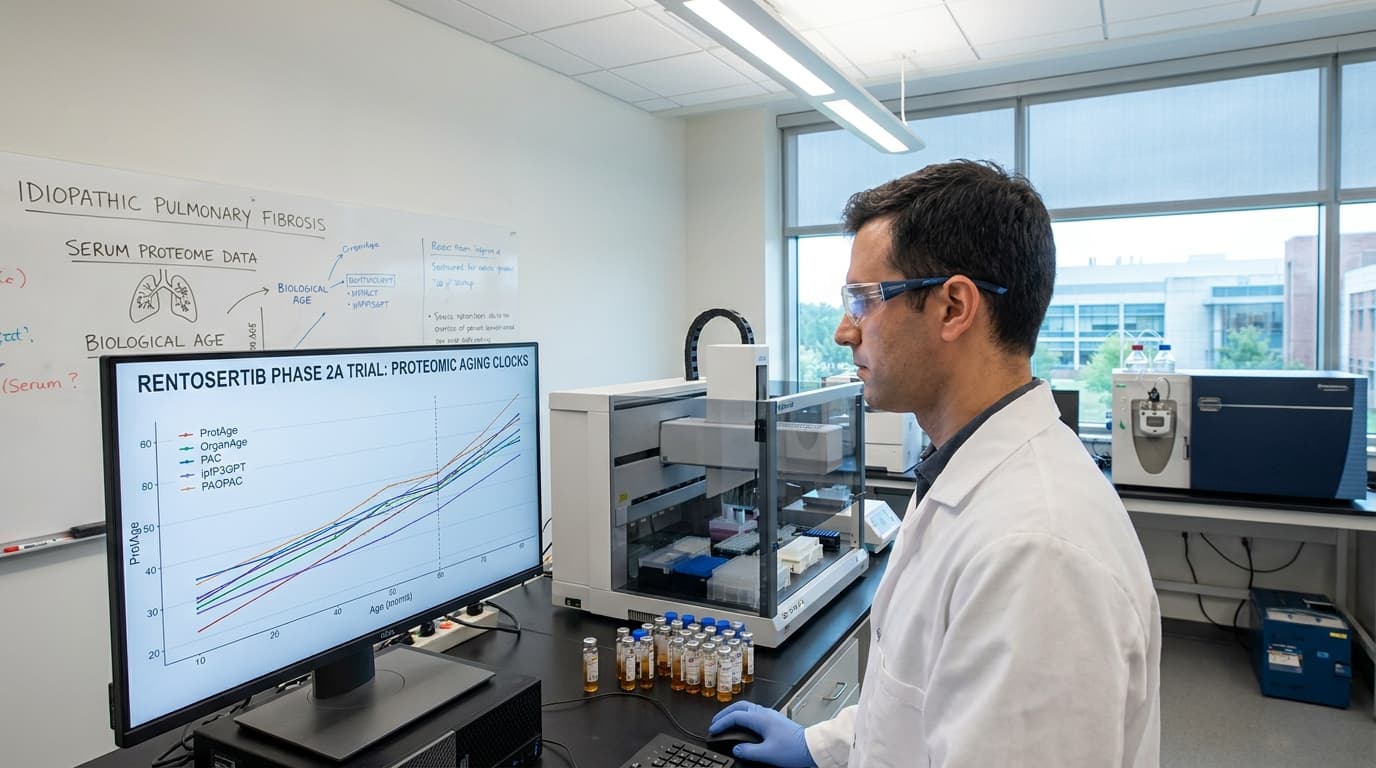
The analysis covered six proteomic clocks: ProtAge, OrganAge mortality, OrganAge chrono, PAC, ipfP3GPT and PAOPAC. The clocks differ in what they were trained to predict, with some targeting chronological age and others mortality risk, and they also differ in methodology, spanning classical machine learning and deep learning approaches.
The source dataset came from a published controlled phase 2a trial of rentosertib in idiopathic pulmonary fibrosis. Rentosertib, formerly INS018_055, is described in the paper as an AI-designed TRAF2- and NCK-interacting kinase inhibitor. In the trial, the researchers incorporated aging biology by performing longitudinal proteomic screening of serum samples, creating what the paper describes as a rare human proteomic dataset on an intervention with aging-modulatory potential.
Across the six clocks, the directional finding was the same: treated arms were predicted to have lower biological age. The authors frame that cross-model agreement as stronger evidence of a biological signal than any single clock could provide on its own.
The study also sets a boundary on what this kind of analysis can claim. Proteomic clocks alone, the authors write, cannot deconvolute aging-specific effects from disease-specific effects. To address that indirectly, they used pathway analyses and identified potential anti-aging shifts in senescence and metabolic processes alongside rentosertib’s anti-fibrotic activity.
Why It Matters For Trial Design
The paper’s broader argument is methodological rather than purely drug-specific. Therapies developed for aging-related diseases often hit pathways that overlap with the hallmarks of aging, but standard clinical trials are not built to detect whether a disease drug is also modulating aging biology. The authors position dual-purpose trial designs as a way to close that gap.
That is the strategic signal here. If aging endpoints can be added to indication-specific studies without replacing conventional efficacy work, developers may get an earlier read on whether a program has value beyond a single disease setting. In that model, biomarkers are not treated as a separate longevity experiment; they become an added analytical layer inside ordinary clinical development.
The paper also explains why the authors favor proteomic clocks over epigenetic ones for this job. It points to inconsistent clinical trial readouts, poor cross-model agreement and limited mechanistic insight as constraints on DNA methylation-based clocks. Proteomic models, by contrast, are presented as better suited to both readout and interpretation because they track immediate effectors of biological change.
The Road Here
The authors place the work in a young but growing body of clinical proteomic-clock research. They cite a 12-week supervised exercise trial in 26 men in which ProtAge detected a 10-month reduction in biological age, and a 40-month simian metformin study that used a dedicated proteomic clock to show multi-tissue aging deceleration. They also note that some human rejuvenative-intervention studies, including plasma exchange, used proteomic profiling in a supporting role to primary epigenetic-clock assessment.
Against that backdrop, the rentosertib analysis stands out less as proof of geroprotection than as a demonstration of how to structure a development program around aging biology from the outset. The authors write that they are attempting to do that across target selection, preclinical validation, indication choice and trial design while adhering to regulatory requirements.
For the field, the practical takeaway is narrower and more useful than a broad anti-aging claim. Concordant movement across six proteomic clocks suggests these tools may be mature enough to inform clinical interpretation, but only when paired with disease context and pathway-level analysis rather than treated as self-sufficient evidence.