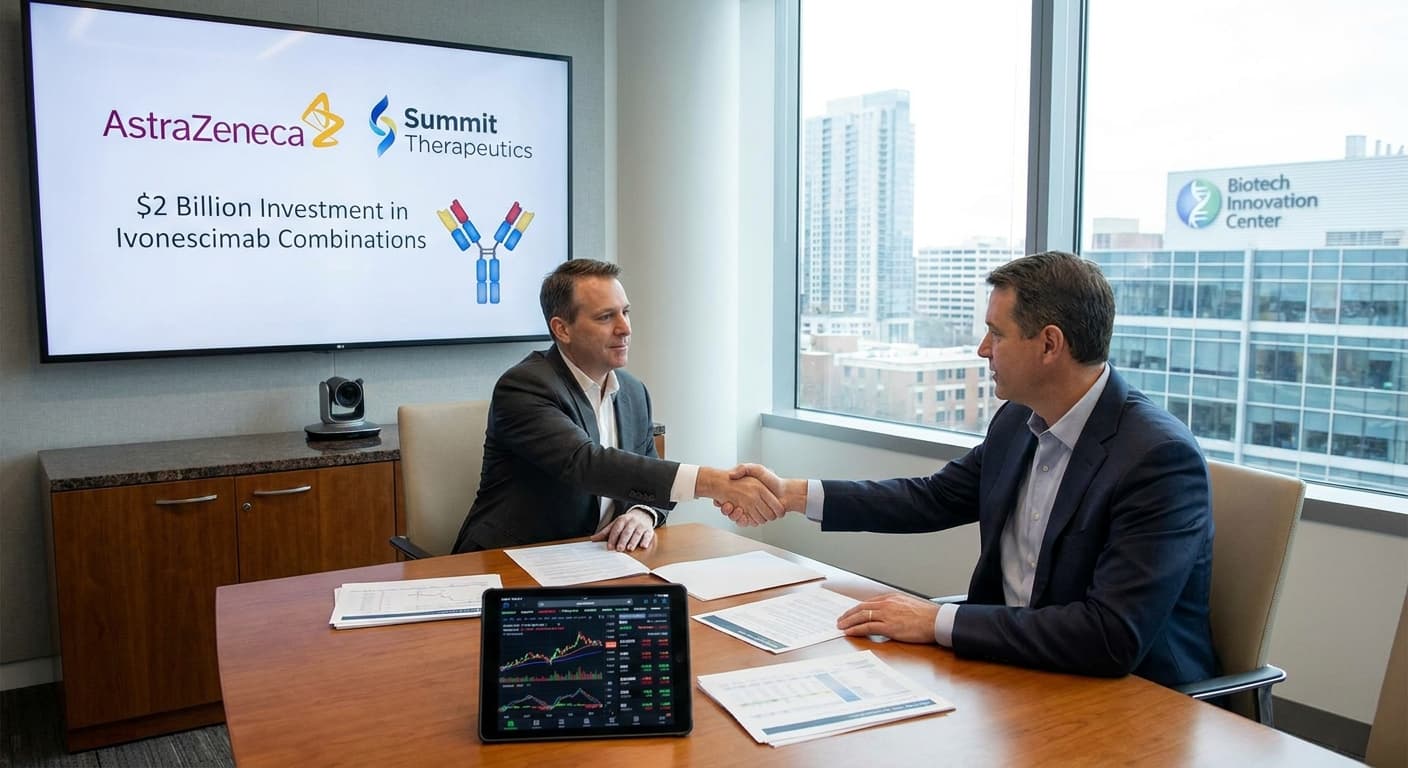
AstraZeneca is investing $2 billion in Summit Therapeutics in a deal built around ivonescimab, the PD-1xVEGF bispecific already approved in China for multiple non-small cell lung cancer indications. Rather than acquiring the company or the asset outright, AstraZeneca is using a three-part structure that gives it exposure to ivonescimab while preserving Summit’s control of its molecule.
First, AstraZeneca is buying a 12% stake in Summit at an 18% premium to Summit’s Monday closing price. Second, the companies will jointly fund clinical trials of ivonescimab with AstraZeneca’s CLDN18.2-directed antibody-drug conjugate sonesitatug vedotin, or sone-ve. Third, they formed a nonbinding agreement to test ivonescimab with other AstraZeneca medicines, including additional ADCs.
Why AstraZeneca Structured The Deal This Way
The immediate development plan starts in gastrointestinal cancers with ivonescimab plus sone-ve. FierceBiotech said AstraZeneca paid KYM Biosciences $63 million upfront for sone-ve back in 2023, so the new agreement creates a way to increase the value of an internal ADC through a combination partner that targets PD-1 and VEGF at the same time.
Evercore ISI analysts called the arrangement “a win on multiple fronts” for Summit, citing a validating buy-in from a global oncology leader, a sizable cash infusion and the retention of Summit’s strategic optionality. According to the source, Summit management told the analysts AstraZeneca has no right of first refusal on future deals. Summit and AstraZeneca will each retain development and commercial rights to their own molecules.
That matters because the nonbinding portion of the agreement leaves room for expansion without obligating either side to every future pairing. The companies are considering the same split-cost, retained-ownership model for additional combinations, but FierceBiotech noted they could still decide not to advance a given cocktail beyond ivonescimab plus sone-ve.
The Signal Ahead Of HARMONi-3
The investment also lands before an important data event. Questions about whether global studies will replicate Chinese trial data have hung over ivonescimab, and FierceBiotech said Evercore took “incremental confidence” from AstraZeneca’s willingness to invest before the readout of HARMONi-3, Summit’s global Phase 3 lung cancer trial. Summit told the analysts AstraZeneca has no visibility into the ongoing study.
Susan Galbraith, AstraZeneca’s executive vice president of oncology R&D, had already signaled interest in the biology at an event in June when discussing HARMONi-6. She said the study was “obviously a positive study,” while also saying that whether there is added benefit from the drug being in a bispecific “remains a question.” She added that one advantage of a bispecific is that it is easier to combine with other active drugs because there is one drug rather than a doublet comparison.
Shares in Summit rose 18% to $18.23 in after-hours trading Monday after the announcement, according to FierceBiotech. The market reaction and deal design point to the same conclusion: AstraZeneca is paying to secure a front-row position in a combination strategy that could strengthen its ADC portfolio, while waiting for global evidence to determine how far ivonescimab can travel beyond the China data set.