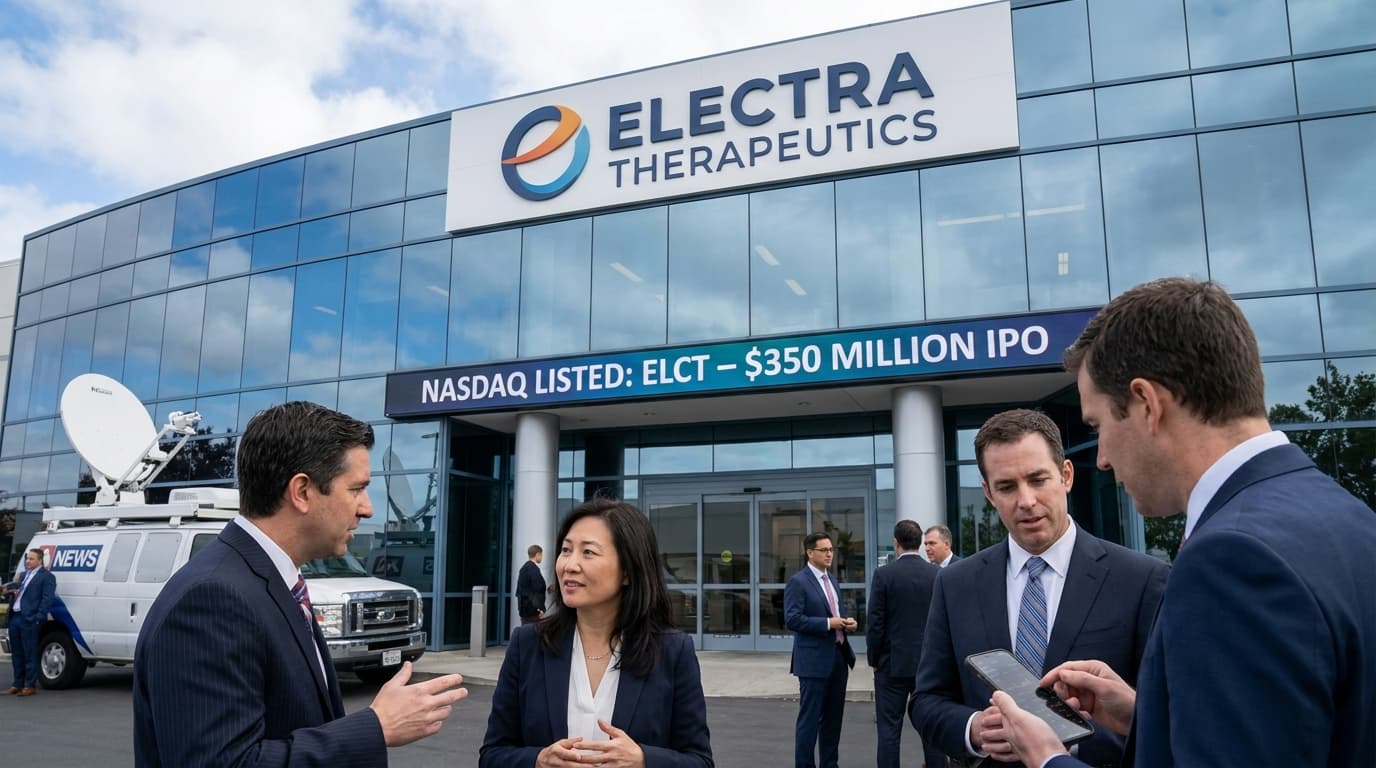
Electra Therapeutics has joined this year’s receptive biotech IPO class with a $350 million Nasdaq debut that came in above the company’s earlier plan. The South San Francisco company sold 23.3 million shares at $15 apiece, compared with expectations earlier this week that pointed to roughly 21.6 million or 21.7 million shares at the same price.
That difference matters less as a rounding issue than as a financing signal: investors were willing to absorb a larger offering from a clinical-stage inflammation company whose main use of proceeds is not broad platform expansion, but an expensive push on a lead program already in an ongoing late-stage study. Electra also could add another $52.5 million if underwriters fully exercise their option to purchase an additional 3.5 million shares.
Where The Money Goes
Electra said the IPO proceeds will be added to the $97.7 million it had on hand at the end of June, after a $183 million series C raised in October 2025. The company has already mapped out how it expects to spend the new capital.
The largest allocation, $220 million, is earmarked for ipsoprubart through an ongoing global phase 2/3 study in secondary hemophagocytic lymphohistiocytosis, or sHLH, and toward an approval application. BioSpace also reported that the company expects the IPO money to support potential commercial activities tied to that asset. Another $25 million is set aside for an ongoing phase 1 study of ipsoprubart in natural killer/T cell malignancies, while $50 million is expected to support an ongoing early-stage study of ELA822 in healthy volunteers and start a planned phase 1/2 study in patients with T cell-mediated immune disorders.
The Clinical Bet
Ipsoprubart is a monoclonal antibody targeting signal regulatory proteins on immune cells. Electra describes the drug as a way to selectively remove pathological or abnormal immune cells while avoiding healthy ones.
The immediate value driver is sHLH, which Fierce Biotech described as a rare, life-threatening hyperinflammatory syndrome caused by overactivation of the immune system. Cancer, infection, autoimmune disease and immunotherapy can all trigger the condition, and the syndrome requires immediate intervention after arising.
The source reports describe encouraging but still early clinical findings. Fierce Biotech cited a phase 1b study in malignancy-associated HLH in which ipsoprubart achieved a 100% overall survival rate at eight weeks among 12 frontline patients. BioSpace, describing the phase 1b portion of the study, reported a 100% objective tumor response rate among eight patients with lymphoma-associated sHLH, including an 88% complete response rate. Because those figures refer to different measures and patient groupings, they point to promise but not a single uniform efficacy readout.
Why This IPO Stands Out
This deal looks like a continuation of a broader reopening rather than an isolated exception. Fierce Biotech placed Electra alongside other well-received 2026 biotech offerings, while BioSpace said the company is the 26th biotech to go public this year after a sluggish 2025.
For investors, the sharper read is that public capital is still available for companies that can present a defined spending plan around a lead asset with a near-enough regulatory path. Electra is not selling a vague platform story: it is raising money to carry one named drug through a phase 2/3 program, expand it into adjacent hematologic settings and keep a second antibody moving. That is a more disciplined IPO use-of-proceeds profile than the market often rewarded in earlier cycles.
Electra, founded in 2018 and employing 46 full-time staffers, said in a Securities and Exchange Commission filing that it plans to increase headcount. CEO Kathy Dong told Fierce last year that enrollment in the phase 2/3 sHLH trial was expected to complete in 2027, with topline data to follow shortly after. That timeline now becomes the central test of whether this upsized financing marks a durable public-market return for later-stage biotech stories or simply another window that stays open only for a select few.