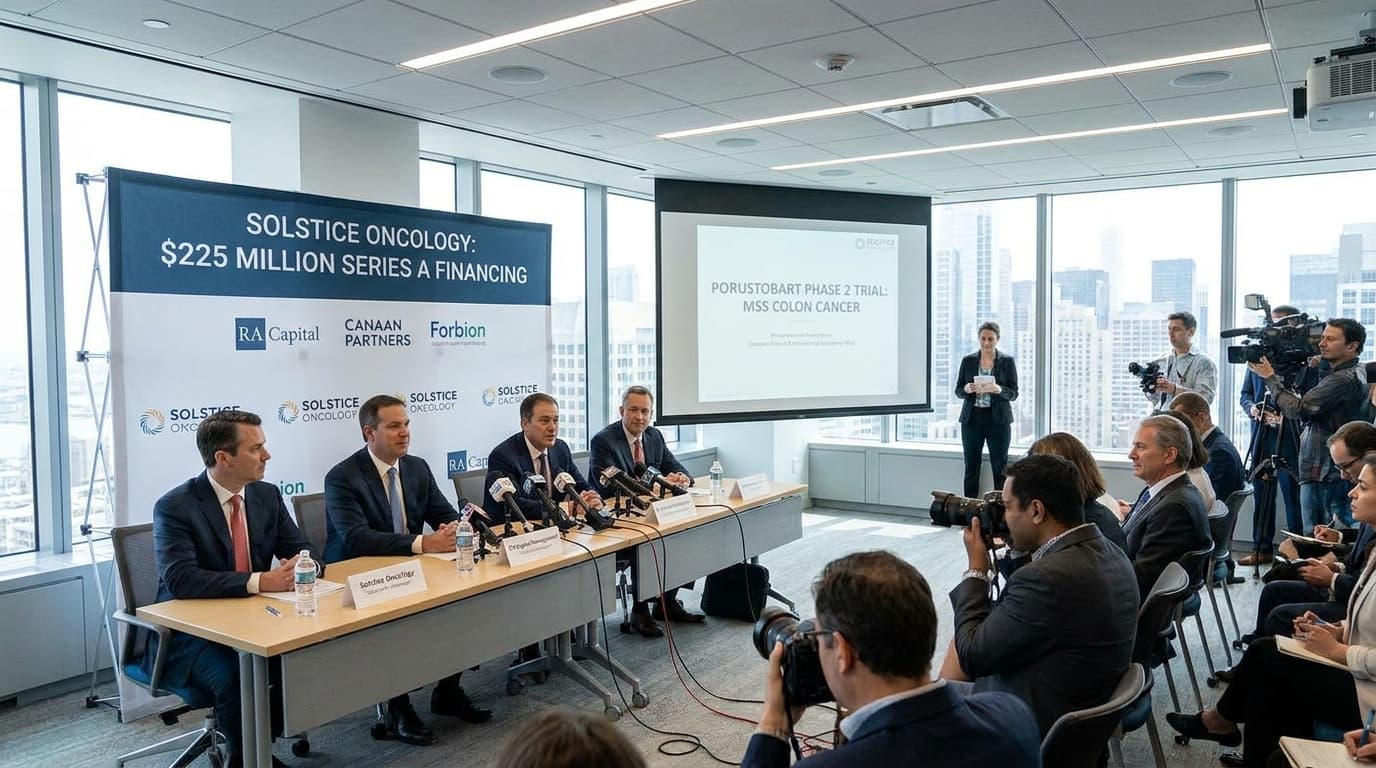
Solstice Oncology has secured $225 million in Series A financing to advance porustobart, an Fc-enhanced CTLA-4 antibody licensed from Harbour BioMed, into phase 2 development in microsatellite stable stage II and III colon cancer. The round was led by RA Capital Management, with participation from Canaan Partners, Forbion and others.
The company was founded in February and moved quickly to build around porustobart. In exchange for a $105 million upfront package, Solstice obtained rights to develop and commercialize the drug outside of China. BioSpace described that package as about $105 million at signing, including a $50 million upfront payment, $5 million in near-term cash and a $50 million equity stake in the biotech, while also noting that Harbour could receive up to $1.1 billion in commercial milestones tied to ex-China sales.
The immediate use of proceeds is a phase 2 study pairing porustobart with Merck's Keytruda in the neoadjuvant setting for advanced colon cancer. Fierce Biotech reported that the study is due to start enrolling this year, while BioSpace said enrollment will begin in the fourth quarter. Both sources said a readout is expected in the second half of 2027. Solstice also said it plans to develop porustobart in another undisclosed indication.
The Data
Solstice is targeting microsatellite stable, or MSS, colon cancer, which the company describes as a setting that has not benefited from immunotherapy. Fierce Biotech called MSS colon cancer a cold tumor, with standard care consisting of surgery and chemotherapy and limited impact from most immunotherapies.
The company’s strategy is to combine CTLA-4 blockade with PD-1 inhibition before surgery, when the tumor remains present and, in Solstice CEO Caroline Loew’s account, the immune system is still intact and patients have not yet been exposed to prior treatment. Loew said the goal is to generate a systemic immune response that can reach micrometastatic disease beyond the primary tumor.
According to Fierce Biotech, Loew said an anti-PD-L1 alone has a 0% response rate in this setting and PD-L1 plus first-generation CTLA-4 has response rates of up to 5%. She contrasted that with Harbour’s phase 1b trial of porustobart, where the combination generated a 30% response rate. BioSpace reported the same early study as a 30% objective response rate, or 7 out of 23 patients, with a median duration of response of 8.4 months. Fierce Biotech described patients as staying in remission for an average of 8.4 months, so the publications align on the numerical result but use different efficacy wording.
Porustobart’s design is central to Solstice’s argument that CTLA-4 can be used more effectively in colon cancer. The company says the antibody has a shorter half-life than existing CTLA-4 therapies, at four to five days versus roughly two to three weeks for existing CTLA-4 antibodies. Solstice believes that shorter exposure could allow more flexible dosing and reduce the frequency and duration of immune-related adverse events.
The Commercial Picture
This financing does more than fund a single mid-stage study. It also tests whether investors are willing to back oncology companies built around imported clinical assets when the differentiation story is clear and the timeline to value inflection is short.
Solstice is not trying to prove CTLA-4 matters in cancer broadly; Bristol Myers Squibb’s Yervoy and AstraZeneca’s Imjudo already established that class. Its bet is narrower and more commercial: that a second-generation CTLA-4 antibody with different pharmacology can widen the utility of checkpoint blockade in a tumor type where PD-1 combinations have produced limited activity. If that thesis holds, the company moves from being a licensing vehicle for an ex-China asset to controlling a program with data in a large solid tumor setting that has been resistant to immunotherapy.
The neoadjuvant approach also shapes the business case. Rather than entering a heavily pretreated metastatic setting first, Solstice is aiming earlier in the treatment sequence, where Loew said there is an opportunity to improve cure rates and long-term survival by attacking micrometastatic disease before surgery. That positioning raises the clinical bar, but it also creates a clearer path to strategic relevance if the trial reads out positively.
For now, the signal is that capital remains available for companies that can pair a defined biological rationale with an already identified clinical catalyst. Solstice has less than a year-old corporate history, but it already has a large financing, a clinic-ready combination plan and a readout expected in the second half of 2027.