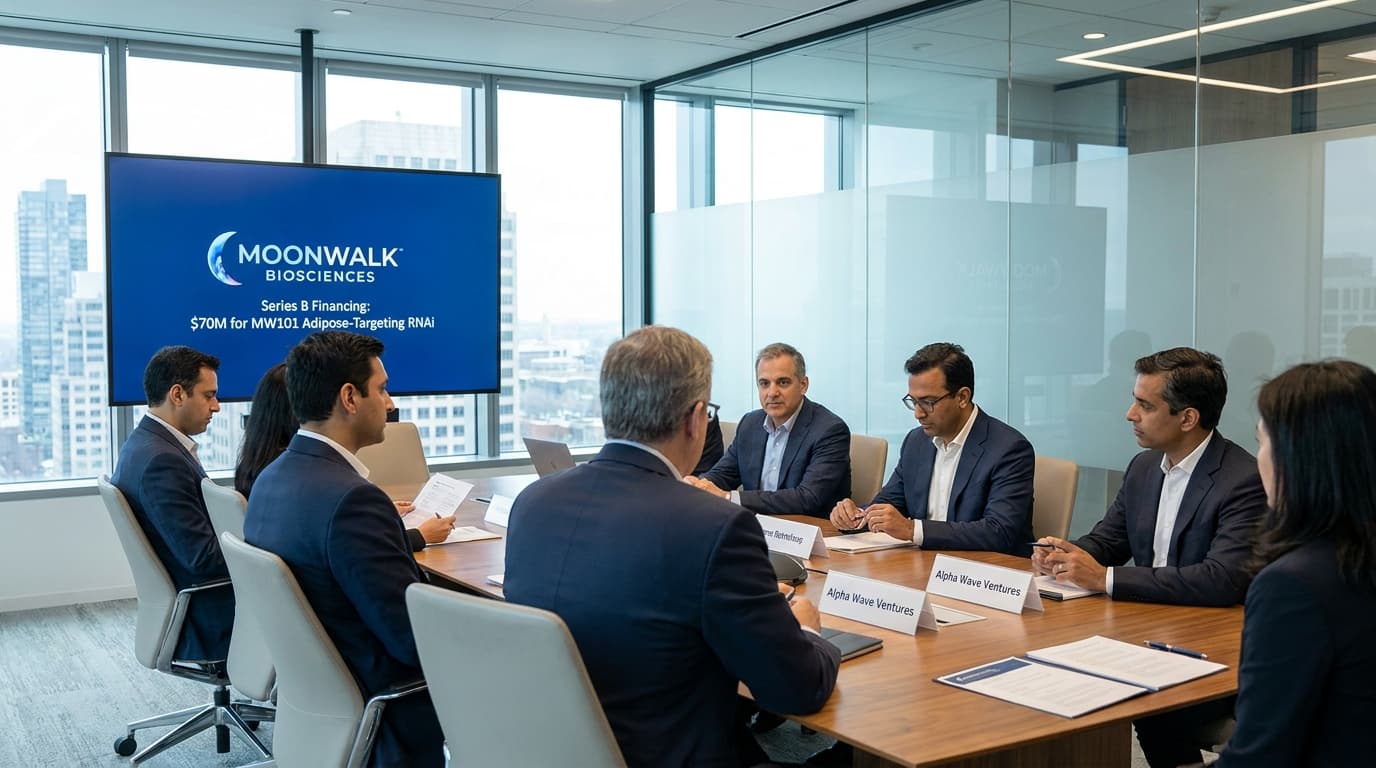
Moonwalk Biosciences has raised $70 million in a Series B financing to support its lead obesity candidate, MW101, on the way to first-in-human studies planned for late 2027. The round was led by Alpha Wave Ventures and YK Bioventures, with participation from Lilly, Gaorong Ventures, ARCH Venture Partners, Khosla Ventures and Future Ventures.
The company is trying to differentiate itself from the current obesity market, which the source says is dominated by GLP-1 drugs from Eli Lilly and Novo Nordisk. Rather than suppressing appetite, MW101 uses small interfering RNA to target adipose tissue, which stores fat under the skin and is described by the company as containing underlying causes of obesity.
The program
According to Moonwalk, MW101 has shown weight loss and fat reduction in mice while maintaining muscle mass without reducing food intake. That combination addresses two issues that remain commercially important in obesity treatment: preserving lean mass and avoiding a mechanism tied to lower caloric intake.
Moonwalk says its broader discovery engine is an AI platform that combines genetics, epigenomics and other omics to identify siRNA therapies designed to reduce adipose fat without the gastric upset and muscle loss that patients receiving GLP-1s can experience. In this framing, AI is being used to improve target and candidate selection inside a difficult metabolic biology problem, not to replace experimental development work.
The financing signal
This raise suggests investors still see room for new mechanisms in obesity if they can make a credible case for differentiation on durability, dosing or tolerability. Moonwalk’s pitch is centered on all three: a long-lasting therapy, preservation of muscle mass and infrequent dosing potential.
Alpha Wave CEO Rick Gerson said the approach could offer durable efficacy, lean muscle preservation and infrequent dosing, based on preclinical studies. Those claims remain preclinical, but they help explain why a company without human data could attract another large round.
The Series B follows Moonwalk’s $57 million seed launch in early 2024, which was backed by Feng Zhang. For investors, the more notable point is not the company’s size but where capital is going: toward obesity programs that try to solve shortcomings of existing drug classes rather than replicate them.