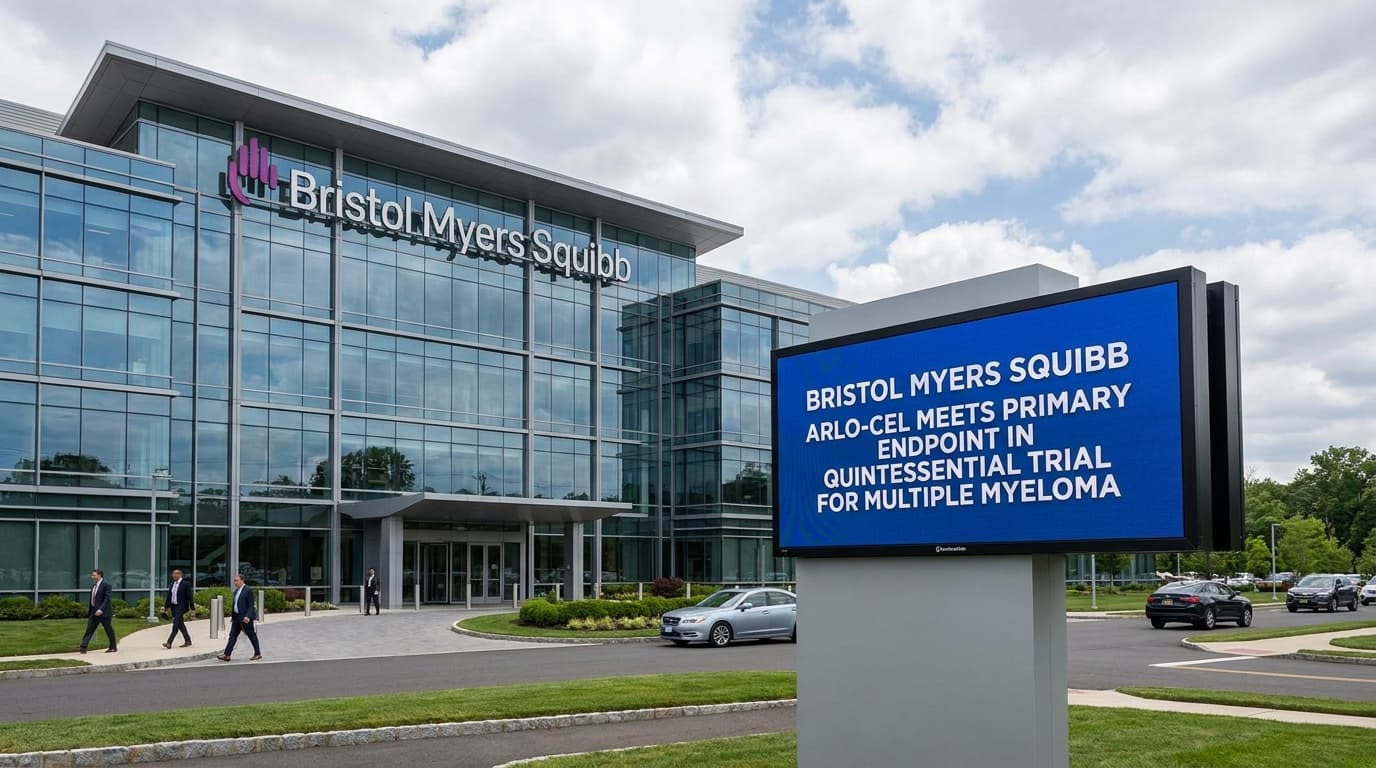
Bristol Myers Squibb said its GPRC5D-directed CAR-T cell therapy arlocabtagene autoleucel, or arlo-cel, met the primary endpoint in the Quintessential trial, advancing the company’s effort to compete in multiple myeloma after patients have already been treated with a BCMA-targeted therapy.
The company reported a hit on the trial’s primary endpoint, which assessed overall response rate, and on the key secondary endpoint of complete response rate. It has not yet shared the data behind those outcomes or disclosed results for other secondary endpoints including progression-free survival and overall survival.
The data
Quintessential treated patients who had previously received an immunomodulatory inhibitor, a proteasome inhibitor, an anti-CD38 therapy and a BCMA-targeted therapy. That matters because BCMA-directed CAR-T cell therapies, bispecific T-cell engagers and antibody-drug conjugates have expanded treatment options, but the source notes that patients relapse and eventually need a treatment aimed at a different target.
Bristol Myers has said it will present Quintessential data at an upcoming medical meeting. Until then, the announcement functions more as a positioning update than a full efficacy readout.
The commercial picture
The comparison investors and clinicians are likely to make is against Johnson & Johnson’s Talvey, a GPRC5DxCD3 bispecific antibody. In the Monumental-1 trial, J&J reported an overall response rate of 72% in a population that had tried a proteasome inhibitor, an immunomodulatory agent and an anti-CD38 antibody, and almost all patients had also received a BCMA-directed T-cell engager.
Early-phase data had suggested arlo-cel might clear that bar while also offering a lower frequency, severity and duration of on-target off-tumor adverse events. That earlier signal supported Bristol Myers’ argument that a one-time cell therapy could have a safety and tolerability edge over continuous treatment with a bispecific antibody. The new Quintessential update keeps that thesis alive, but without detailed results it does not yet prove superiority on efficacy or tolerability.
What to watch
Bristol Myers is already running a phase 3 trial comparing arlo-cel with standard treatment regimens in patients who have received one to three prior lines of therapy, with data expected in 2028. The company has also discussed the potential to seek approval using Quintessential, even after the FDA said last year that it would require CAR-T developers to show superiority over existing treatments to win approval.
That creates the central strategic question: whether a positive single-arm result can open the door to a near-term filing in a niche that is attracting more competition from AbbVie, AstraZeneca, Legend Biotech and Sanofi, while J&J is also advancing a trispecific that engages BCMA and GPRC5D.