
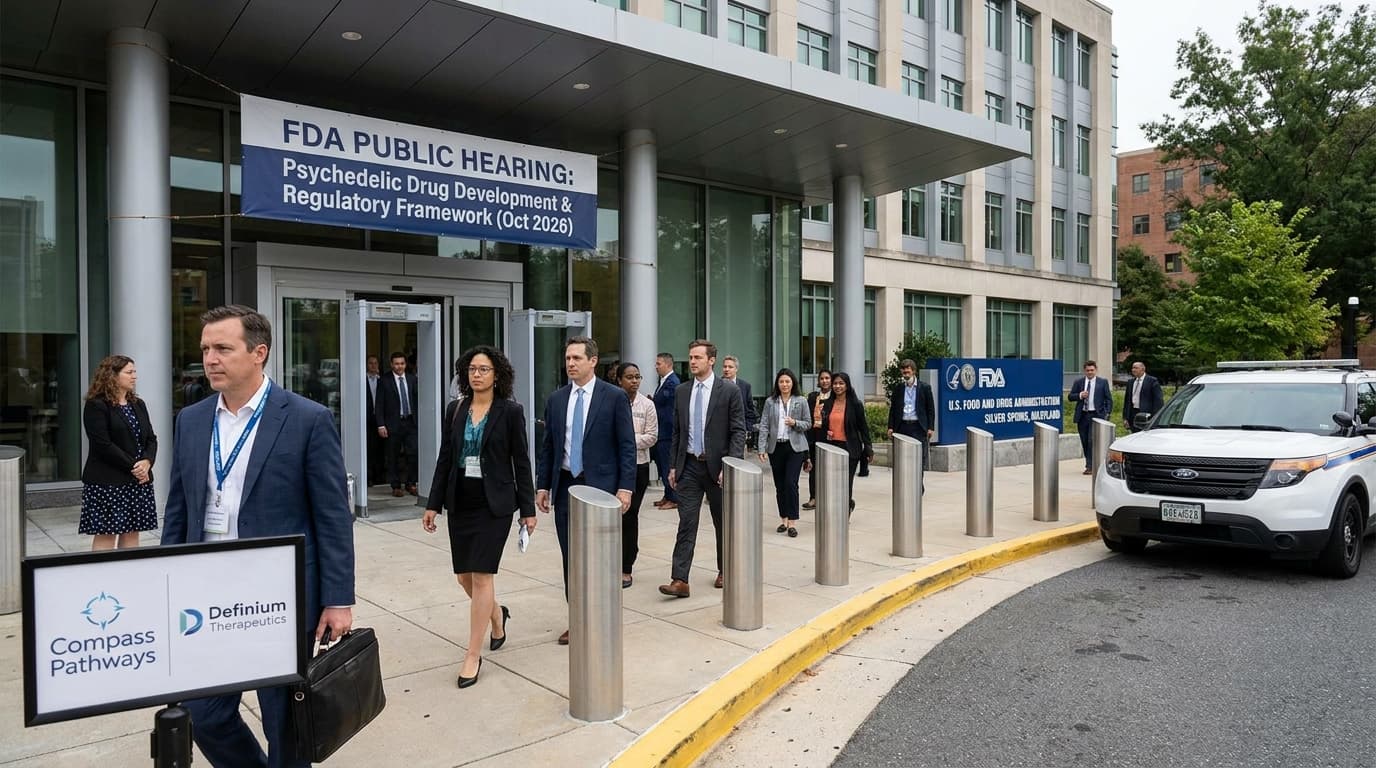

A Monday FDA public hearing on psychedelic drug development is arriving at a moment when the policy environment appears more favorable than it has in years. According to Jefferies, support now extends across patients, doctors, interventional psychiatry centers, the FDA and Department of Health and Human Services, the White House and Veterans Affairs, creating what the firm called an engaged and constructive ecosystem for potential launches in 2027 and beyond.
The near-term readthrough is not just about sentiment. The hearing will cover provider training, patient safety, access issues and best practices for data collection and standardization of psychedelic medications, which suggests the conversation has moved beyond whether the field should advance and toward how it would be operationalized if approvals begin to arrive.
The regulatory setup
The hearing follows a series of actions and statements from FDA officials aimed at loosening restrictions on once illegal substances for therapeutic exploration, while also adding incentives that can speed development. In July, the FDA issued updated guidance for psychedelic drug developers that addressed key challenges in running clinical trials for these compounds.
Last week added another signal. The FDA made Michael Davis and Karim Mikhail the permanent directors of the Center for Drug Evaluation and Research and Center for Biologics Evaluation and Research, respectively, after both had been serving in acting roles. RBC Capital Markets wrote that Davis' appointment would likely be positive for CNS and neuropsychiatry because he has prior experience with psychedelic development through nonprofit work.
Davis also co-authored a Sept. 9 New England Journal of Medicine article titled "FDA’s New Framework for Psychedelic Drugs." The piece cited the ongoing mental health crisis in the U.S. and pointed to the burden of major depressive disorder and post-traumatic stress disorder on veterans and the economy, arguing that psychedelic compounds may offer one path toward better treatments. Between FDA stints, Davis was chief medical officer at Usona Institute, which studies psilocybin and 5-MeO-DMT for mental health.
The broader political context matters as well. In April, President Donald Trump issued an executive order directing HHS and FDA to support advances in psychedelic drug development and regulation. Jefferies said the timing of Monday's hearing implies that effort has entered a new phase and makes the coordinated federal push look more substantive than rhetorical.
Companies nearest the window
Compass Pathways appears to be the company most directly exposed to a favorable regulatory shift. Jefferies said COMP360, its psilocybin-based depression candidate, is widely expected to reach the market first, potentially through the new Commissioner’s National Priority Voucher program by the end of this year or in early 2027. The same analysts previously said they were 75% to 85% confident the FDA would approve the treatment based on Phase 3 data released in July that showed durability.
Definium Therapeutics is another name tied to the hearing's near-term relevance. The company has reported positive late-stage data this year for DT120, an oral LSD candidate being developed for generalized anxiety disorder and major depressive disorder. RBC said companies with near-term FDA reviews, including Compass and Definium, could benefit particularly from Davis' appointment.
The signal for investors and developers is that the current debate is becoming less about theoretical acceptance and more about launch readiness. If the federal stance remains supportive, companies with advanced programs may have an opportunity to shape training, safety and data standards while regulators are still defining them.
The commercial picture
Jefferies expects psychedelics to build on the commercial precedent set by Johnson & Johnson's esketamine-based depression treatment Spravato, which posted $584 million in second-quarter sales and could surpass $2 billion for the full year. J&J has previously told BioSpace that it does not consider Spravato a classic psychedelic, but analysts still use it as a reference point for how payers and providers may respond to this treatment area.
Large-company dealmaking is another marker that the field is no longer niche. The source cited Eli Lilly's up to $3.8 billion purchase of AtaiBeckley in July, AbbVie's $1.2 billion acquisition of Gilgamesh Pharmaceuticals in August 2025, and Otsuka's acquisition of Transcend Therapeutics, worth more than $1 billion with milestones, which closed in June.
Taken together, the policy moves and acquisition activity point to a market that is being prepared on two fronts at once: regulatory architecture from Washington and balance-sheet validation from larger drugmakers. Monday's hearing does not decide approvals, but it does test whether the government is ready to convert broad support into rules that companies can actually build around.


