Spyre Therapeutics has reported a phase 2 win for SPY003 in ulcerative colitis, completing positive induction readouts for the third leg of its inflammatory bowel disease program. With earlier successes from SPY001 in April and SPY002 in June, the company has now produced supportive monotherapy data across all three antibodies in its Skyline platform.
That matters less as a one-off efficacy update than as a test of Spyre’s broader development model. The company is trying to assemble a modular IBD portfolio that can move from standalone agents into combinations, with the commercial upside depending on whether those pairings can outperform established therapies in a crowded market.
The data
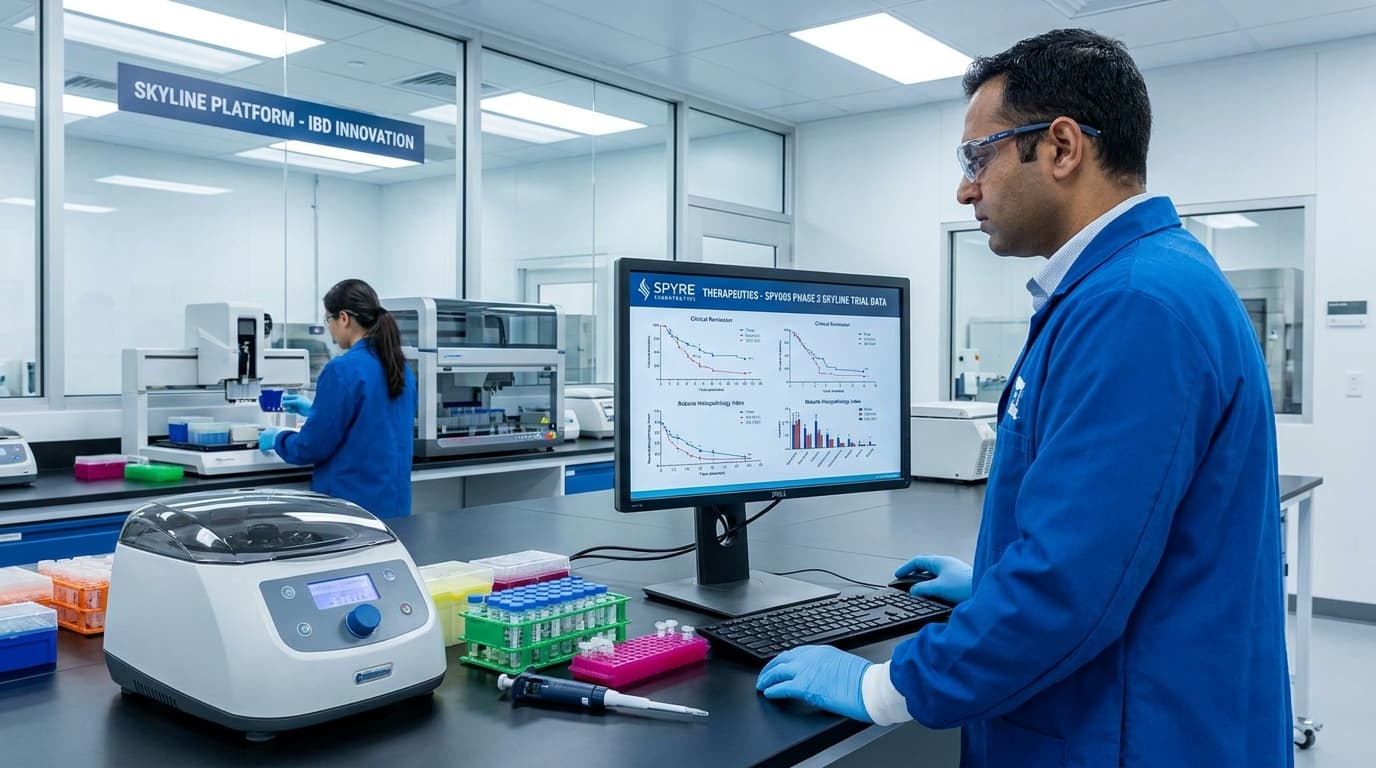
SPY003, an anti-IL-23 antibody, met primary and secondary endpoints in Part A of Skyline, a study in 44 patients with ulcerative colitis. According to Spyre, the drug showed a significant reduction in disease activity and induced clinical remission.
More specifically, SPY003 produced a 10-point reduction from baseline in Robarts Histopathology Index score by Week 12. Spyre said secondary endpoints included clinical remission by modified Mayo Score of 20% and endoscopic improvement of 30%.
On safety, 19 of the 44 enrolled patients experienced treatment-related adverse events. None led to discontinuation. Three adverse events were categorized as serious, but none were considered related to the drug.
Why this result matters
Skyline is a two-part induction and maintenance platform trial in moderately-to-severely active ulcerative colitis built around three investigational antibodies: SPY001, an anti-α4β7 antibody; SPY002, an anti-TL1A antibody; and SPY003. Part A tested a single dose level for each investigational monotherapy. Part B will evaluate two dose levels of the monotherapies and combinations.
The significance of the SPY003 readout is that it rounds out the monotherapy package Spyre needs before combination data arrive. A three-pronged approach only creates strategic value if each component shows enough activity and tolerability to justify being combined later. Spyre now has that early support across α4β7, TL1A and IL-23.
The competitive context
Ulcerative colitis already has several therapies with different mechanisms, including Takeda’s Entyvio, AbbVie’s Skyrizi and Rinvoq, and Johnson & Johnson’s Tremfya. Spyre’s challenge is therefore not proving that these pathways matter, but showing that its versions, alone or together, can deliver a better efficacy, safety or dosing profile than current options.
That is why the next inflection point is not another monotherapy readout. Spyre has said combination data are expected in 2027, and those results will determine whether its platform translates into a differentiated IBD strategy rather than a collection of credible but familiar targets.