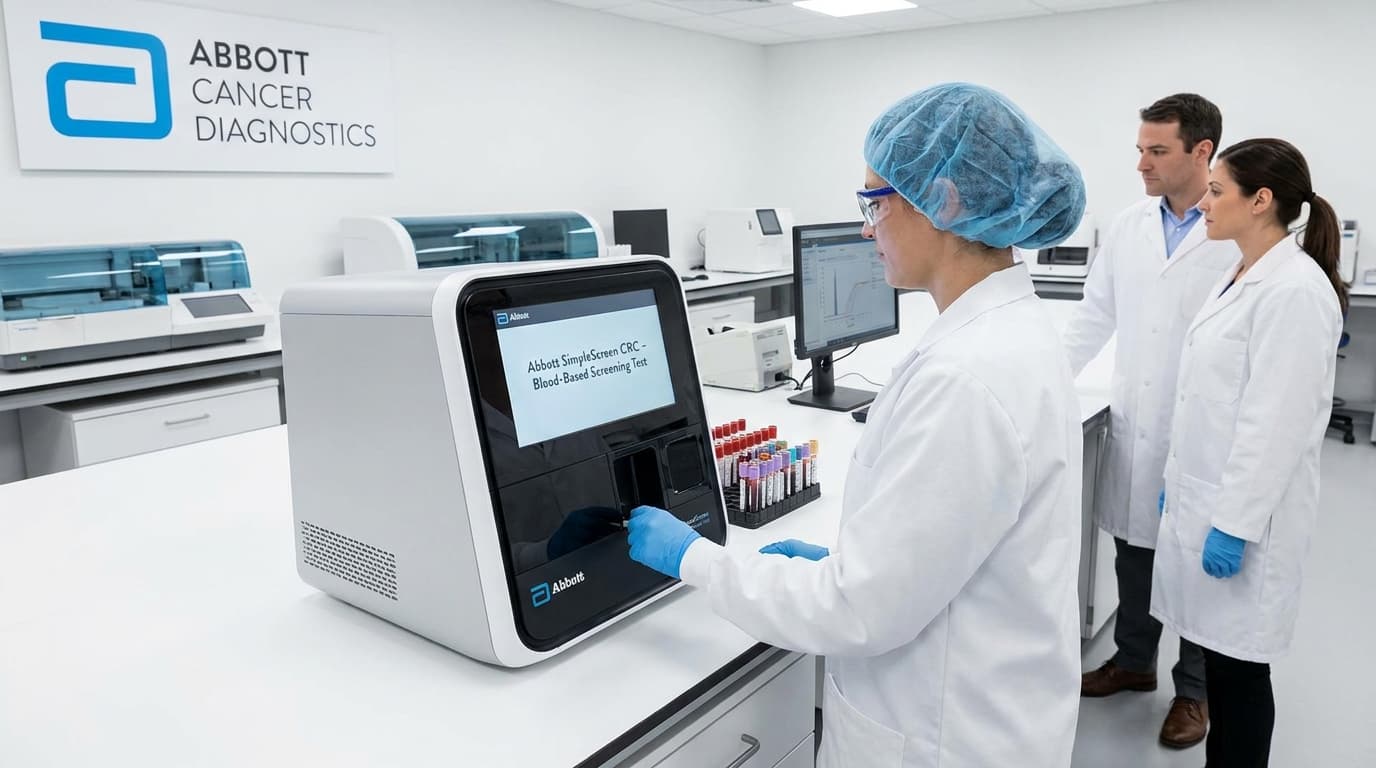
Abbott is beginning the U.S. commercial launch of SimpleScreen CRC, an FDA-approved blood-based colorectal cancer screening test for adults age 45 and older who are at average risk for the disease. The test was developed and manufactured by Freenome and is being sold exclusively by Abbott.
The launch adds a blood-based option to Abbott’s colorectal cancer screening portfolio after Abbott’s acquisition of Exact Sciences earlier this year. Abbott said it is now the only company offering both stool and blood-based colorectal cancer screening options, a positioning that matters because the company is not presenting the blood test as a replacement for colonoscopy or stool testing, but as another way to reach people who have stayed outside the screening system.
The data
SimpleScreen CRC detects signals associated with colorectal cancer by monitoring circulating cell-free DNA in blood. Abbott said the test was evaluated in PREEMPT CRC, which it described as the largest prospective clinical validation study conducted to date for a blood-based colorectal cancer screening test.
The study enrolled more than 48,000 asymptomatic, average-risk adults ages 45 to 85 who were scheduled for screening colonoscopy. In a prespecified analysis adjusted to match the U.S. Census, SimpleScreen CRC showed 81.1% overall sensitivity for colorectal cancer, including 63.5% sensitivity for Stage I colorectal cancer, 13.7% sensitivity for advanced precancerous lesions, and 90.4% specificity for advanced colorectal neoplasia. Abbott summarized that performance as correctly detecting about eight in 10 colorectal cancers while correctly producing negative results for nine in 10 people without colorectal cancer or advanced precancerous lesions.
The commercial picture
Abbott is targeting a specific gap in screening behavior rather than trying to reorder current screening guidelines. The source says colonoscopy remains the most reliable way to screen for colorectal cancer, and Abbott also said the American Cancer Society recommends several preferred screening options, including stool-based tests and direct visual tests. According to Abbott, blood-based screening should be recommended only for individuals who decline or do not complete a preferred screening option.
That framing is central to the product’s commercial logic. In 2025, the CDC estimated that 28 million Americans ages 45 to 75 had never been screened for colorectal cancer. If even a fraction of that group is more willing to complete a blood draw than a colonoscopy or stool-based test, the test’s value is less about outperforming incumbent methods and more about reducing non-participation.
Abbott tied the launch to that access problem in comments from clinicians and executives. Dr. Folasade May of UCLA Health said expanding screening methods gives clinicians another opportunity to address barriers and may help patients who have declined preferred approaches finally take action. Jake Orville, senior vice president of Abbott’s cancer diagnostics business, said the company’s goal is to connect each person with an appropriate screening test, prioritizing the Cologuard Plus test for average-risk patients, colonoscopy for those who need it, and SimpleScreen CRC for appropriate patients who decline or do not complete a preferred screening test.
The broader signal is that blood-based cancer screening can find a commercial foothold without displacing standard methods if it is positioned as a completion tool for missed patients. For Abbott, that makes the launch as much a distribution and portfolio strategy as a product introduction.