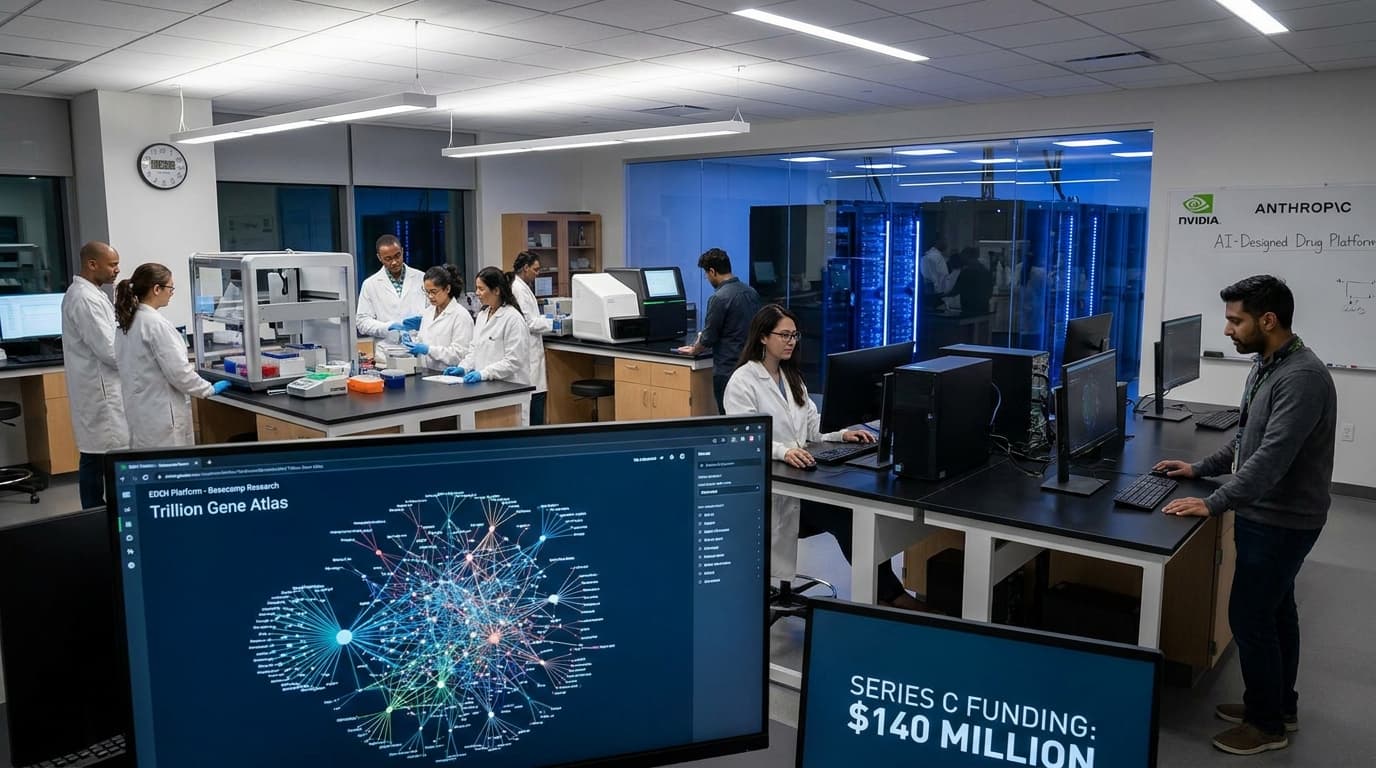
Basecamp Research said it has closed a $140 million series C fundraising to advance a pipeline of therapies designed using machine learning models. The company described the round as oversubscribed and said it was led by S32, with participation from NVIDIA, Anthropic and senior biopharma leaders including Roche Vice Chairman André Hoffmann.
The financing is notable less for the cash amount alone than for who joined it. The mix of technology backers and established biopharma names points to continuing demand for platforms that present computation as a central part of how drug candidates are generated, not just as an add-on tool for screening or analytics.
The Platform Bet
Basecamp’s model, EDEN, is trained on the Trillion Gene Atlas, which the company launched in March and calls the largest biological dataset for training AI models. The Atlas was built in collaboration with companies including NVIDIA and Anthropic.
EDEN is designed to generate potential drug candidates across peptides, enzymes, and cell and gene therapies. Basecamp said the new financing will support investigational medicines produced through that system, with an initial focus on in vivo cell therapies that rewire a patient’s cells from inside the body.
That choice of initial focus is commercially important. In vivo cell therapy is a category where better design, delivery and customization could matter as much as raw target selection, giving AI platforms a chance to argue they improve development efficiency and expand what is practical to build.
What The Round Signals
Hoffmann said in a statement that “personalized, AI-designed therapeutics represent the next transformation” in biotechnology. The broader market context in the source supports why investors are leaning in: some of the biggest biotech financings this year have gone to AI-centric companies, including Isomorphic Labs’ $2.1 billion series B in May and Enveda’s $311 million series E on Wednesday.
The signal from Basecamp’s raise is that investors are still funding AI drug discovery when the pitch moves beyond software services and toward owned therapeutic programs. That raises the bar for companies in the category: capital is available, but increasingly for groups claiming their models can turn proprietary biological data into actual medicines.