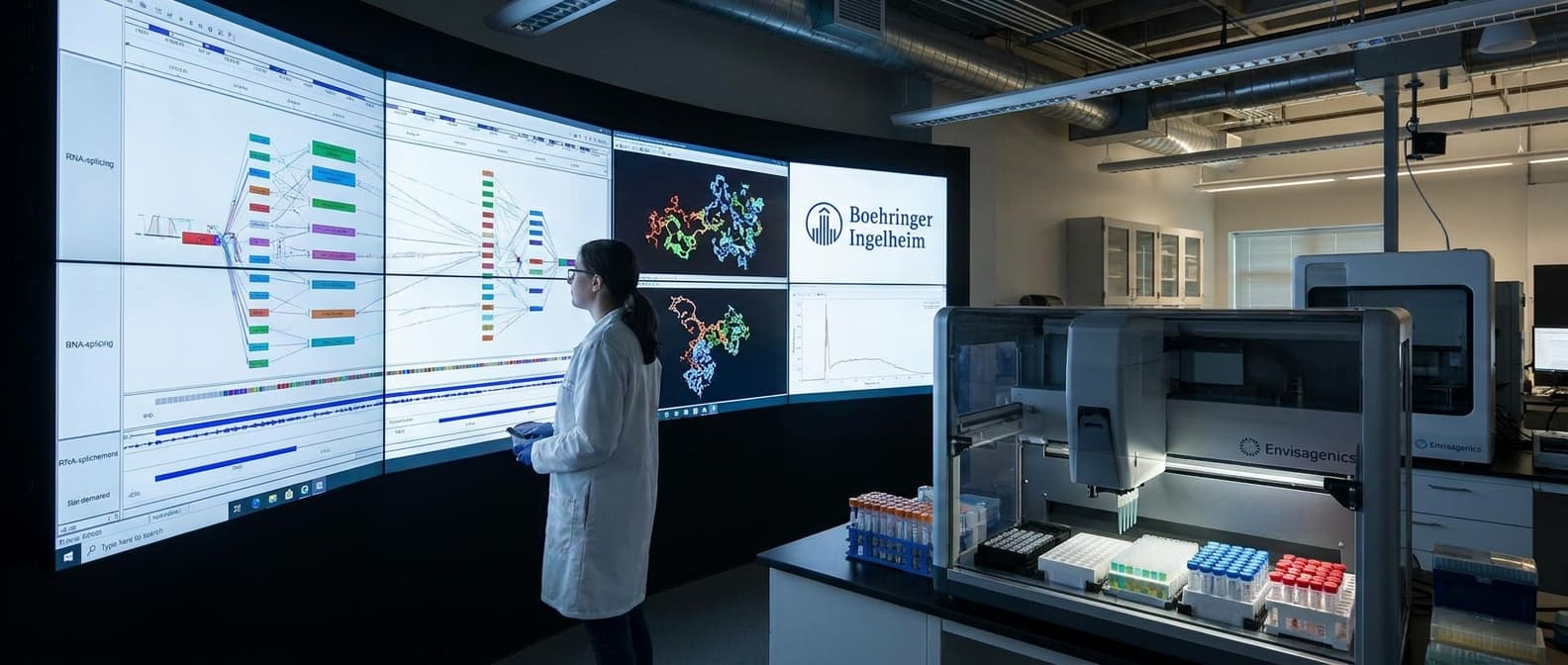
Boehringer Ingelheim and Envisagenics have agreed to a potential $1 billion multi-year oncology collaboration built around tumor-specific targets identified with Envisagenics’ SpliceCore platform. Under the pact, Boehringer will analyze previously identified targets and validate their therapeutic potential across antibody-drug conjugates, T-cell engagers and multi-specific antibodies.
The agreement pairs Boehringer’s interest in expanding its oncology pipeline with Envisagenics’ focus on RNA splicing, an area the companies are presenting as underexplored for target discovery. Boehringer global head of oncology research Mark Petronczki said alternative RNA splicing offers access to a “largely unexplored target space,” while Envisagenics CEO Maria Pineda said the approach is designed to find protein isoforms present in tumors but absent from normal tissues, with the aim of widening the therapeutic window and reducing off-target effects.
Why this target class matters
SpliceCore uses artificial intelligence and large-scale transcriptomics to screen more than 14 million splicing events and prioritize potential targets, while predicting disease specificity, patient prevalence and therapeutic suitability. The platform focuses on alternative RNA splicing, a process that can generate malformed or dysfunctional proteins and create tumor-specific isoforms that conventional target screens may miss.
That matters commercially because Boehringer is not just buying access to a software tool. It is seeking targets that could fit several high-value oncology modalities. If the platform can reliably identify clean tumor-restricted biology, it could help improve target selection at a point in development where failure rates remain high.
Deal structure and strategic use of proceeds
Envisagenics did not disclose further payment details, but Pineda told Fierce that upfront and milestone payments will be used to take the company’s lead internal CNS candidate into the clinic. She highlighted ENV-375, a preclinical asset for ALS patients, as one program that would benefit from the partnership by moving into the clinic.
Boehringer will have the option to exclusively license selected targets for further development and commercialization. For Envisagenics, that keeps the platform-partnership model intact while preserving room to build its own pipeline. Pineda said the deal gives the company runway to advance its platform and internal programs, scale the company and look for financing partners for its next raise.
The collaboration also fits a broader pattern in Boehringer’s external innovation strategy. The company signed a $15 million oncology and autoimmune AI partnership with Immunai in June 2025 to discover targets on dysfunctional T cells, after another deal with OpenProtein.AI to develop specialized antibodies. Envisagenics, for its part, is extending a set of SpliceCore oncology collaborations that already includes Bristol Myers Squibb, Johnson & Johnson and Biogen.
The signal from this deal is that AI target-discovery platforms are being judged less on headline model claims than on whether they can surface biology that maps cleanly onto druggable modalities. Envisagenics is positioning RNA splicing as one such niche, and Boehringer is paying for optionality across multiple therapeutic formats rather than committing to a single asset at the outset.