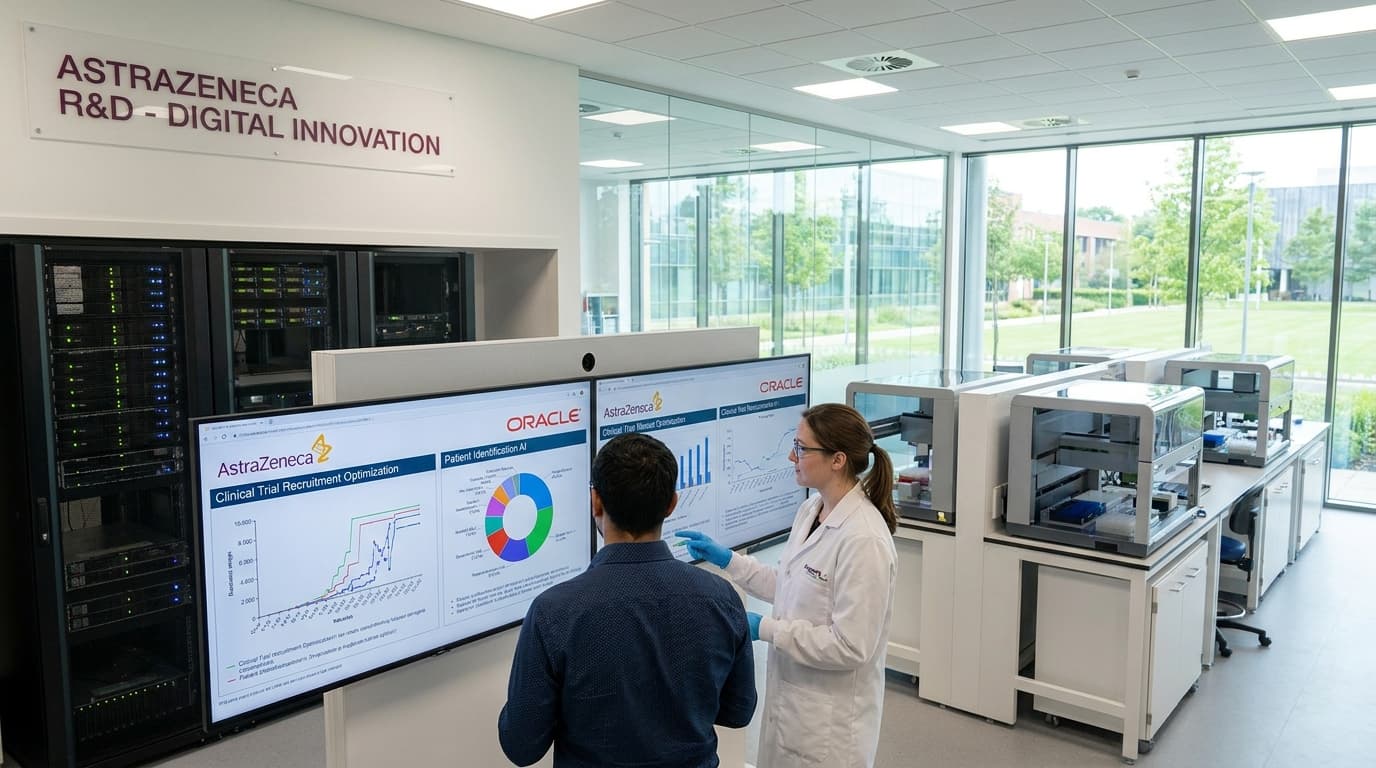
AstraZeneca has entered a non-binding agreement with Oracle to explore how modern applications and AI could improve clinical-trial efficiency and success, with an early emphasis on helping care teams identify eligible patients sooner. The companies said the initial disease areas under consideration range from oncology and rare diseases to cardiovascular, renal and metabolic indications, as well as respiratory and immunology.
The structure of the announcement matters. This is not a product launch or a disclosed revenue-generating platform deployment. It is an exploratory collaboration around selected use cases, which makes the near-term signal less about immediate operating impact and more about where AstraZeneca sees friction in development: patient finding, trial execution and evidence generation.
What The Collaboration Covers
According to the Oct. 20 release, AstraZeneca and Oracle will explore use cases that could improve clinical-trial efficiency and success by leveraging modern applications and AI. In practice, the companies said this could support care teams in identifying eligible patients earlier in the trial process.
AstraZeneca also linked the collaboration to safety monitoring and earlier diagnosis. Chief Digital, Data and AI Officer Anne-Claire Gerbaldi said the companies believe they can support smarter clinical trials, strengthen safety monitoring, and help ensure patients are diagnosed sooner and receive the right care.
Oracle CEO Mike Sicilia framed the opportunity around better use of data in healthcare, saying the partnership could help accelerate research, connect more patients to clinical trials and bring relevant insights into care faster.
Where It Fits In AstraZeneca’s AI Strategy
The Oracle agreement extends a broader AstraZeneca push to use AI as an operating tool across discovery, development and manufacturing. The company has developed an open-source generative AI framework called Reinvent, which it said has halved the time needed to identify molecular structures that could become potential new medicines.
AstraZeneca has also continued to use its quantitative continuous scoring algorithm platform to identify patients most likely to respond to treatment. On the manufacturing side, the company has said it wants its AI Development Agent ultimately to halve chemistry, manufacturing and controls development time.
This year, AstraZeneca also signed agreements with Owkin to use its autonomous AI Scientist platform and used Evinova’s AI-native platform in an effort to speed clinical development. Against that backdrop, the Oracle pact looks less like a standalone experiment and more like another layer in a multipoint build-out of digital infrastructure around development bottlenecks.
The Commercial Signal
Recruitment has long been one of the most persistent constraints in clinical development, so the commercial rationale here is straightforward even if the operational details remain thin. If AI helps identify eligible patients earlier, sponsors can potentially reduce delays, improve trial execution and increase the probability that studies reach interpretable endpoints on schedule.
For Oracle, the deal is also a credibility play in life sciences. The company launched its Oracle Life Sciences AI Data Platform at the start of the year and said it uses generative AI, agentic reasoning and customizable AI agents to help pharmaceutical, medical device and research organizations accelerate drug development, clinical trials, safety monitoring and commercialization efforts.
Pascal Soriot described the agreement as a unique collaboration that brings healthcare and AI leaders together at global scale to accelerate the journey from medicine discovery to patient care. The more durable test, though, will be whether that framing turns into measurable improvements in enrollment, monitoring and evidence generation rather than another broad AI partnership with limited operational proof.