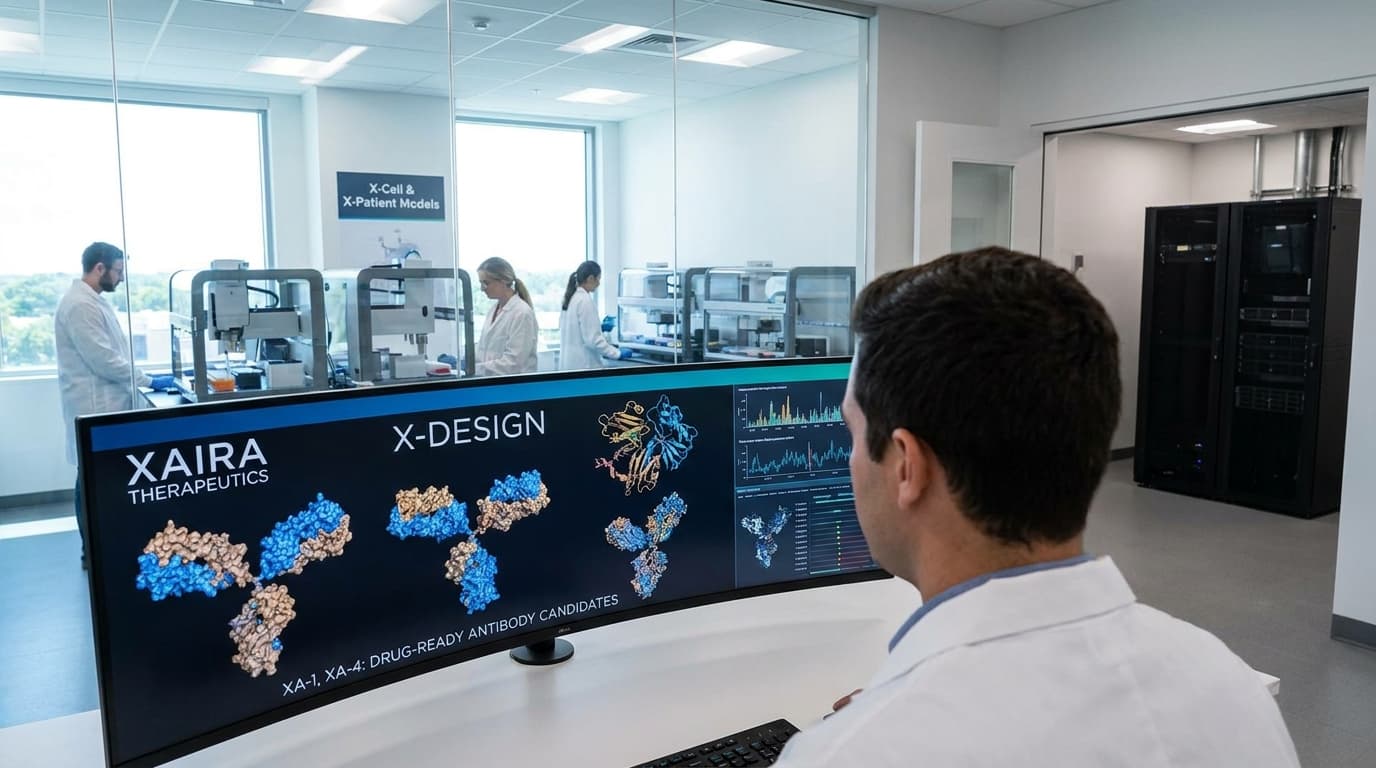
Xaira Therapeutics has provided its first concrete look at the pipeline behind one of biotech’s largest recent AI financings, pairing two early candidates with a more detailed description of its antibody design platform, X-Design. The company launched in 2024 with $1 billion in funding, then largely stayed out of view while building what CEO Marc Tessier-Lavigne said is a model that can design antibodies that are drug-ready from the start.
The first named assets are XA-1 and XA-4. Xaira is not disclosing their targets, but Tessier-Lavigne said XA-1 is a cancer candidate created from scratch in seven weeks, while XA-4 is intended to drug a G-protein coupled receptor that was otherwise “seemingly intractable” to target. He said both programs focus on targets where Xaira has “great conviction” but where prior attempts to make antibodies have failed.
The Platform Pitch
X-Design is one of three models Xaira now highlights alongside X-Cell and X-Patient. Tessier-Lavigne said the company is trying to address three stages of drug discovery: identifying targets, making the drugs, and identifying the patients most likely to respond. In that framing, X-Design is the therapeutic engine, while the other models support target and patient selection.
David Baker, a co-founder of Xaira, said in a statement that some disease-driving proteins have remained off-limits to antibody drugs because traditional discovery approaches failed on them. His argument for X-Design is that AI is beginning to design those antibodies from scratch, which could widen the reachable target set rather than simply speed up work on familiar biology.
That distinction matters because AI antibody design is becoming crowded. Fierce listed BigHat Biosciences, Absci, Generate:Biomedicines and Roche subsidiary Chugai among companies pursuing AI-enabled antibody design or optimization. Xaira’s stated attempt to separate itself is not speed alone, though the seven-week timeline for XA-1 is part of the message. Tessier-Lavigne said most AI design work stops at finding hits, molecules that bind, whereas X-Design is built to optimize for drug readiness from the start.
What Xaira Has Actually Shown
The disclosure is still more strategic signal than data package. Xaira also identified XA-2 and XA-3 as preclinical candidates, but it did not provide target details, efficacy data, or timelines for clinic entry for any of the four programs. Tessier-Lavigne said the company plans to advance XA-1 and XA-4 into human studies, but declined to share timing.
Even with those limits, the update does clarify where Xaira appears to be aiming commercially. In a past conversation with Fierce, then-chief operating officer Jeff Jonker said the company was working in immunology and inflammatory diseases. The newly disclosed XA-1 adds cancer to the visible mix. Tessier-Lavigne also said Xaira may eventually partner some assets with larger biopharma companies and is already in active discussions about using its antibody design platform on targets of interest to other companies.
That suggests a hybrid model: internal pipeline creation plus platform partnering. For an AI biotech with unusually deep initial financing, that approach could spread risk across both therapeutic assets and technology access deals, although Xaira did not disclose the status of those talks or the current state of its cash balance.
The Funding Signal
Tessier-Lavigne said Xaira was capitalized so it would not have to return to the capital markets until it had molecules in the clinic, while adding that he would consider raising more money sooner if investor interest or the chance to accelerate or extend programs justified it.
For now, the main takeaway is that Xaira is trying to position AI as a way to improve the odds that an antibody candidate is developable before it reaches the usual attrition points. That is a narrower and more commercially testable claim than broad promises about end-to-end AI drug discovery, but the company still has to show whether that positioning holds up once its programs enter human testing.