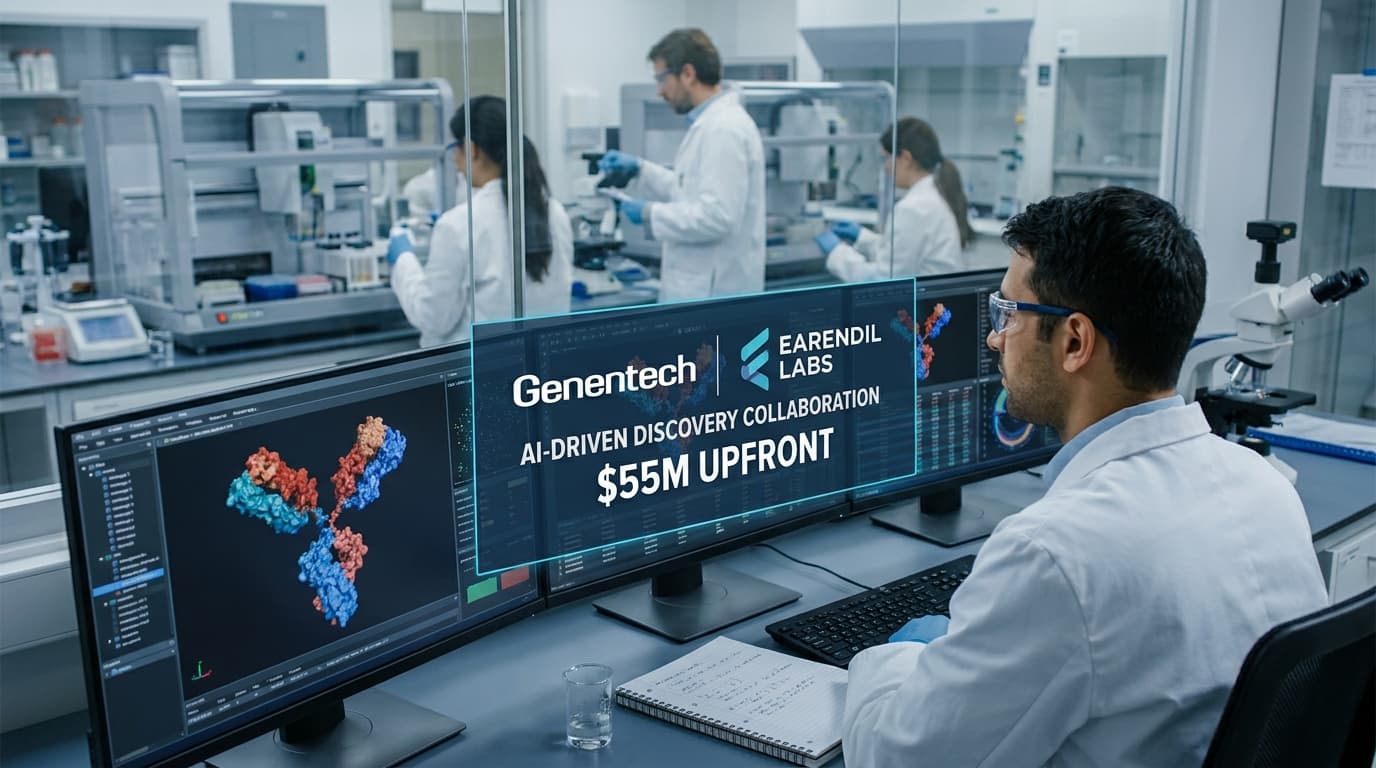
Genentech is paying Earendil Labs $55 million upfront to discover and develop multiple bispecific antibody programs in oncology, in a deal that could exceed $1.5 billion once development, regulatory and sales milestones are included. Earendil is also eligible for tiered royalties on net sales if any resulting products reach market.
The structure is notable as much for what it buys as for what it does not disclose. Neither Genentech nor Earendil has publicly identified the target combinations or target diseases, but the companies have divided responsibilities clearly: Earendil will lead antibody discovery and early clinical work for certain pre-agreed target combinations, and Genentech will take over global clinical development and commercialization.
Why The Deal Stands Out
For Genentech, the agreement adds external bispecific capacity without committing to a single named asset. That gives Roche’s oncology group another way to expand a modality it already knows well while keeping most of the economics tied to downstream progress.
For Earendil, the pact adds another large validation point to a run of sizable partnering activity. BioSpace reported that the company raised $787 million in March in a private funding round backed by Sanofi and the Biotech Development Fund, which is created by Hillhouse and Pfizer, among others. Fierce Biotech separately reported that Earendil has also struck deals with Sanofi and WuXi XDC over the past 18 months, with the Sanofi agreements alone carrying more than $4 billion in potential milestones and the WuXi XDC agreement valued at $885 million.
That pattern matters. AI-enabled platform companies often need repeated transactions to show they are becoming durable discovery suppliers rather than one-off financing stories. Earendil now has another large pharma partner using its antibody-design capability in a different disease setting from Sanofi’s autoimmune and inflammatory work.
The Platform And Portfolio Context
Earendil says its AI-driven platform can generate antibody sequences at massive scale, with tools to predict antibody properties and optimize molecules. In this alliance, that technology is being applied to bispecific antibodies, where design complexity is higher because one molecule is meant to address complementary biology.
Earendil co-CEO Zhenping Zhu said tumor growth and metastasis depend on multiple and interactive pathways, making single-mechanism therapies especially challenged in delivering durable benefit. That rationale helps explain why Genentech chose a multi-program structure rather than a narrower asset license.
The company’s broader pipeline also provides context for the partnership. Fierce said Earendil has built an early-stage pipeline across immunology, inflammation and oncology, with cancer work that includes antibody-drug conjugates, several T-cell engagers, two assets engaging distinct, non-overlapping epitopes of GUCY2C and DLL3, and a CEACAM5xCDH17 bispecific.
What It Signals For Roche
The agreement also fits a broader Roche business-development cadence. BioSpace noted that Roche struck another deal on Thursday with Atavistik Bio for $70 million upfront in a pact that could reach nearly $2 billion, while Fierce noted that Roche recently paid Dualitas Therapeutics $36.5 million to screen more than 300,000 novel bispecific combinations. BioSpace also cited earlier Roche deals with DualityBio and Hanmi Pharm.
Taken together, the Earendil pact suggests Roche is using partnering to widen its shot count in complex biologics rather than relying only on internal invention. In AI discovery, that is where commercial credibility is forming: not in claims that algorithms replace lab teams, but in whether a platform can repeatedly earn upfront cash, retain royalties and move from target selection into programs that large drugmakers are willing to carry through global development.