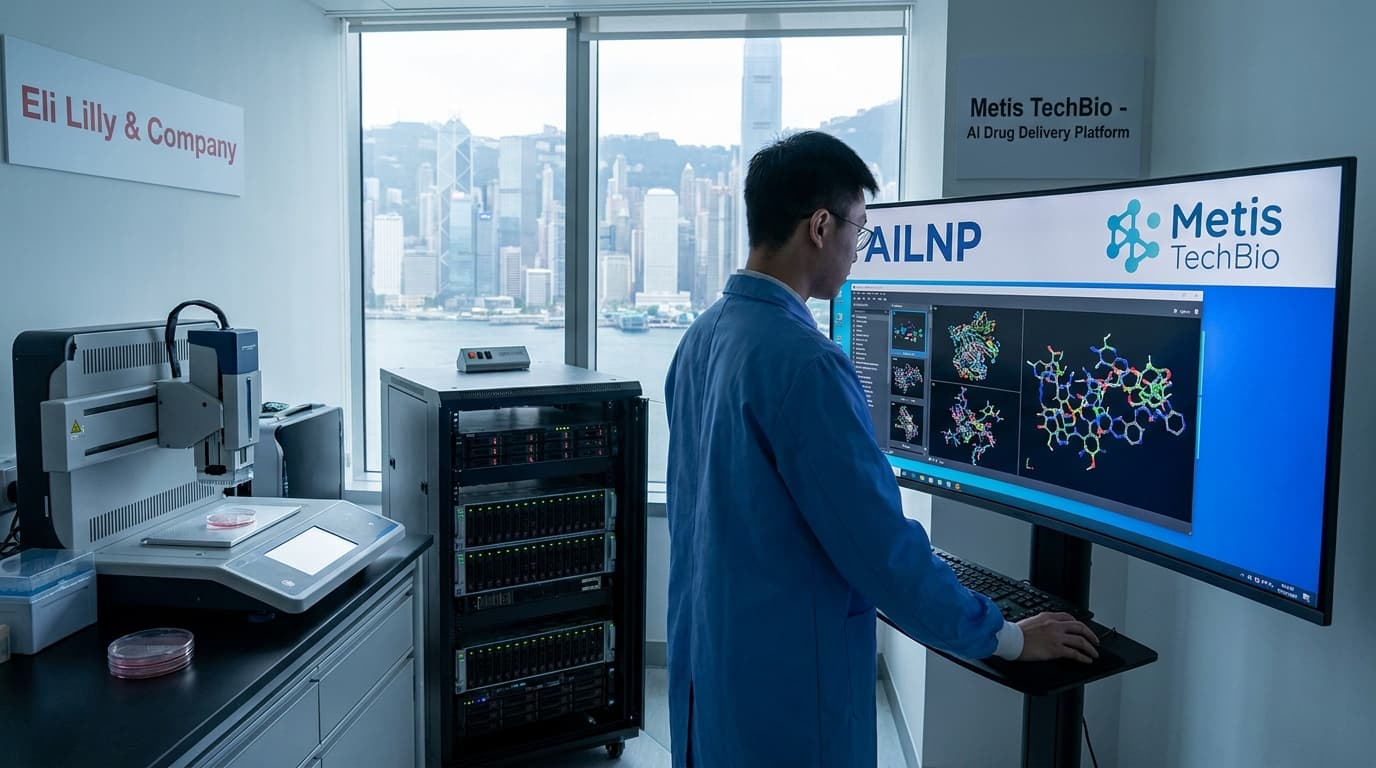
Eli Lilly has formed a partnership with Hong Kong’s Metis TechBio worth up to $1.1 billion, adding an AI drug delivery platform aimed at improving the performance of therapies carried by lipid nanoparticles.
Metis said Lilly will use its ionizable lipid discovery and optimization platform, AiLNP, while Metis receives an upfront payment of “low double-digit millions of U.S. dollars” and becomes eligible for milestone payments and potential royalties on resulting products. The structure matters more than the headline number: Lilly is paying first for platform access, with most of the economics pushed into later development and commercial success.
The platform
The collaboration will center on AiLNP, which Metis describes as the “world's first and only de novo lipid generation algorithm.” According to the company, the platform relies on a large lipid library, end-to-end screening and a lipid language model.
Metis says the goal is to identify particles that can target tissue more efficiently and effectively, reducing development time from in silico to in vivo validation. In practical terms, that positions AI here as a tool for narrowing delivery design choices faster, not as a substitute for experimental work. The commercial appeal is straightforward: better delivery can improve the usable performance of a therapeutic program that might otherwise fall short on distribution, potency or tolerability.
Metis traces its origins to an idea from MIT in 2017. By 2021, the company had raised $86 million in series A financing to support a clinical trial related to delivery of small-molecule and RNA therapeutics.
Why it fits Lilly
For Lilly, the Metis agreement is the latest addition to a broader buildout in two connected areas: drug delivery and AI capability. On the delivery side, this year Lilly also struck deals with QurCan Therapeutics, which focuses on non-viral, polymer-lipid nanoparticle delivery across the blood-brain barrier, and Entos Pharmaceuticals, which uses proteolipid vehicles for neurological delivery. The company has also worked with the University of Texas at Austin on lipid nanoparticle structural stability and performance.
Lilly has also bought capabilities outright, including Verve Therapeutics and Engage Biologics, both of which brought technology for delivery of genetic material. On the AI side, the company has invested in super-computing alongside Nvidia and in AI discovery and development biotech Insilico Medicine.
The signal in the Metis deal is that Lilly appears to be treating delivery as a platform constraint that can shape the value of multiple future programs, especially as the industry expands into more complex therapeutic modalities. That makes an AI-enabled delivery partnership strategically different from a single-asset licensing deal: if the platform works as intended, its impact could extend across a pipeline rather than one product.