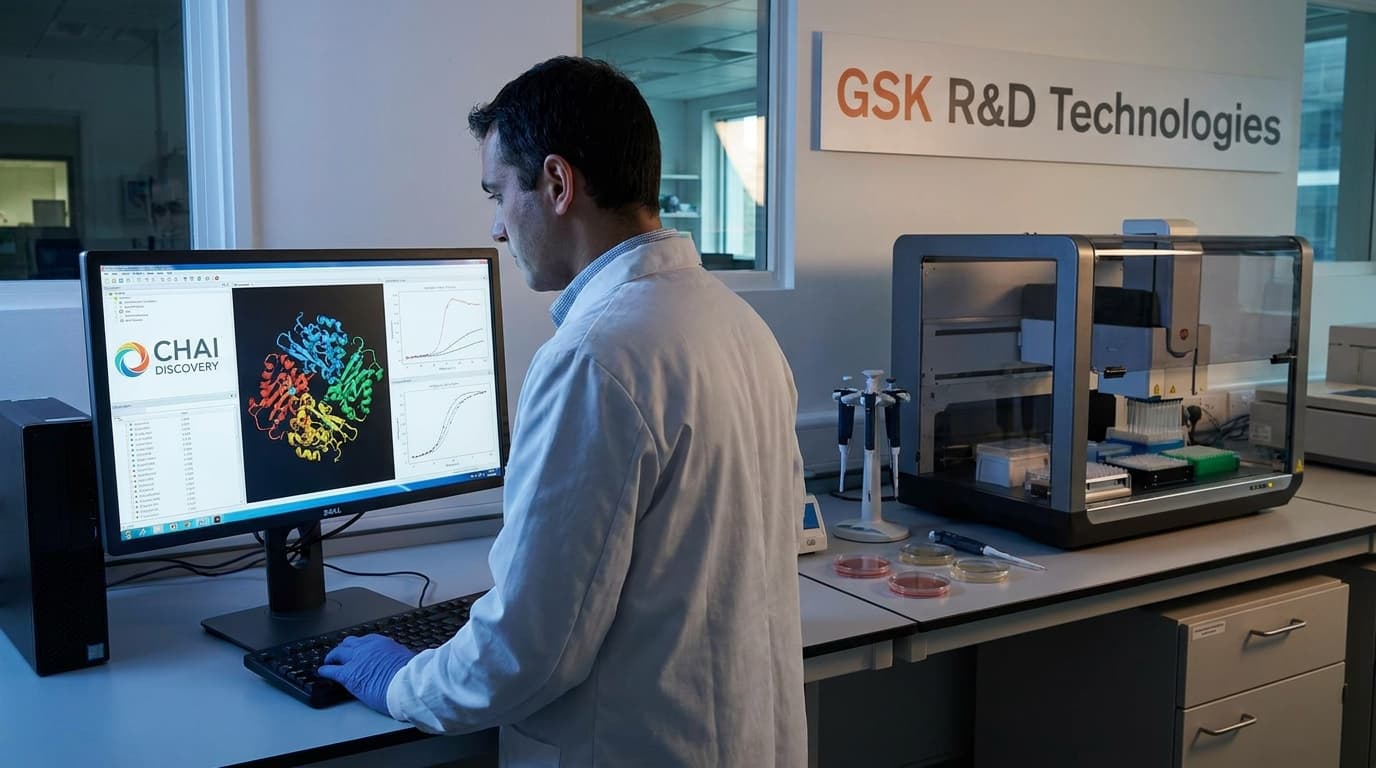
GSK has signed on to use Chai Discovery's protein-folding and design models after an internal evaluation that, according to Chai, produced binders to all tested targets in GSK wet-lab experiments. Christopher Austin, GSK's senior vice president of R&D technologies, said the company evaluated the models across a panel of diverse targets and saw designs with strong binding affinities.
That makes the announcement more meaningful than another generic AI partnership release. Chai's central challenge has not been visibility; the San Francisco company has already raised a $400 million series C round and built relationships with Bristol Myers Squibb, Eli Lilly, Novartis and Pfizer. The harder step is showing that model outputs survive contact with experimental biology inside a large drugmaker's research workflow.
What GSK evaluated
Chai said the models generated designs to GSK targets zero-shot, without target-specific training. The company did not disclose the number of targets or the terms of the deal, but the reported result matters because it suggests the platform was tested on problems relevant enough for GSK to run internal validation rather than simply licensing access on promise alone.
Austin said Chai's technology complements GSK's internal models, which the company continuously retrains against its own wet-lab data, to help accelerate discovery of potential new medicines. That framing is important for understanding where these tools are landing commercially. Large drugmakers are not treating external AI platforms as replacements for internal discovery groups; they are layering them into existing model-and-experiment loops to improve decision quality and hit generation.
Why this matters for Chai
Chai has publicized technical progress through preprint papers. The company linked its second model to a 16% hit rate in fully de novo antibody design and said the resulting antibodies showed drug-like properties. It has also said Chai-2 could design antibodies against six GPCRs.
The newest model, Chai-3, was designed to achieve high target success rates and binding affinities, including on challenging targets. The GSK agreement suggests pharma buyers are now judging Chai less by benchmark-style claims and more by whether the system can produce workable molecules against their own targets.
The commercial signal
The limitation remains the same: none of this is clinical validation. Drug development timelines mean evidence that Chai has promising technology has not yet translated into proof in patients. But customer concentration among major pharma companies can still be a leading indicator. If several large companies continue to test the platform across target classes and keep finding wet-lab activity, Chai strengthens its position as an enabling layer in early discovery rather than a one-off AI story tied to a single flashy result.
GSK has already signaled a broader interest in this category. Back in May, CEO Luke Miels told journalists that the "number one priority for the usage of AI is the innovation dimension." Since then, the company has also signed a $110 million deal with Relation focused on generating large-scale human cellular perturbation data and deploying them into models.
Taken together, the Chai and Relation moves suggest GSK is buying into different parts of the AI discovery stack at once: one centered on molecular design and one centered on data generation and model building. For Chai, landing GSK after internal wet-lab validation is a stronger commercial message than adding another logo alone, because it implies the platform cleared an experimental bar that sophisticated buyers increasingly expect before expanding use.