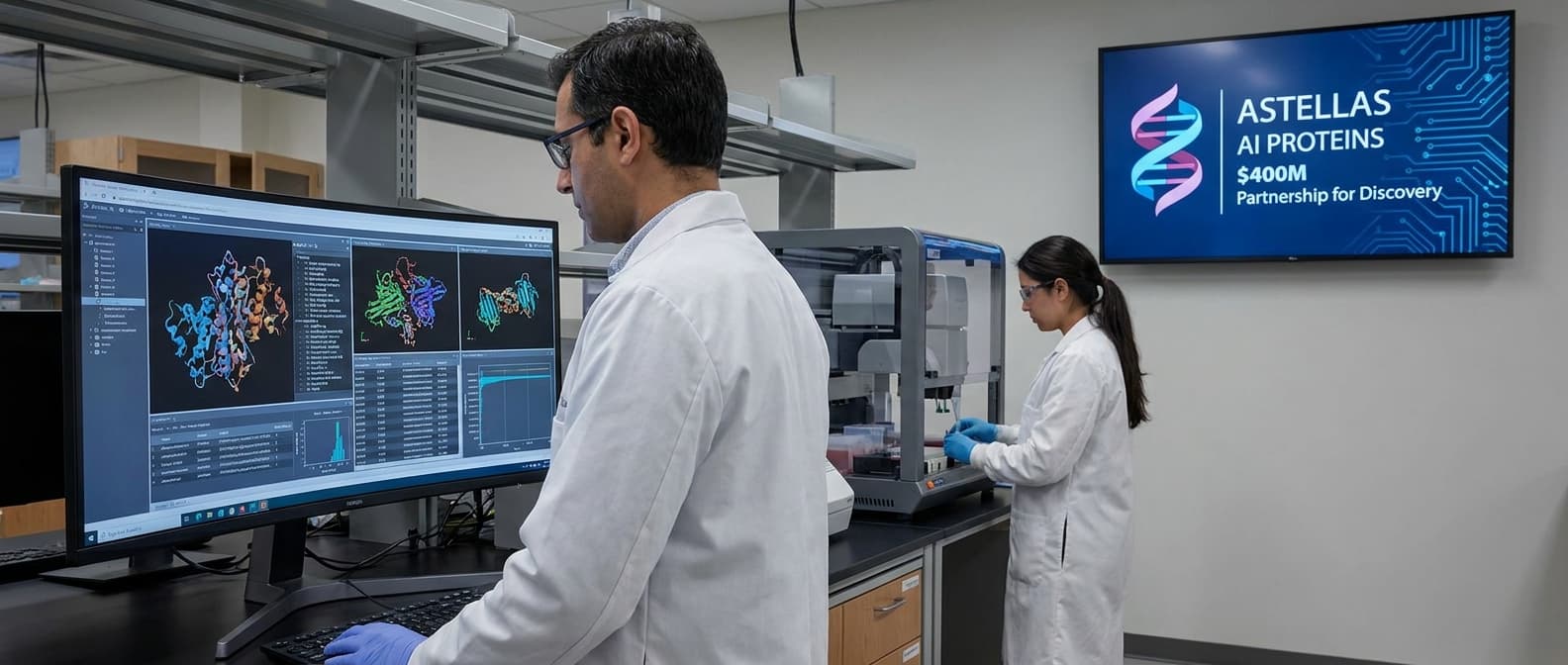
Astellas Pharma has signed AI Proteins to a computational drug discovery partnership that could be worth more than $400 million, adding another external platform to its effort to strengthen the front end of its pipeline. The deal gives Astellas access to AI Proteins’ de novo miniprotein design technology, while leaving development, regulatory processing and commercialization in Astellas’ hands.
The structure says as much about Astellas’ strategy as the headline value. With Xtandi, its blockbuster cancer drug, generating $6 billion in sales last year and an upcoming patent cliff approaching, the company has been arguing for longer-term investment in discovery rather than relying on conventional business development to patch future revenue gaps. This agreement fits that framing: it is a platform access deal aimed at producing future candidates, not an acquisition of late-stage assets.
The Deal And The Platform
According to the source, AI Proteins will receive an undisclosed upfront fee, with milestones taking the potential value of the collaboration to north of $400 million. Astellas will be responsible for any downstream development work, regulatory processing and commercialization of assets that emerge.
AI Proteins’ pitch is that it can design miniproteins from scratch rather than starting with biologic molecules borrowed from nature. The company said its computational design platform has produced binding activity “beyond what’s possible with traditional nature-derived biologics.” CEO and founder Chris Bahl said the idea is to specify what a medicine needs to do and then build a molecule to do that task precisely.
For Astellas, the attraction is not just AI as a label but the chance to widen its modality base in early research. Morten Sogaard, senior vice president of Astellas Innovation Lab, said the collaboration is meant to provide access to novel biology, differentiated technologies and new therapeutic possibilities, with the goal of accelerating discovery of high-quality therapeutic candidates.
Why It Matters Commercially
Astellas’ AI push predates this deal. The company began bringing AI into its development processes in 2019 through what the source described as a “human-in-the-loop” platform for operationalizing data collection and research. Adding AI Proteins suggests Astellas is using AI selectively where it may improve candidate generation and decision quality, rather than presenting it as a replacement for the rest of drug development.
That distinction matters because this is still an early-discovery bet. There are no named targets, no disclosed therapeutic areas, and no identified lead assets in the announcement. The immediate value for Astellas is optionality: if the platform can generate differentiated binders, the pharma gets a larger set of shots on goal before it commits major clinical capital.
The partner choice also comes with some external validation. AI Proteins previously signed a $400 million deal with Bristol Myers Squibb at the end of 2024, entered an R&D collaboration with Vivtex earlier that year, and has explored radioligand therapies with the University of Missouri. Its most recent financing was a $41.5 million Series A in November 2025, following an $18.2 million seed round in 2022.
For investors and competitors, the signal is that Astellas is leaning further into platform sourcing to rebuild future pipeline depth. If the industry’s next phase of AI adoption is less about broad claims and more about specific molecular design workflows, this kind of partnership is where that shift shows up first: upstream, milestone-heavy, and tied to the hard problem of producing candidates worth advancing.