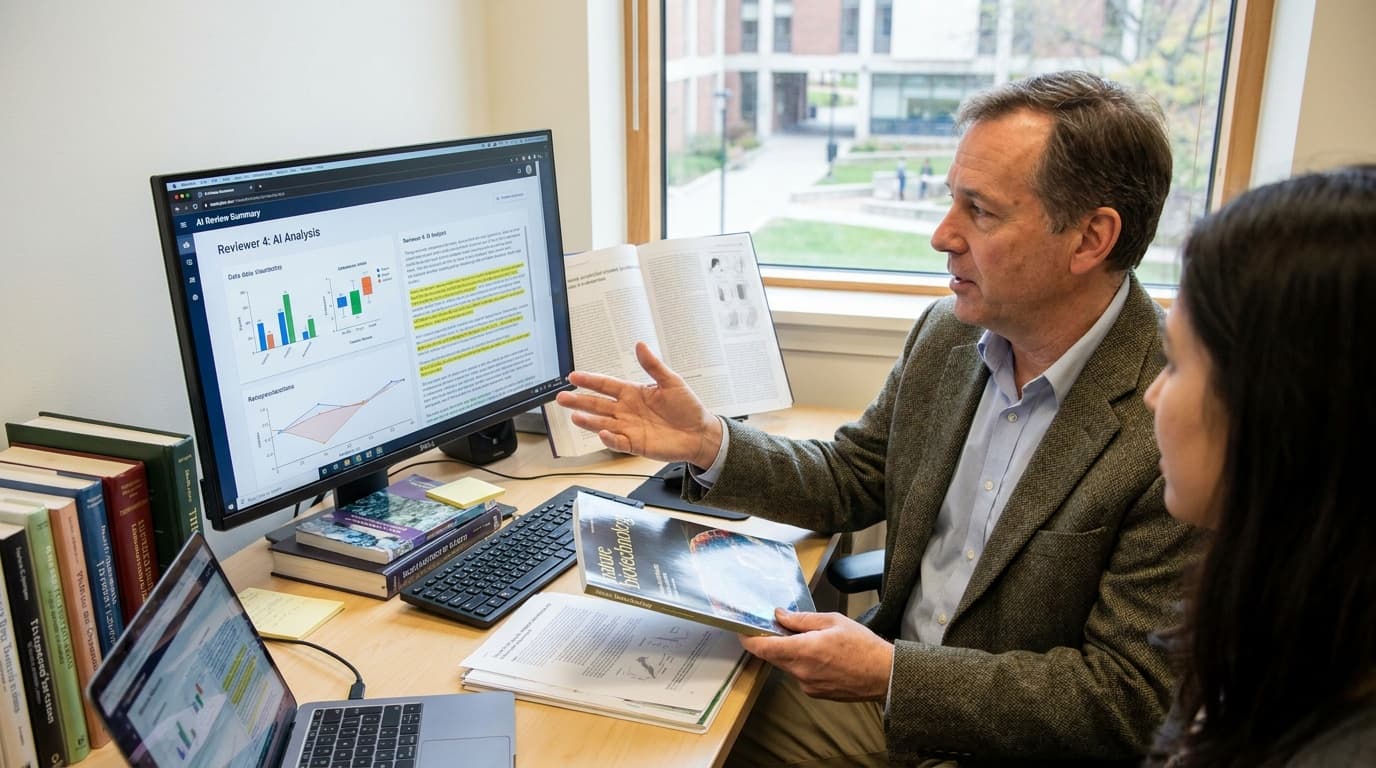
A commentary in Nature Biotechnology argues that artificial intelligence should be introduced into peer review as a bounded support tool rather than a substitute for scientists. The authors propose AI as an additional, non-voting “Reviewer 4” that is secure and auditable, with the goal of strengthening a process they describe as foundational to science.
Their starting point is a capacity problem. External peer review remains central to merit-based research, they write, but the time needed for thorough and fair review has become scarce as scientists balance manuscript and grant assessment with their own research, grants, clinical duties, teaching, mentoring, and administrative work.
The proposal
According to the article, the core structure of peer review has changed little even as reviewer workloads have increased. Manuscripts and grant applications are still typically assessed by three scientists, while editorial boards and funding agencies make decisions based mainly on those expert evaluations.
The authors argue that AI can already perform many tasks that sit inside that process. Their proposal is not to give the technology decision-making authority, but to use it in a constrained role that helps refocus human effort on judgment-intensive parts of review.
That framing matters for research organizations and publishers because it treats AI as an efficiency tool for scientific evaluation, not as a replacement for scientific accountability. A non-voting role preserves the authority of human reviewers while opening room for software to absorb some of the growing volume and complexity of the work.
The signal
The commercial and operational significance is broader than scholarly publishing alone. If AI becomes acceptable as a secure and auditable support layer in peer review, it strengthens a more general model for scientific workflows: use AI to improve decision quality and conserve expert time, while keeping formal responsibility with trained professionals.
That is a narrower claim than full automation, but it is also the one most likely to be usable in regulated and credibility-sensitive settings. In that sense, the article’s proposal is less about replacing reviewers than about formalizing where AI can sit inside high-stakes scientific processes without displacing human judgment.