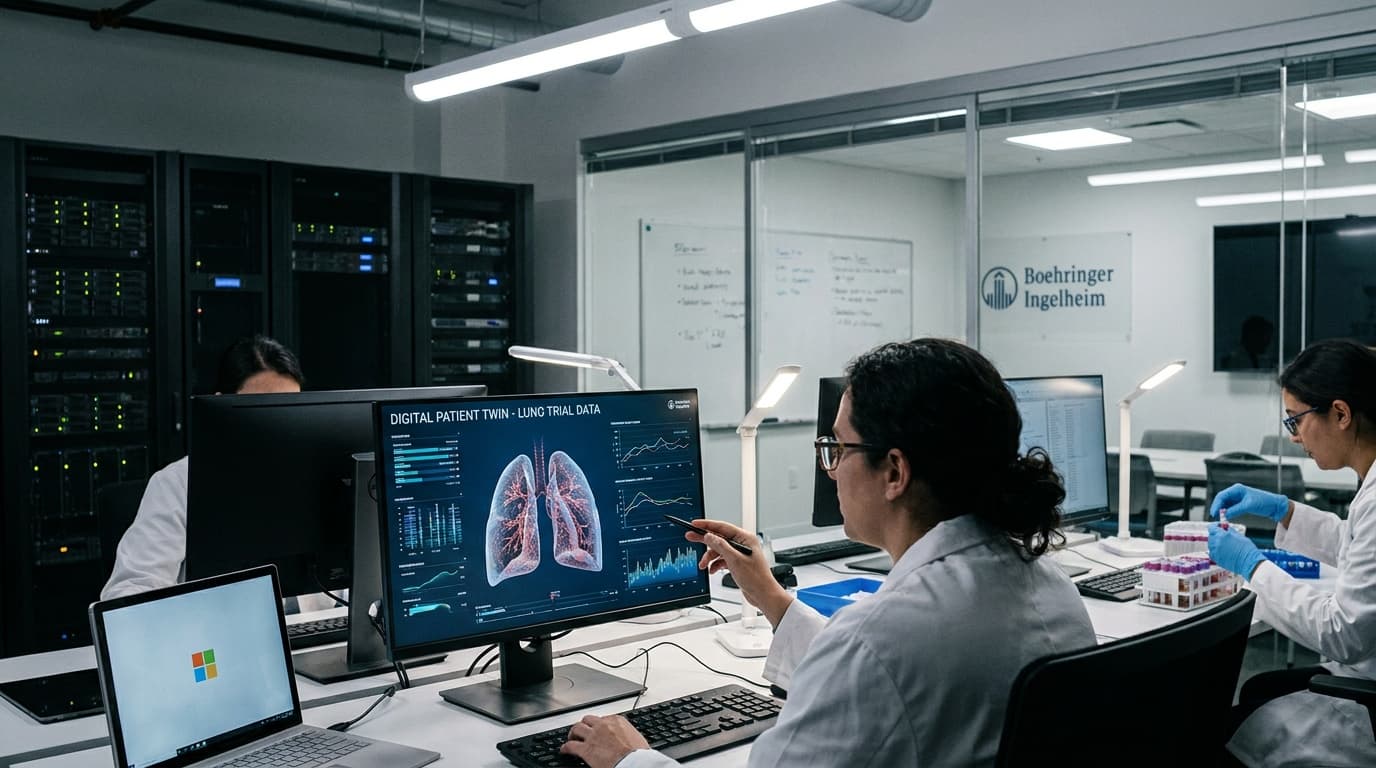
Boehringer Ingelheim and Microsoft have launched a collaboration to explore AI-powered digital patient twins as a tool for improving clinical trial design, starting in lung health. Boehringer Ingelheim described digital patient twins as computational representations of individual patients that use clinical and other relevant data to predict how a disease might progress and how outcomes could evolve under different scenarios.
The companies are framing the effort as exploratory research rather than a substitute for conventional studies. A Boehringer Ingelheim spokesperson said the aim is not to mimic or replace an entire clinical trial, but to explore disease-progression modelling, predictive outcome modelling, patient stratification and advanced trial simulation in support of more patient-centric and efficient trials.
What The Collaboration Covers
One approach the companies plan to explore is the use of digital patient twins to create synthetic or hybrid control arms, which could reduce the number of patients needed in conventional control groups. If that works in practice, the commercial attraction is straightforward: clinical evidence could be generated faster, while trial operations become more efficient.
That said, Boehringer Ingelheim also attached an important limit to the announcement. The spokesperson said any application would require rigorous validation and regulatory acceptance. That qualifier matters because the value of digital twin models depends less on technical novelty than on whether they can be trusted in development decisions that affect study design and evidence standards.
Data And Next Steps
Boehringer Ingelheim said the precise datasets have not yet been determined. The research could draw on clinical trial, real-world or biological data, subject to appropriate authorization and oversight.
The program will initially focus on lung health, with plans to explore its potential across additional diseases and therapeutic areas, though no other specific areas have been identified. For the broader AI-in-development field, that makes this a measured efficiency play: the near-term question is whether digital patient twins can improve trial decisions, not whether they can replace the scientists and clinical processes around them.