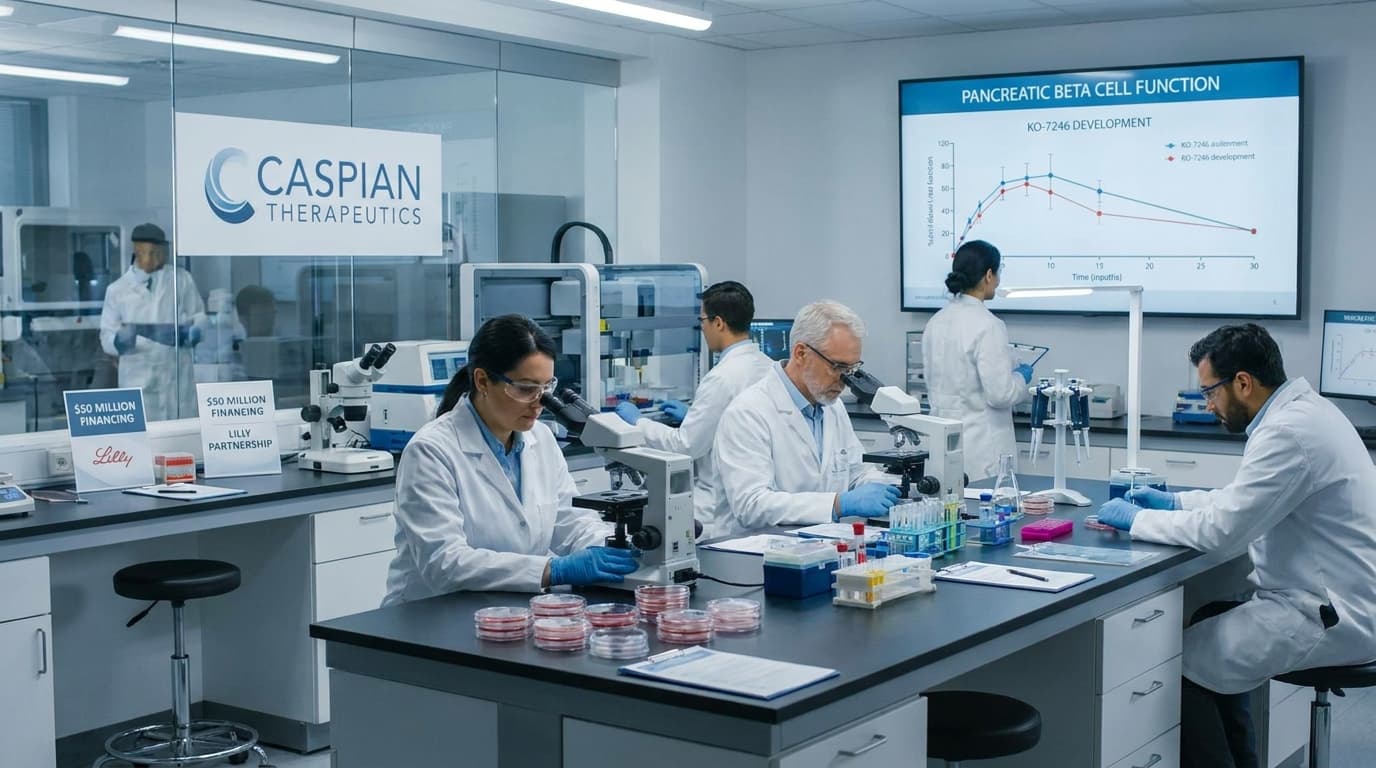
Caspian Therapeutics has launched with $50 million in financing and support from Eli Lilly to advance KO-7246, an investigational oral menin inhibitor for diabetes that was spun out from Kura Oncology.
The new company is built around a relatively unusual thesis for the diabetes market. Rather than focusing on insulin replacement or blood-sugar control alone, Caspian says menin inhibition could modify disease biology by increasing the number and function of pancreatic beta cells. The financing will fund initial clinical proof-of-concept work and investigational new drug-enabling development for KO-7246, while also supporting a second menin inhibitor aimed at diabetes and cardiometabolic conditions.
That makes the launch strategically notable beyond its size. Menin inhibitors are already an established oncology modality, but Caspian is trying to transfer that chemistry and development know-how into metabolic disease, where the commercial bar is high and differentiation from established therapies matters more than novelty by itself.
The Scientific Bet
Caspian describes KO-7246 as a next-generation, highly selective small-molecule menin inhibitor designed for chronic metabolic diseases. According to the company, menin is a scaffold protein that helps regulate pancreatic beta-cell multiplication. Caspian’s thesis is that excessive menin activity can impair the pancreas’s ability to produce insulin, contributing to diabetes.
Kura said its preclinical findings support the idea that menin inhibition may address the underlying loss of functional beta-cell capacity rather than simply manage the consequences of that loss. The company added that the findings were consistent across Type 1 and Type 2 diabetes models and translated into human islet systems. Caspian separately said animal studies have shown improvements in glycemic control and insulin production after menin inhibition.
Those details point to the core promise and the core risk of the program. If menin inhibition can preserve or restore beta-cell function, it could support a disease-modifying positioning in both type 1 and type 2 diabetes. But the current evidence described in the sources remains preclinical, so the next inflection point is whether that biology can survive the transition into human testing.
The Corporate Structure
The financing was led by BVF Partners. Participants included Eli Lilly, Kura, the T1D Fund, Invus, Montanova, members of Kura’s leadership team and several biotech entrepreneurs, according to Fierce Biotech. BioSpace also identified Lilly, Kura and other investors in the round.
Kura will retain about 50% ownership of Caspian and have board representation. Fierce reported that Kura is supplying the spinout with the relevant intellectual property and know-how around KO-7246, while BioSpace said Caspian will operate under an intercompany services arrangement that gives it access to Kura’s research, development and corporate capabilities.
That structure lowers some of the usual launch friction for a new biotech. Caspian gets a dedicated identity and outside capital, but it is not building entirely from scratch. For Kura, the arrangement allows the company to keep its oncology focus while preserving upside in a noncore metabolic program.
Why Lilly’s Involvement Matters
Lilly’s participation does not validate the science on its own, but it does add commercial signal. Lilly is one of the largest players in metabolic disease and owns the tirzepatide franchise, sold as Mounjaro for type 2 diabetes and Zepbound for chronic weight management. BioSpace said tirzepatide generated $36.51 billion in 2025 across those two brands and also noted Lilly markets its weight-loss pill Foundayo.
A Lilly-backed company pursuing a disease-modifying diabetes approach suggests investors still see room for mechanisms outside incretins, particularly if they target beta-cell biology more directly. The market already rewards effective glucose lowering and weight loss at scale. A new entrant therefore needs a rationale that is meaningfully different, not just incrementally competitive.
Caspian plans to file an IND for KO-7246 as soon as practicable, according to BioSpace, and Kura said it expects to present supporting preclinical data at the European Association for the Study of Diabetes Annual Meeting in Milan, Italy, at the end of the month. Those steps should start to show whether the company can turn an oncology-derived mechanism into a credible metabolic development story.