
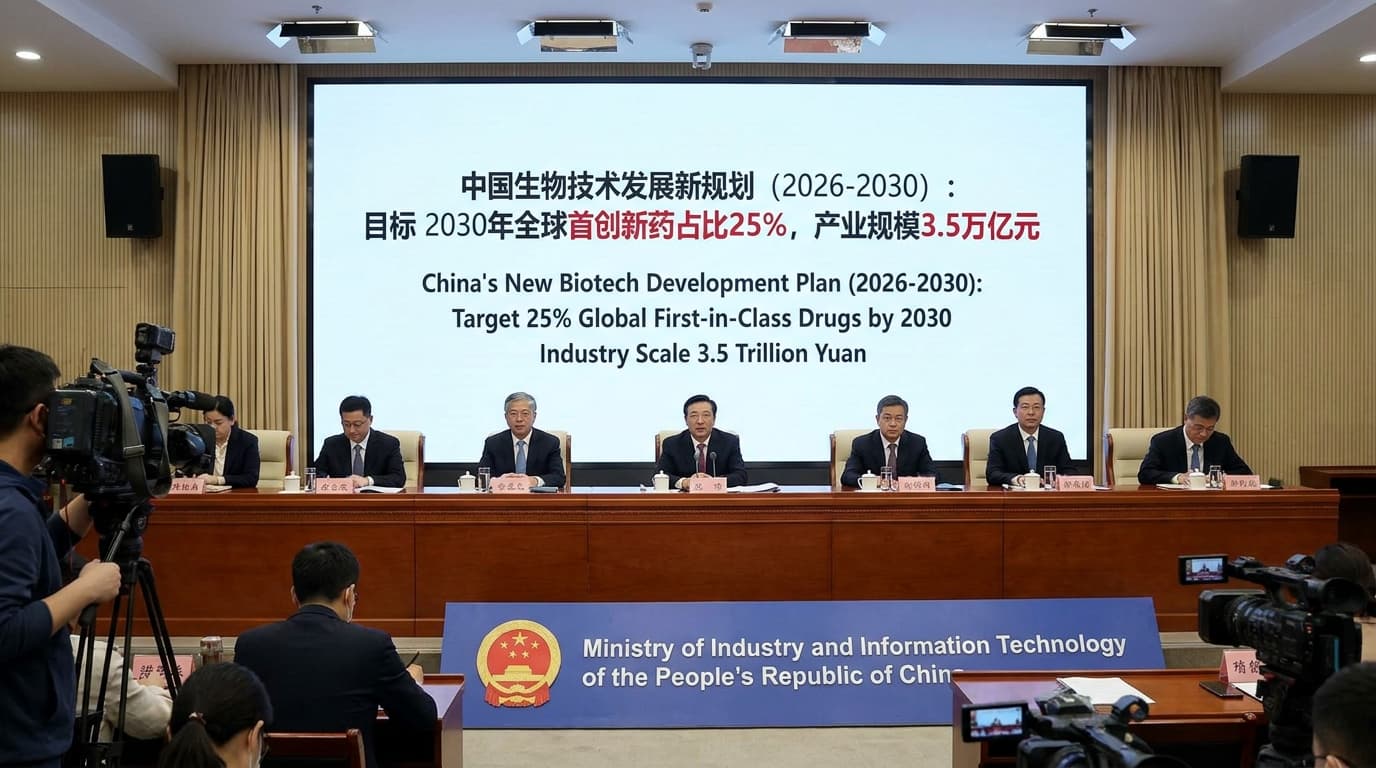
China has set out a new five-year biotechnology plan that aims to make the country the origin of at least 25% of first-in-class drugs on the global market by 2030, according to the Ministry of Industry and Information Technology. The plan also calls for the biotech industry to grow 20% annually over the 2026 through 2030 period.
The headline financial target is even larger: the government wants the local biotech industry to expand from about 20 million yuan, or $2.98 million, to 3.5 trillion yuan, or $521.8 billion, in the next five years. By the end of the term, the plan says 50 individual companies should be generating 10 billion yuan, or $1.5 billion, in revenue, and at least five Chinese-developed drugs should reach and exceed blockbuster status with $1 billion in sales.
The policy signal
China has issued multiple biotech-focused five-year plans since 2007, and this version reads less like a new direction than an effort to accelerate a transition already underway. The government’s own framing says the pharmaceutical industry is moving away from its traditional role as a supplier of active pharmaceutical ingredients and a large consumption market toward export of innovative drugs.
That matters because it shifts the benchmark for success from domestic manufacturing depth to ownership of globally competitive intellectual property. A target tied specifically to first-in-class drugs is not just about volume; it is a claim on where future biopharma innovation should originate.
The commercial picture
The source points to evidence that this transition is already feeding deal activity. Licensing deals for China-developed drugs have grown 36% year-on-year, with total value surpassing $120 billion. In recent years, obesity, immunology and cancer have emerged as major targets, though the source describes the region as offering a broad range of innovative medicines.
One of the most prominent examples cited is Summit Therapeutics and Akeso’s PD-1/VEGF bispecific antibody ivonescimab, which is awaiting FDA approval in a type of non-small cell lung cancer. That kind of cross-border asset development helps explain why China policy targets now matter beyond domestic industry planning: they increasingly affect pipelines, partnering strategy and competitive positioning for companies in the U.S. and Europe.
The geopolitical tension
The plan arrives as U.S. biotech and policy voices are debating how to respond. Caitlin Frazer of the National Security Commission on Emerging Biotechnology recently told BioSpace that China’s approach has been to “steal, scale and strangle American competitors in this space,” while BIO CEO John Crowley said guardrails are needed to avoid creating “inescapable dependencies.”
At the same time, the source notes broad agreement that there is meaningful innovation in China and that good science should be accessible to American patients regardless of borders. For industry participants, that leaves a two-track reality: China is becoming more important as a source of licensable innovation, even as policymakers debate how much dependence is strategically acceptable.


