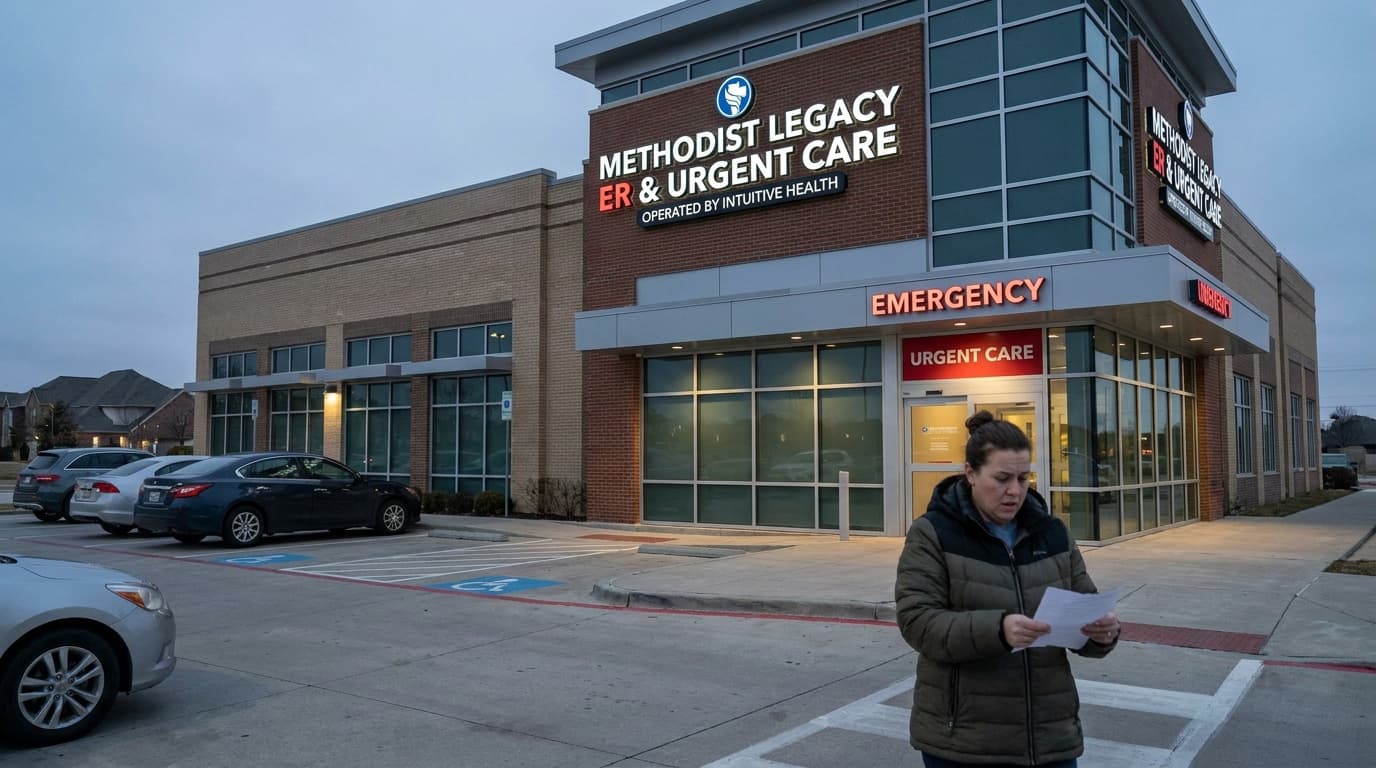
A STAT investigation examined billing complaints tied to hybrid emergency room-urgent care facilities operated by Intuitive Health, a private equity-backed company that runs nearly 50 such sites. Patients told STAT they arrived with issues they viewed as straightforward urgent care cases, including urinary tract infections, coughs, congestion, and flu symptoms, but later received bills for emergency room care that in some cases ran into the thousands of dollars.
One patient, Kristin Gills, went to Methodist Legacy ER & Urgent Care in Allen, Texas, for what STAT described as a textbook urgent care visit for a urinary tract infection. She paid $211 before leaving after a urine test, diagnosis, and antibiotic prescription. She later received an additional bill that brought the total to $1,756. After she posted online about the charge, a Methodist representative offered a cash-pay discount that reduced her balance to $667, which she said she is still contesting.
Where The Billing Tension Sits
Intuitive Health says the hybrid model helps patients by removing the need to guess whether a condition is an emergency. In principle, that positioning addresses a real triage problem. In practice, the complaints reported by STAT point to a different risk: if patients believe they are choosing urgent care but are ultimately billed at ER rates, the model can shift uncertainty from the front door to the invoice.
STAT also reported that company officials said every patient should be asked to sign a form before an “upgrade” to ER care. But the reporting found that this was far from standard practice. That gap matters because the commercial logic of hybrid sites depends not just on having both care settings in one building, but on patients understanding which one they are actually using. When that distinction breaks down, a convenience-oriented format can start to resemble a billing trap instead of a navigation tool.