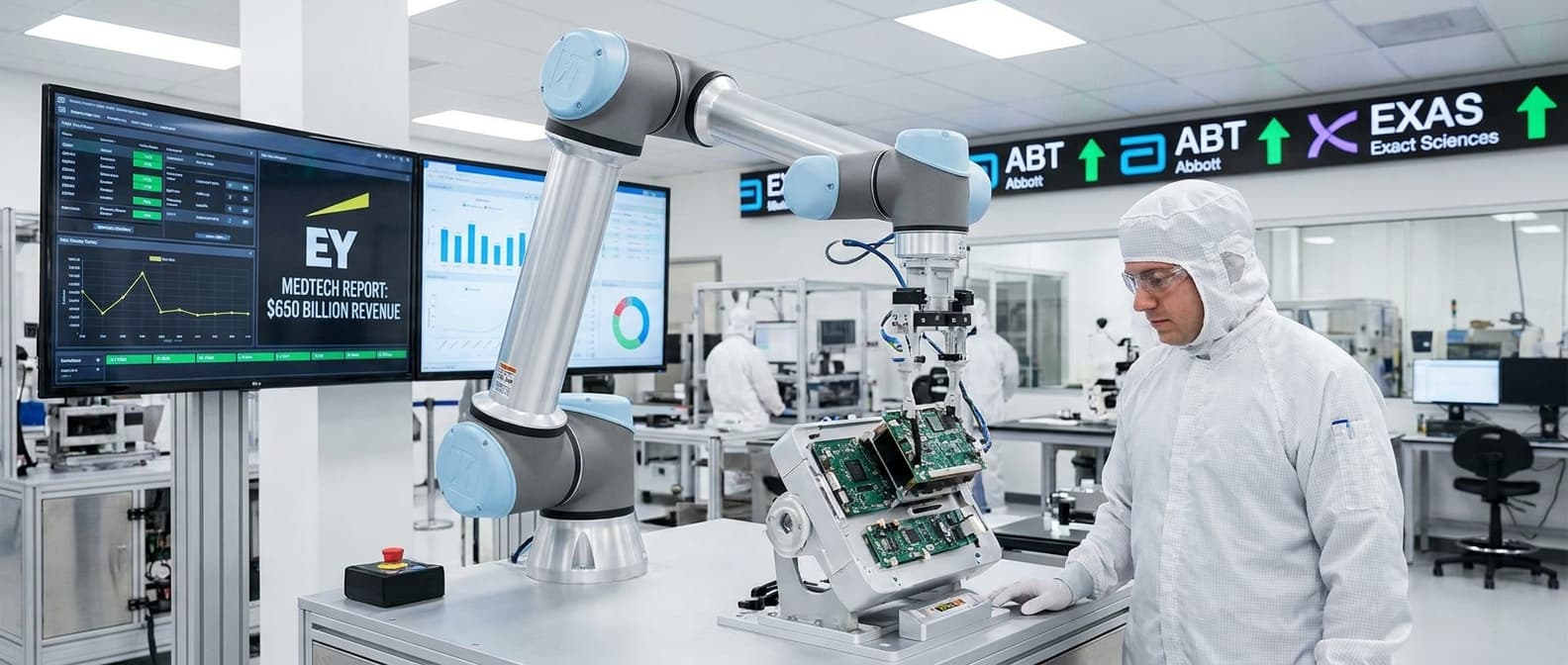
The medtech sector is back at a revenue high point, according to the latest Ernst & Young LLP Pulse of the MedTech Industry report, but the recovery is not evenly shared. EY said the industry generated around $650 billion in revenue last year, up 11%, and produced $325 billion in the first half of 2026, a 7.1% increase from the same period in 2025.
Those numbers point to a market that has absorbed negative investor sentiment and persistent global trade and supply chain uncertainty better than many expected. The more important signal in EY’s report is that growth is becoming more concentrated among commercial leaders, widening the performance gap across the sector even as headline metrics improve.
Where Growth Is Showing Up
EY said therapeutic devices led industry growth, followed by non-imaging diagnostic, imaging, and lab equipment and tools. The report also said growth continued to expand into alternative care settings during 2025 through the first half of 2026, while innovation increased dealmaking and R&D investment.
That combination matters because it suggests medtech’s next phase is not being defined by a single rebound factor. Revenue growth, care delivery shifts and portfolio investment are moving together. For companies with established commercial infrastructure, that creates room to scale into adjacent settings and support more aggressive business development.
For companies without that footing, the same environment may be harder to navigate. EY’s warning about concentration implies that a rising market is not automatically lifting the rest of the field.
M&A And AI Are Reinforcing The Split
EY found that medtech M&A reached its highest level in more than a decade, with total disclosed deal value of roughly $130 billion. The report added that the rebound was driven by a limited number of blockbuster transactions, including Abbott’s $23 billion acquisition of Exact Sciences.
That qualifier is important. Strong deal value can suggest broad strategic confidence, but EY’s framing shows the recovery was not based on a large number of mid-sized transactions spread across the industry. It was propelled by a few very large deals, which is more consistent with scale advantages accruing to already dominant players.
The same pattern appears in AI. EY said intelligence is increasingly being deeply embedded into devices and the care pathways around them. Hardware design, clinical evidence and manufacturing quality remain fundamental, but they are increasingly being complemented by the quality of algorithms, data and digital services surrounding the product.
A recent study cited by the report found just over 400 FDA AI-enabled medical device authorizations from 2020 to 2022. From 2022 to 2025, that number grew to nearly 800, and the FDA authorized 331 AI-enabled devices in 2025 alone.
Those figures show AI adoption is becoming operational rather than experimental in medtech. But the commercial implication is not simply that more devices have AI features. Companies now need to compete on algorithms, data and digital services in addition to the traditional device stack, which tends to favor organizations with the capital and systems to support all four.
John Babitt, EY Global MedTech Leader, said in the report that the broader sector is at a turning point where discipline is essential to convert innovation into profitable growth. Diana Hoff, EY Americas Life Sciences Sector Leader, said the leaders of the next decade will be those that embrace AI, make more deliberate portfolio choices and build productive, resilient operating models.
Taken together, the report describes an industry that has regained momentum, but not breadth. Record revenue and elevated M&A do not erase the fact that performance is clustering around companies already equipped to commercialize, acquire and operationalize AI at scale.