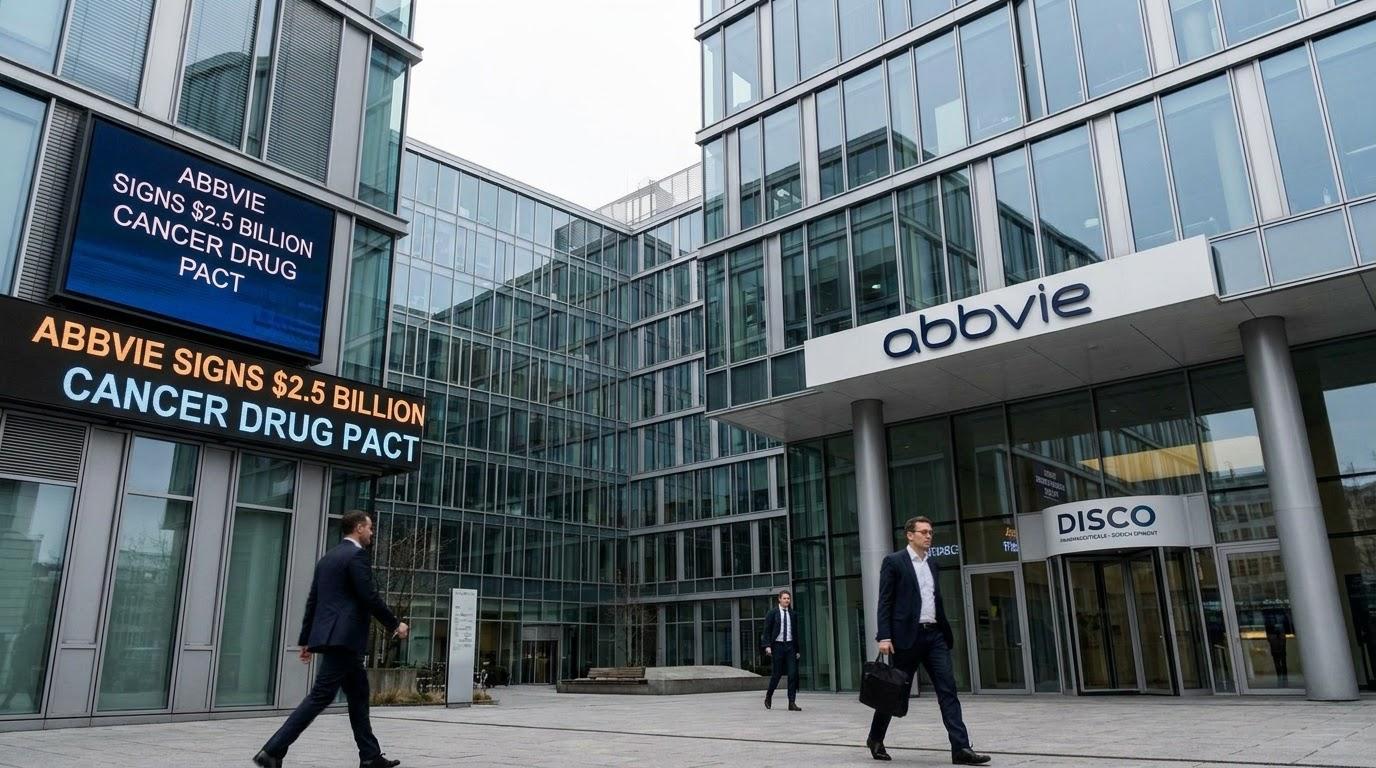
AbbVie has entered an option-to-license agreement with Germany-based Disco Pharmaceuticals focused on cancer-targeted bispecific discovery, with total economics described as up to $2.5 billion in one source and $2.54 billion in another. Both sources agree the package includes a $40 million upfront payment, with the remaining value tied to potential milestone payments.
The companies said the collaboration is aimed at developing novel AND-gated bispecific therapeutics for solid tumors with high unmet medical need. AbbVie said the goal is to identify and potentially advance highly selective bispecific therapeutics, while Disco framed the approach as a way to selectively target tumor cells while sparing healthy tissue.
The Platform Bet
Disco’s DiscoTech platform maps proteins on the cancer cell membrane, or the surfaceome, to reveal potential targets for AND-gated bispecific antibodies. One source also said the technology is used to map novel cell-surface targets for targeted therapies including antibody-drug conjugates and T cell engagers.
The strategic appeal is clear from the sources’ description of the problem Disco is trying to solve. When AbbVie’s venture arm joined Disco’s 20 million euro seed financing in 2024, the industry was still highly interested in antibody-based programs but was having trouble differentiating cell-surface targets. That makes target-selection technology part of the value proposition here, not just antibody engineering.
For AbbVie, the agreement looks less like an entry into bispecifics than an effort to improve selectivity within an area it already backs heavily. The company already has a late-stage BCMA x CD3 T-cell engager that, in September, showed improved response rates and progression-free survival in relapsed or refractory multiple myeloma.
Why It Matters
This deal also fits a broader AbbVie partnering pattern. One source pointed to AbbVie’s January agreement with RemeGen worth up to $5.6 billion, and another highlighted a more recent Nxera Pharma deal with $100 million upfront plus $1.37 billion in back-end payments for an EP4 receptor agonist program in inflammatory bowel disease. The Disco pact continues that use of external discovery and licensing to add optionality without committing full acquisition-scale capital upfront.
For Disco, the collaboration is another commercial validation event for a young platform company formed in 2022 as a spinout from work at ETH Zürich. The biotech had already signed a similar deal earlier this year with Amgen worth up to $618 million around a target identified before that engagement. Taken together, the AbbVie and Amgen agreements suggest that large companies are willing to pay for earlier access to differentiated target-discovery engines in solid tumors, especially when the pitch is more precise tumor recognition rather than another broad bispecific build.