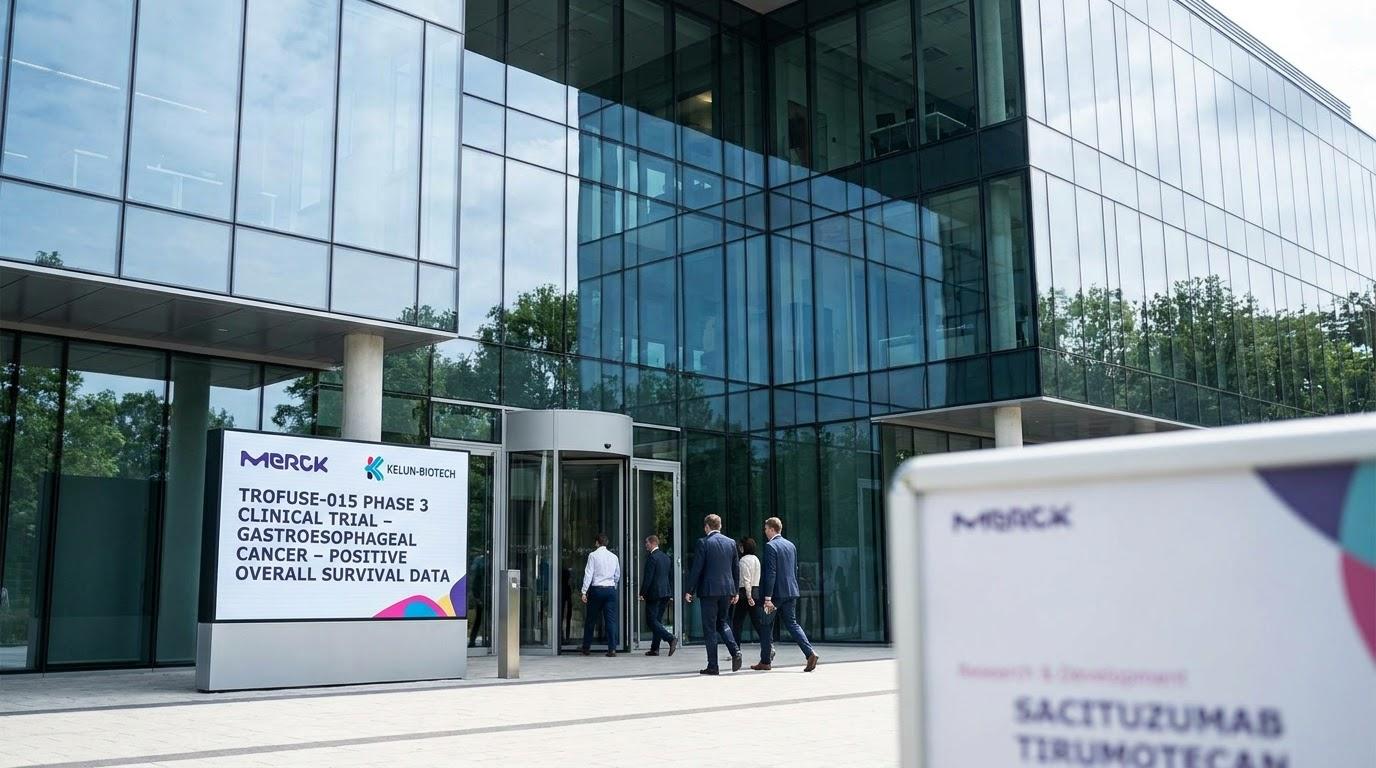
Merck and Kelun-Biotech said their TROP2-directed antibody-drug conjugate sacituzumab tirumotecan, or sac-TMT, significantly improved overall survival in TroFuse-015, a Phase 3 study in advanced gastroesophageal adenocarcinoma. The companies described the result as the second Phase 3 success in sac-TMT’s global program.
The readout came with important limits. Sac-TMT did not significantly improve progression-free survival, and Merck said the drug showed only a nominal objective response rate benefit that was not formally tested under the prespecified analysis plan. Even so, the result matters because overall survival was the trial’s primary endpoint, and both sources frame that measure as the most consequential one in this setting.
The Data
TroFuse-015 enrolled 473 patients with advanced unresectable or metastatic gastroesophageal adenocarcinoma who had received at least two prior lines of systemic therapy. Patients received sac-TMT or treatment of a physician’s choice.
Fierce Biotech reported that treatment of physician’s choice consisted of trifluridine-tipiracil, irinotecan, paclitaxel or docetaxel. In the final analysis, Merck said overall survival was significantly longer with sac-TMT than with that control arm, meeting the study’s main goal. The company also said results were generally consistent across subgroups regardless of TROP2 expression status.
Safety findings were consistent with previous studies, according to Merck, and no new safety signals were observed. That matters for an ADC being tested broadly across tumor types, because an overall survival benefit is harder to commercialize if it arrives with an unexpected tolerability tradeoff. Here, the companies are arguing for efficacy without a newly identified safety cost.
RBC Capital Markets wrote that the pattern of an overall survival win without a progression-free survival win is not unheard of in oncology trials and that overall survival remains the gold standard in these settings. That does not erase the secondary-endpoint miss, but it does shape how investors may interpret the result: as clinically meaningful, though less clean than a across-the-board endpoint win.
The Commercial Picture
Merck said sac-TMT is the first TROP2 ADC to improve overall survival versus treatment of physician’s choice in a global Phase 3 study in advanced gastroesophageal adenocarcinoma. In a crowded TROP2 field, being first to show that outcome in this patient population is a positioning claim, not just a scientific one.
The broader competitive context is mixed. Fierce Biotech noted that Gilead’s Trodelvy won FDA approval in 2020 and that AstraZeneca and Daiichi Sankyo’s Datroway won FDA approval in 2025. Trodelvy and Datroway are approved for breast cancer, while Datroway also has a non-small cell lung cancer population on its label. Merck, by contrast, is using the TroFuse program to push sac-TMT across breast and lung cancer as well as tumor types its rivals have not yet unlocked.
That breadth is central to the investment case. The TroFuse program includes 18 ongoing Phase 3 studies, with 14 first-in-class opportunities, according to the companies. BioSpace also noted that sac-TMT succeeded this summer in a late-stage study for first-line PD-L1-positive non-small cell lung cancer, and that BMO analysts have projected peak sales of $4.3 billion. Those same analysts previously argued the ADC could become a meaningful part of the Keytruda solution as Merck faces exclusivity losses at the end of 2028 that put $33 billion in revenue at risk.
The Road Here
This is not sac-TMT’s first late-stage win. BioSpace said Merck reported in October that TroFuse-005 in advanced or recurrent endometrial cancer cut the risk of death by 32% versus chemotherapy. Fierce Biotech likewise described that study as the first global Phase 3 victory for the program.
The asset is already approved in four indications in China, according to BioSpace. In the U.S., it is under FDA priority review for previously treated endometrial cancer, with a decision expected by June 2027. BioSpace also reported that sac-TMT secured a Commissioner’s National Priority Voucher through an FDA pilot program that is now reportedly defunct.
Merck joined sac-TMT’s development in May 2022, when it offered Kelun-Biotech up to $1.36 billion to secure certain rights, according to a release translated from Chinese cited by BioSpace. Later that year, BioSpace reported, Merck expanded the relationship with a deal worth up to $9.3 billion for seven investigational ADCs.
The immediate next step is fuller disclosure. Merck said it plans to share the TroFuse-015 data with regulatory authorities and at an upcoming medical conference. Until hazard ratios, subgroup detail and duration data are available, the result reads as a strategically important topline win that strengthens the case for sac-TMT as a multi-indication oncology asset, while leaving open how durable its edge will be against other TROP2 programs.