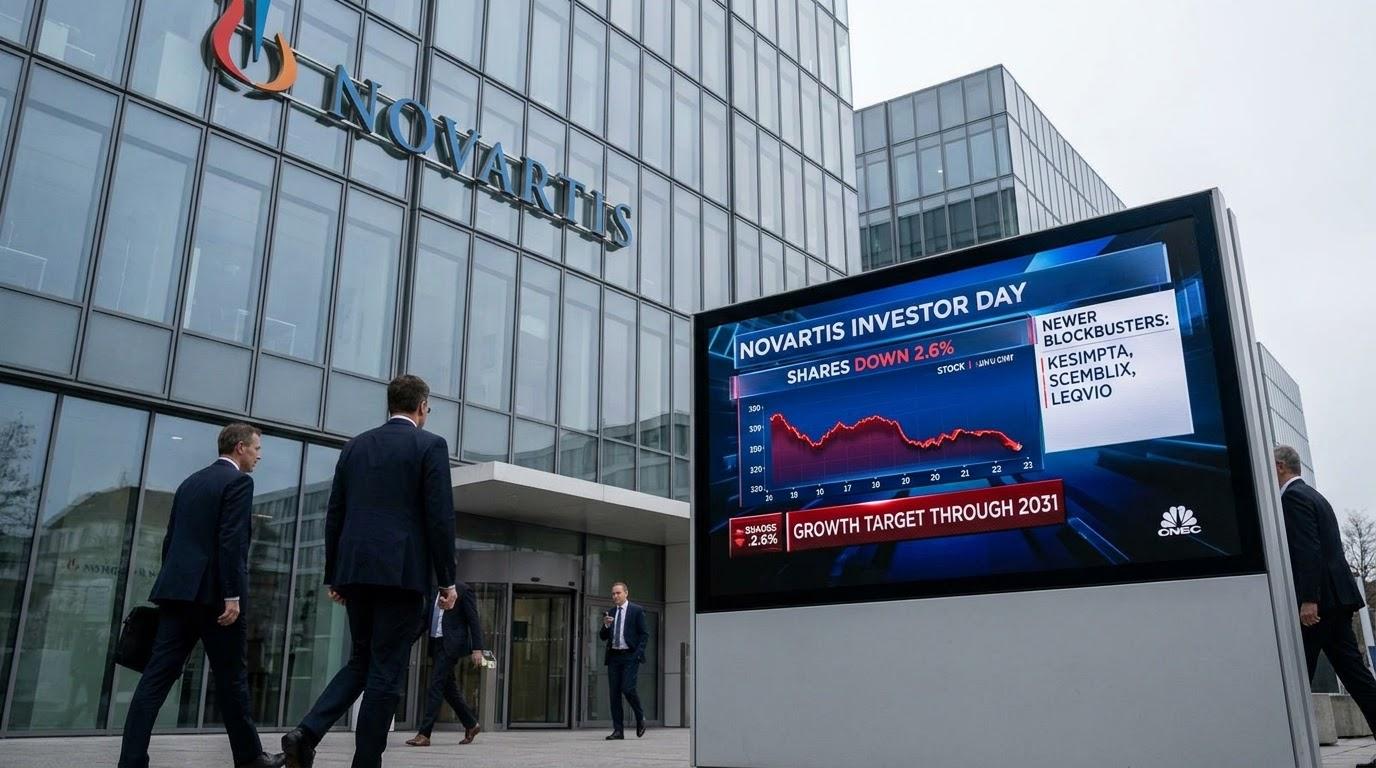
Novartis used its investor day to lower the temperature around expectations for the end of the decade. The Swiss pharma now projects 5% growth through 2031, a more modest outlook than some investors were expecting, as generic entry and U.S. pricing pressure begin to weigh on products that have carried much of the company’s growth story.
The strategic shift is not that Novartis lacks replacement assets, but that the market will have to look beyond Cosentyx and Kisqali to find them. Management raised sales guidance for Kesimpta to $8 billion and for Scemblix and Leqvio to $5 billion each, signaling that the next phase of the company’s commercial case rests more on broadening the bench than on extending a few long-standing franchises.
The Commercial Reset
Novartis said sales projections for 2025-2030, set last year, landed at the low end of the previously forecast 5-6% growth rate. The difference in 2031 comes from the start of generic pressure across the portfolio, which has led the company to lower expectations for some key products.
Cosentyx, approved for multiple immune-mediated inflammatory diseases such as psoriasis, is expected to peak in 2027, CEO Vas Narasimhan said on a call with analysts. The drug generated $6.67 billion for 2025, up 9% year over year. Narasimhan said Cosentyx will face price declines from the U.S. Inflation Reduction Act beginning in 2028, followed by loss of exclusivity in 2029.
Kisqali brought in $4.78 billion last year and will also face an IRA-driven price decline in 2028. Narasimhan said he expects the breast cancer medicine to return to growth afterward, with sales potential of $10 billion “in the 2030 period.” Last year, Novartis had described expectations as $10 billion-plus for the same period. When asked whether the missing “plus” reflected lower expectations, Narasimhan said it was “a policy decision just to remove pluses” rather than a change in conviction.
Investors did not fully embrace that explanation. Novartis shares fell about 2.6% to $151.18 on Thursday, extending a second straight day of declines.
Pipeline And Deal Support
Management’s argument is that slower growth around patent and pricing headwinds is normal if the next wave is strong enough. Narasimhan pointed to remibrutinib, pelabresib and ianalumab as assets with multibillion-dollar potential, arguing that two or three successes from the current pipeline could close a $10 billion revenue gap by 2035.
That defense comes after a difficult year. Novartis has absorbed multiple Phase 3 failures for acquired products, including Avidity Biosciences’ main asset del-desiran, and its cardiovascular drug pelacarsen also failed. Those setbacks are part of why investors pressed management on what may be missing from the post-2030 picture.
The company is still forecasting average growth in the mid-single digits through 2031, with core operating income margin returning to 40% or more by 2029. CFO Mukul Mehta said the margin, which reached 41% in the third quarter, is expected to dip by at least 2% in the coming years because of patent and pricing headwinds.
Novartis also said its long-range plan does not assume a large acquisition. Narasimhan said there is “no assumption of a big M&A deal,” while chief strategy and growth officer Ronny Gal said the company will look mainly for smaller to mid-sized deals, particularly $2 billion or less, in early-stage research. Gal added that, long term, Novartis expects about half of its revenue to come from external assets.
That combination of internal pipeline claims and smaller external dealmaking is the central signal from the update. Novartis is asking investors to accept slower top-line expansion through 2031 in exchange for a more diversified replacement strategy, but after recent late-stage failures, the burden shifts to execution rather than franchise durability alone.