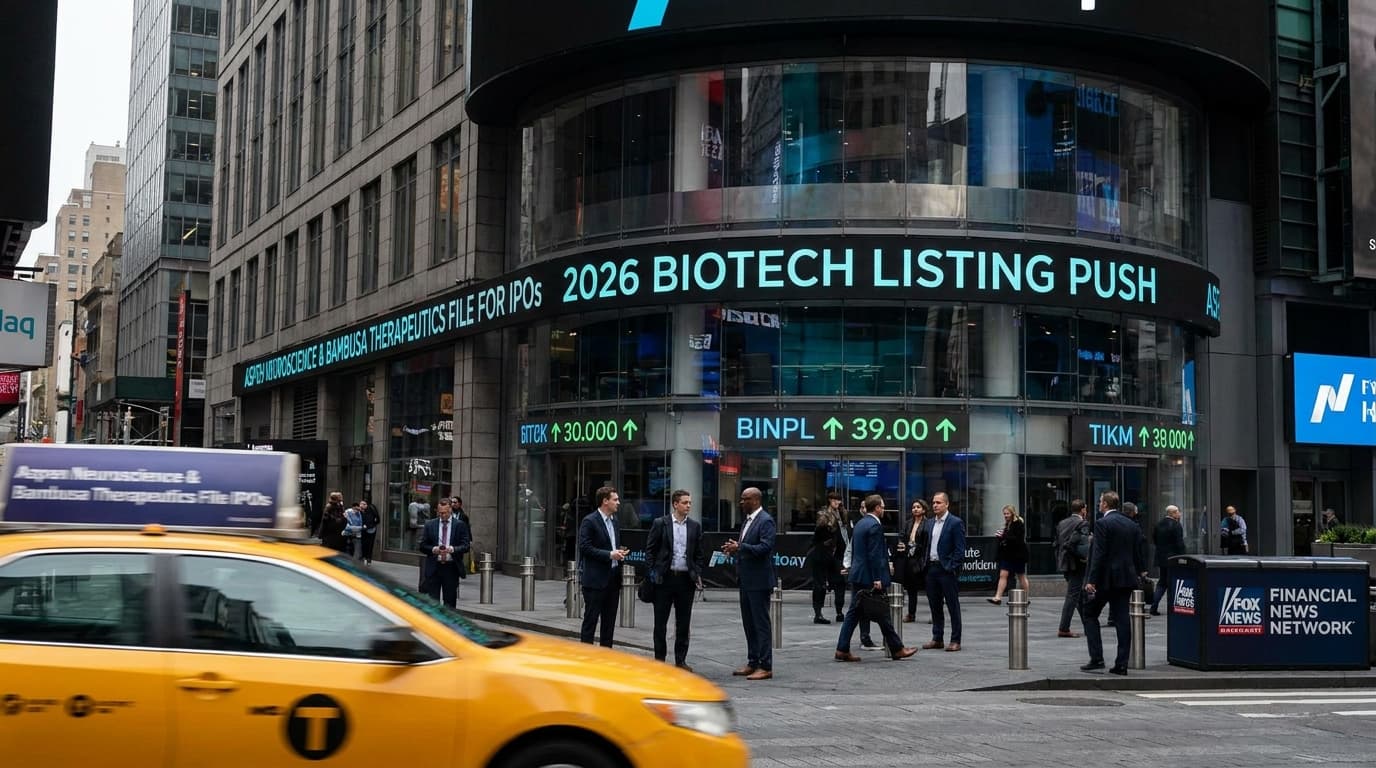
Aspen Neuroscience and Bambusa Therapeutics have each outlined plans to go public, according to Friday filings with the Securities and Exchange Commission, though neither company has yet said how many shares it expects to sell or at what price. The two proposed offerings arrived the same day that TRex Bio and Retension Pharmaceuticals joined the Nasdaq with IPOs of $116.7 million and $45 million, respectively, adding to a busy 2026 market for biotech listings.
The pair are coming to market from different positions. Aspen is trying to build on promising phase 1/2a data in Parkinson’s disease, while Bambusa is presenting a newer inflammation-focused bispecific antibody story with multiple studies already underway across geographies. That contrast matters for investors: one company is asking public markets to finance a potential late-stage transition in a single lead program, and the other is seeking capital to broaden a platform-style development plan around two antibody assets.
The Programs
Aspen’s lead candidate, sasineprocel, is an autologous cell therapy designed to convert patients’ skin cells into stem cells and then into new neurons for implantation into the brain. According to a March readout cited in the filing, patients showed marked improvements in symptom control, motor function and quality of life one year after receiving either a low or high dose. Aspen CEO Damien McDevitt, Ph.D., had previously told Fierce that some patients were able to reduce the amount of levodopa they were taking, which he described as a sign that the transplanted neurons are producing dopamine.
Aspen said the top spending priority for IPO proceeds would be continuing the ongoing phase 1/2a study. The company also expects to use proceeds to start a phase 3 trial of sasineprocel before the earlier study has finished. That is an aggressive use of capital, but it also signals that Aspen is trying to shorten the gap between early clinical proof and a registrational path. Beyond Parkinson’s, the company plans to spend some proceeds on autologous microglia cell replacement therapies for leukodystrophies, with a goal of beginning human trials in the second half of 2027.
Bambusa’s lead program, BBT001, is a long-acting bispecific antibody targeting interleukin-4 receptor alpha and IL-31. The filing says IPO money would primarily support the asset, including moving it into a phase 2b study for atopic dermatitis. BBT001 is already in a global phase 1 trial for atopic dermatitis and a phase 2 study in chronic spontaneous urticaria in China. In July, the company reported preliminary data from 17 patients in the phase 1 study showing that 82% of treated patients achieved more than 50% improvement in eczema area and severity by Week 6 when adjusted for placebo.
Bambusa also plans to fund BBT002, a long-acting bispecific antibody targeting IL-4/13 and IL-5. That candidate is already in a global phase 1 study for chronic obstructive pulmonary disease, as well as a phase 1/2a and a phase 2a trial in China for chronic obstructive pulmonary disease and chronic rhinosinusitis with nasal polyps, respectively.
The Financing Setup
Aspen launched in 2019 with $6.5 million and later raised a $70 million series A in 2020, a $147.5 million series B in 2022 and a $115 million series C in November 2025. That latest round included Kite Pharma, Gilead Sciences’ cell therapy unit. As of the end of June, Aspen had $72.4 million in cash and 120 full-time employees.
Bambusa was formed in May 2024, raised a $15 million seed round later that year and followed with a $90 million series A in 2025. The company, led by founder and CEO Shanshan Xu, M.D., Ph.D., had $71.5 million on hand by the end of June and 30 full-time employees.
Those balance sheets suggest both companies are using the public market less as emergency financing than as a way to fund the next, more expensive step. For Aspen, that is the move toward phase 3 manufacturing and trial execution in an autologous cell therapy setting. For Bambusa, it is the cost of running parallel clinical programs across immunology indications and regions. In a market that has already supported record-breaking biotech listings from companies such as Kailera Therapeutics and Parabilis Medicines, these filings point to continued investor appetite for stories with either visible clinical inflection points or multi-asset expansion potential.