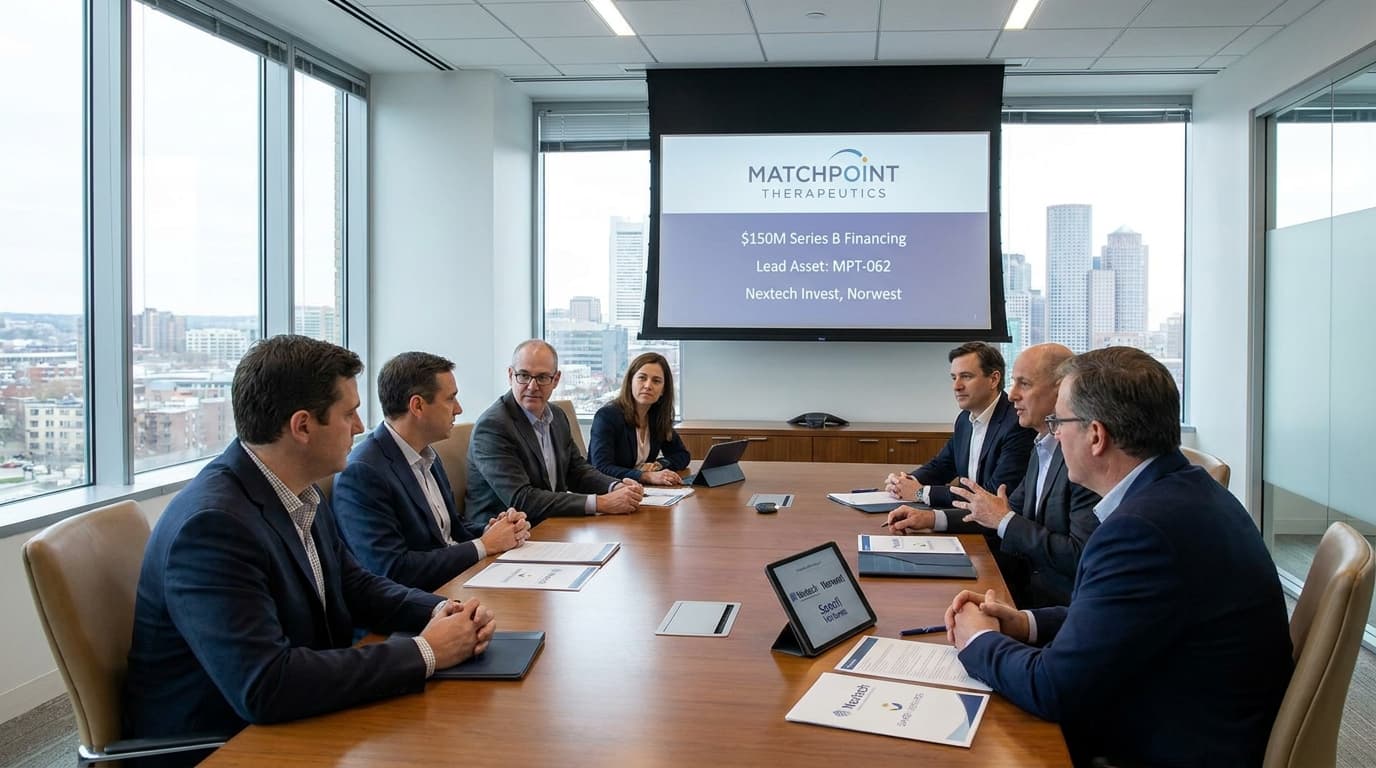
Matchpoint Therapeutics has raised $150 million in a series B round to push its precision covalent medicines strategy into the clinic, with lead program MPT-062 set as the top spending priority. For a company founded in 2022, the financing is notable both for its size and for what it says about where private biotech capital is still available: platform companies can still attract large rounds when they pair discovery claims with a near-term clinical plan.
The Watertown, Massachusetts-based biotech said the money will be used primarily to take MPT-062 into the clinic next year. Matchpoint describes MPT-062 as an oral T cell modulator and has been positioning it as a first-in-class candidate for autoimmune and inflammatory diseases. Some of the proceeds will also go toward the broader pipeline, although the company has not disclosed details of those programs.
The financing picture
The series B was co-led by Nextech Invest and Norwest. Returning investors Sanofi Ventures and Digitalis Ventures participated alongside new investors Invus, BB Biotech, T1D Fund and BOLD Longevity Growth. Founding investors Access Biotechnology and Atlas Venture were also named.
The new round follows a $70 million series A in 2022, led by Sanofi Ventures. Since then, Matchpoint has also secured external validation from Novartis, which paid $60 million upfront for the option to develop oral covalent inhibitors against an unnamed transcription factor associated with several inflammatory diseases.
That sequence matters. The company is no longer selling only a discovery vision; it now has both venture backing and a pharmaceutical partner willing to pay upfront for access to the approach. In a financing market that has often favored narrower stories, Matchpoint appears to have convinced investors that covalent chemistry can support both platform optionality and product-specific development.
Why investors are backing it
Matchpoint launched with its Advanced Covalent Exploration, or ACE, platform, which combines machine learning, a library of covalent compounds and chemoproteomics that can identify covalent binders. The company’s thesis is that covalent bonds can create a more durable attachment to a target, improving potency while limiting systemic exposure.
Investors joining the board tied their support to that technical proposition. Nextech managing partner Kanishka Pothula said MPT-062 could change management of many immune-mediated inflammatory conditions with an oral medicine by precisely addressing disease-causing over-activation of T cells. Norwest principal Brian Matesic said the platform has made advances against historically hard-to-drug targets.
The broader signal is that covalent drug discovery remains an active capital destination, but with a clear expectation that chemistry innovation must translate into clinically and commercially differentiated medicines. Matchpoint’s next test is straightforward: turning a well-funded platform story into human data on MPT-062 next year.