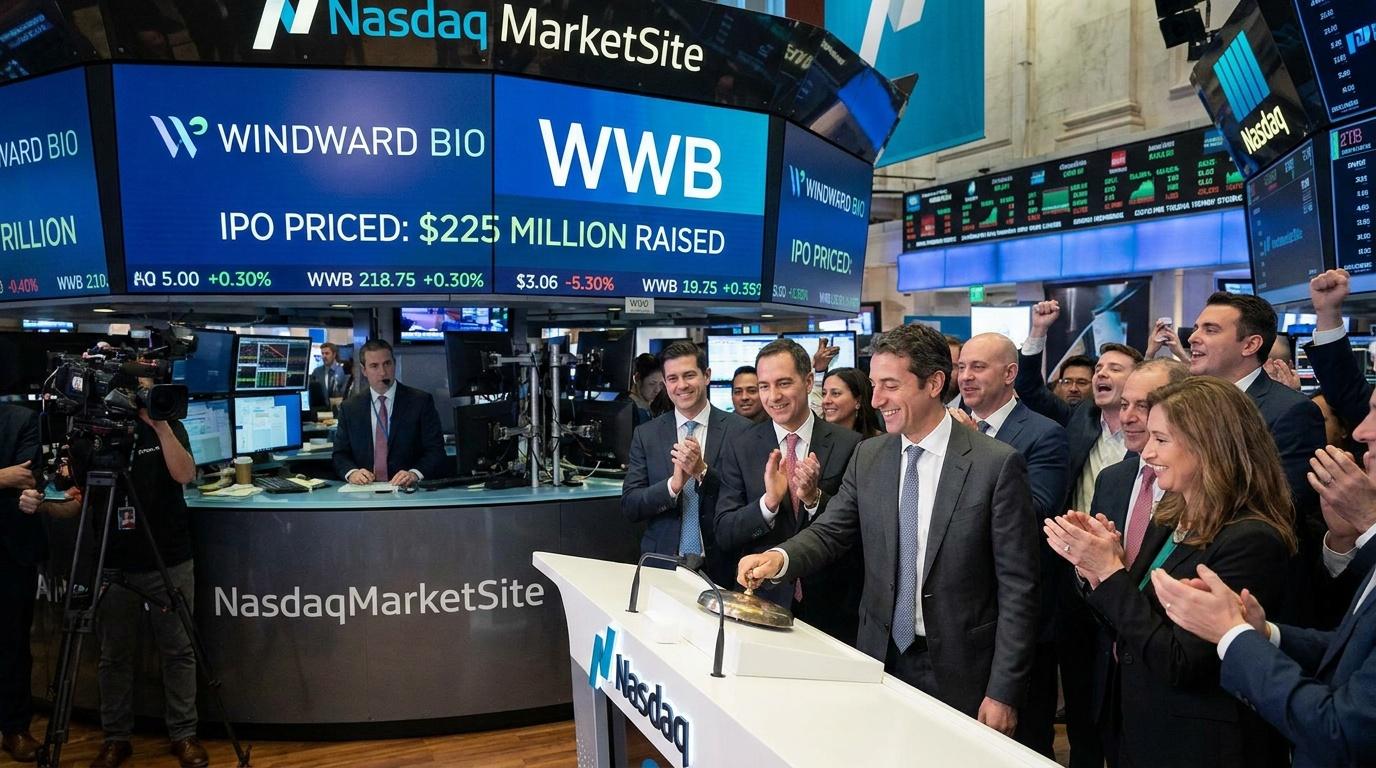
Windward Bio priced its IPO exactly at the range it had laid out earlier in the week, raising $225 million in gross proceeds by offering 10.3 million shares at $17 each. The stock is set to begin trading on the Nasdaq on Friday under the ticker symbol WWB, with underwriters holding an option to buy an additional 1.5 million shares at the same price, which could add around $26.2 million.
The immediate significance is less the mechanics of the listing than the use of proceeds. Windward is using public market capital to push forward a respiratory pipeline built around assets it licensed from China last year, at a time when investors are still selective about biotech financing. With $207.3 million already on hand at the end of June, a $200 million series A in 2025, a $165 million series B earlier this year and a separate agreement for Sanofi to purchase $50 million of stock in a private placement, the company has assembled unusually deep funding for a clinical-stage respiratory platform.
The Pipeline
Windward said its top spending priority is WIN378, an anti-human thymic stromal lymphopoietin monoclonal antibody acquired from Kelun-Biotech and Harbour BioMed in a $970 million biobucks deal last year. The company has already moved the candidate into a phase 2 trial in chronic obstructive pulmonary disease and a phase 2/3 trial in asthma.
Windward has estimated it will need up to $227.5 million to complete those studies and to start a phase 3 asthma trial in the first half of next year. That puts most of the IPO proceeds against one lead program, suggesting the listing is designed to fund execution rather than broaden the portfolio.
The second main asset is WIN027, which targets both TSLP and human interleukin-13. Windward said this dual targeting may have the potential to deliver deeper and more durable disease control than targeting either pathway alone. The company estimated earlier this week that it may need up to $85 million to run a planned phase 2b study of WIN027 in COPD and launch a phase 2 trial in atopic dermatitis. Windward licensed that IgG1 bispecific monoclonal antibody from Qyuns Therapeutics in a separate $700 million deal last year.
Between $5 million and $10 million may also go toward preclinical bispecific programs led by a next-generation candidate targeting both type 2 and non-type 2 inflammatory pathways.
The Competitive Setup
TSLP is already an active respiratory target rather than a blank-slate bet. Amgen and AstraZeneca entered the field in 2021 with the FDA approval of Tezspire as an add-on maintenance treatment for severe asthma. More recently, Upstream Bio reported Tezspire-like efficacy for verekitug in asthma, although a 24-week dose that would have been a more direct comparator for WIN378 fell short of expectations.
Other companies are also advancing anti-TSLP programs, including GSK, Teva and Blackstone-backed Uniquity Bio. On the bispecific side, Windward pointed to Sanofi’s TSLP and IL-13 inhibitor, which succeeded in two mid-stage respiratory studies earlier this year but missed in a phase 2 eczema trial.
That context matters for how to read the offering. Windward is not financing an untested target class; it is funding a differentiated-positioning strategy inside a validated one. The sharper commercial question is whether assets sourced from China and developed by a Swiss biotech can move fast enough in asthma and COPD to claim room in a field where mechanism validation already exists but competitive spacing is tightening.
Windward is led by CEO Luca Santarelli, who previously ran VectivBio and Therachon, both of which were acquired. This IPO gives him capital to test whether that operating history can translate into a respiratory company built through licensing rather than internal discovery.