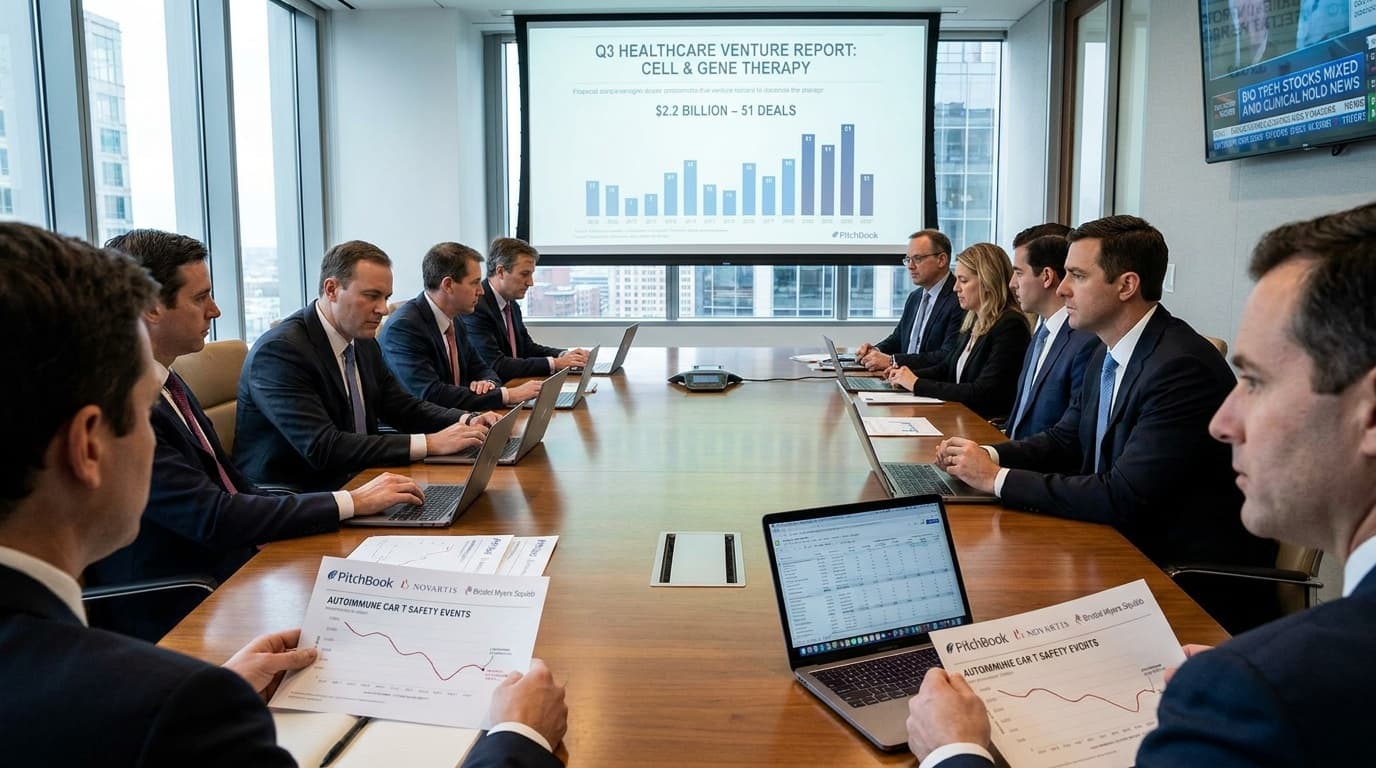
Cell and gene therapy attracted $2.2 billion in venture capital across 51 deals in the third quarter, according to PitchBook, placing the category behind small molecules at $3.2 billion and ahead of biologics at $1.5 billion.
That showing stands out because it arrived during a period when the cell therapy sector was dealing with multiple high-profile safety setbacks in autoimmune CAR T. PitchBook said this was only the second time since 2022 that cell and gene therapy had out-raised biologics, driven by both a jump in cell and gene therapy funding and a significant drop in biologics from second-quarter totals.
The funding signal
The headline for investors is that capital did not leave the modality wholesale. Recent clinical-trial deaths at Novartis and Bristol Myers Squibb created pressure around autoimmune CAR T, particularly because these programs are being tested in diseases that are generally less immediately lethal than cancer. Even so, venture investors continued to fund the category.
That points to a more selective read of risk: safety events may be hurting specific development paths, but they have not closed the door on cell therapy as an investment class.
What rattled the sector
In late August, Novartis paused a handful of clinical trials for rapcabtagene autoleucel after three deaths. Last month, Bristol Myers Squibb reported a death in a multiple sclerosis trial for zolacabtagene autoleucel, or zola-cel, after previously pausing certain zola-cel trials to investigate safety signals. The source report notes that the deaths occurred months earlier but were confirmed by the companies more recently.
At the same time, Caribou Biosciences suspended R&D activities. CEO Rachel Haurwitz described the backdrop as a challenging fundraising environment for allogeneic cell therapy. Caribou’s problems illustrate another split inside the sector: investor appetite appears weaker for some allogeneic approaches even while other cell therapy formats continue to draw money.
Where the money went
PitchBook highlighted Sail Biomedicines as the quarter’s leading financing. Johnson & Johnson struck a deal with Sail worth up to $925 million initially, including an equity purchase that led PitchBook to treat the transaction as venture capital because of JJDC’s involvement. Upfront payments totaled $785 million, including a $465 million equity investment, with another $140 million in development-based milestones on the back end. Johnson & Johnson also secured an exclusive option to buy Sail later for $2.58 billion. PitchBook said the August deal valued Sail at $2.8 billion.
Unlike Caribou’s allogeneic CAR T strategy, Sail is advancing in vivo CAR T therapies for immune-mediated conditions. Johnson & Johnson said in a September company presentation that it expects assets from the collaboration to reach the clinic this year.
Other financings PitchBook cited included BrainChild Bio’s $116 million series A, Link Cell Therapies’ $90 million raise, K2 Therapeutics’ $50 million seed round, and Cirrus Therapeutics’ $14.7 million seed round. BioSpace also noted that cell therapy activity continued into the fourth quarter, including Armed Cell Therapeutics emerging with assets acquired from Lakefront Biotherapeutics for just under $240 million in biobucks.