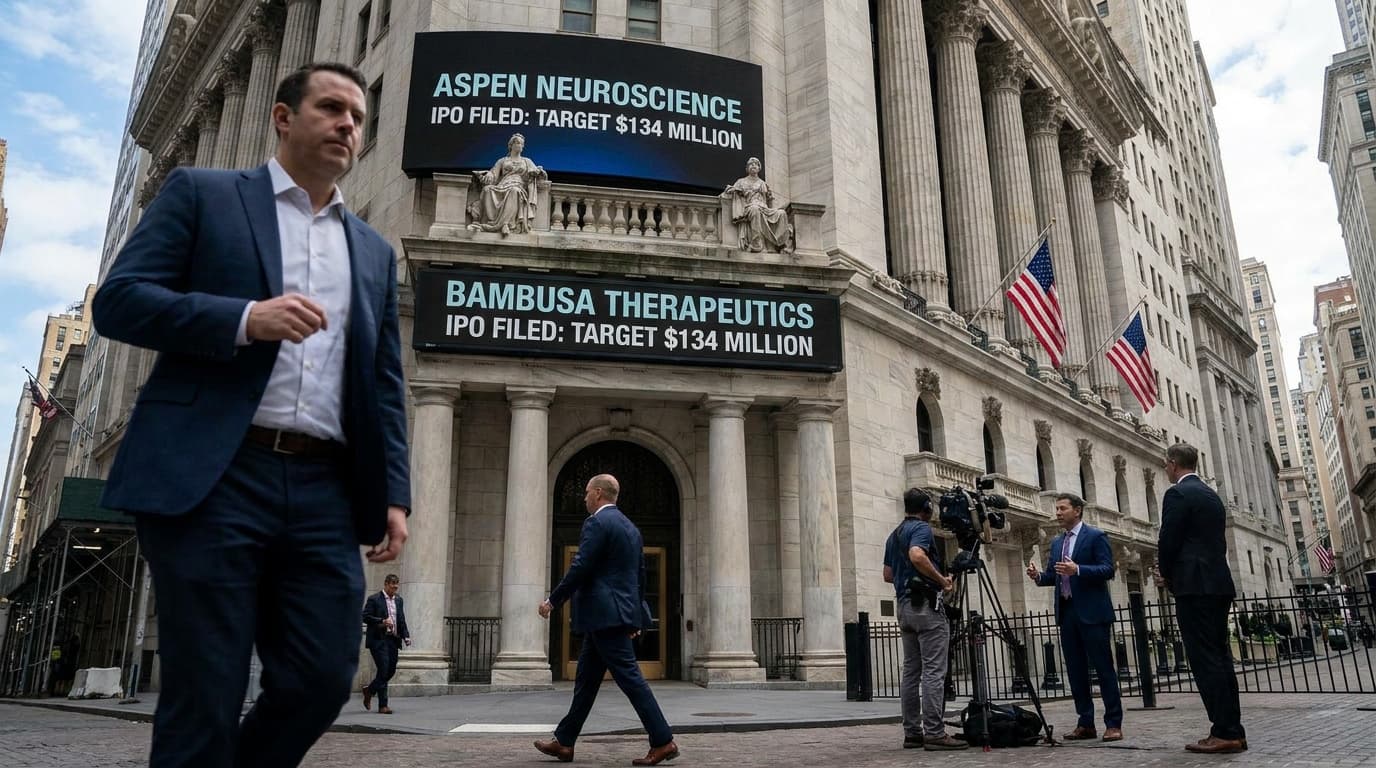
Aspen Neuroscience and Bambusa Therapeutics have each set terms for initial public offerings that aim to raise roughly the same amount: about $134 million in net proceeds if their shares price at the midpoint of a $15 to $17 range. Both companies said in Securities and Exchange Commission filings Monday that they plan to offer 9.4 million shares, with upside to about $155 million if underwriters exercise options to buy an additional 1.4 million shares at the same price.
The similarity in deal structure masks two different financing cases. Aspen is asking public investors to fund a late-stage push around an autologous Parkinson’s disease cell therapy after reporting phase 1/2a data, while Bambusa is presenting itself as a bispecific antibody company with one dermatology program and one respiratory program already in the clinic.
The Commercial Picture
Aspen said it expects $134.5 million in net proceeds at the midpoint, rising to $155.4 million if the underwriters’ option is exercised in full. Bambusa’s filing points to $134.9 million in net proceeds at the midpoint, or $155.8 million with the additional share purchase. The figures are close but not identical, so the cash outcomes should be read as company-specific estimates rather than a single shared benchmark.
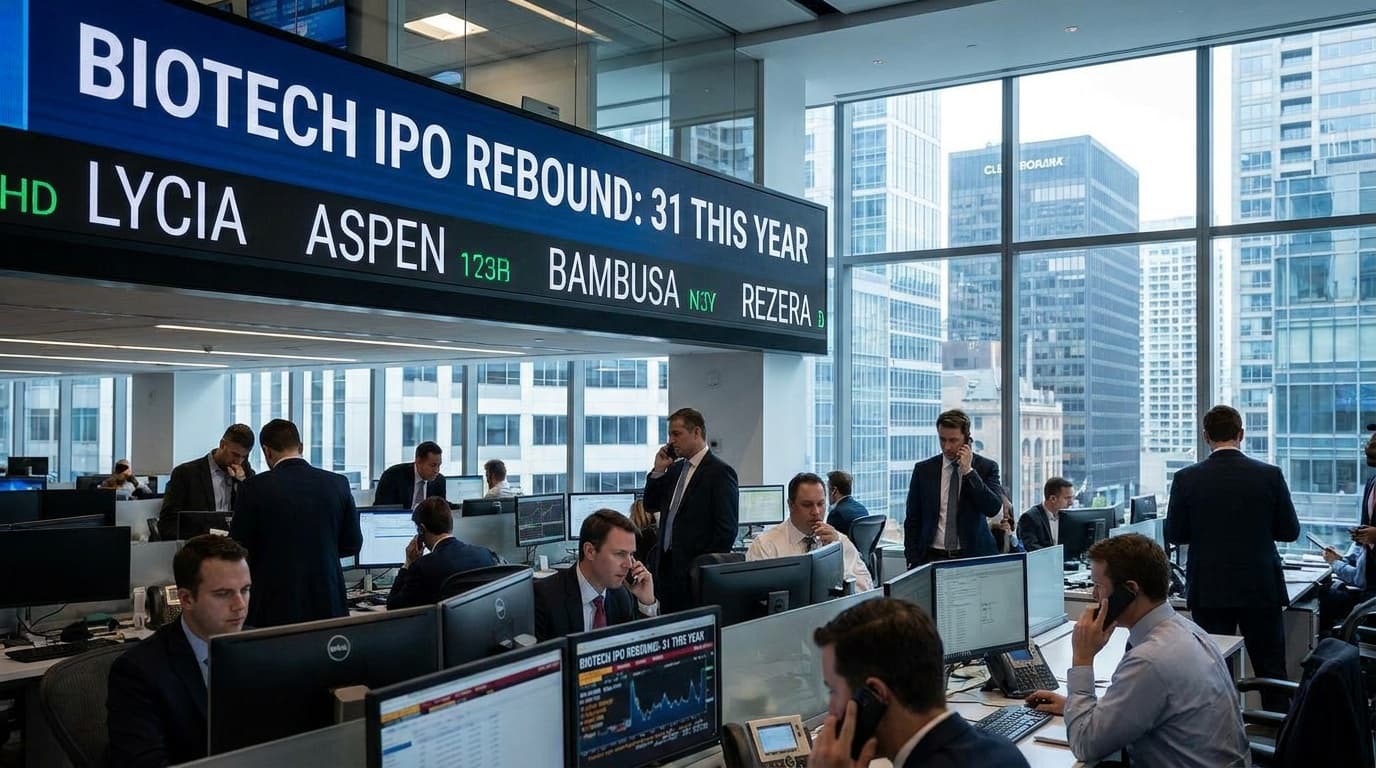
The offerings also arrive in a stronger issuance market than biotechs saw from 2022 through 2025. BioSpace, citing an October biopharma report from J.P. Morgan, said biopharma IPOs raised $7.5 billion across 22 offerings in the first three quarters of this year. BioSpace separately counted at least 31 biotechs that had gone public as of Oct. 26, including October debuts and non-U.S. IPOs. That momentum has come alongside stronger year-to-date biotech equity performance, although the same report said overall biotech indices were largely flat in the third quarter, suggesting the open window has not removed the need for a precise funding narrative.
The Road Here
Aspen’s lead asset, sasineprocel, is an autologous therapy designed to turn a patient’s skin cells into stem cells and then into new neurons for implantation into the brain. The company said about $8 million of the IPO funds is needed for an ongoing phase 1/2a trial in patients with sporadic and genetic Parkinson's, while $110 million would be set aside for a phase 3 program. Aspen also plans to spend $4 million on autologous microglia cell replacement therapies initially aimed at leukodystrophies, with a target of beginning human trials in the second half of 2027.
Founded in 2019, Aspen launched with $6.5 million, then raised a $70 million series A in 2020, a $147.5 million series B in 2022 and a $115 million series C in November 2025. As of the end of June, the company had 120 full-time employees and $72.4 million in the bank.
Bambusa plans to put around $90 million of its IPO haul toward a phase 2b study of BBT001 in atopic dermatitis. BBT001 is a long-acting bispecific antibody targeting interleukin-4 receptor alpha and IL-31. The company said the drug is already in a global phase 1 trial for atopic dermatitis and a phase 2 study in chronic spontaneous urticaria in China. In July, Bambusa cited preliminary phase 1 data from 17 patients showing that 82% of those who received BBT001 achieved more than 50% improvement in eczema area and severity by Week 6 when adjusted for placebo.
A further $40 million is slated for BBT002, a long-acting bispecific antibody targeting IL-4/13 and IL-5. Bambusa has already taken BBT002 into a global phase 1 study for chronic obstructive pulmonary disease, as well as a phase 1/2a and a phase 2a trial in China for chronic obstructive pulmonary disease and chronic rhinosinusitis with nasal polyps, respectively. The company’s next planned step is a phase 2b study in one of those respiratory indications. Bambusa had 30 full-time employees and $71.5 million on hand by the end of June.
What To Watch
The clearest signal from the paired filings is that the market is still willing to entertain development-stage biotech stories, but not on generic momentum alone. Aspen is trying to convert an individualized cell therapy platform into a registrational Parkinson’s program, a capital-intensive path that depends on execution deep into development. Bambusa is offering a more conventional antibody play, but one that still needs to translate early multi-indication activity into a clearer clinical and commercial winner.
In that sense, the matching IPO math matters less than the divergence in use of proceeds. Public investors are being asked to choose between financing a concentrated late-stage bet and a broader earlier-stage bispecific buildout at a moment when the IPO window is open, but less forgiving than earlier in the year.