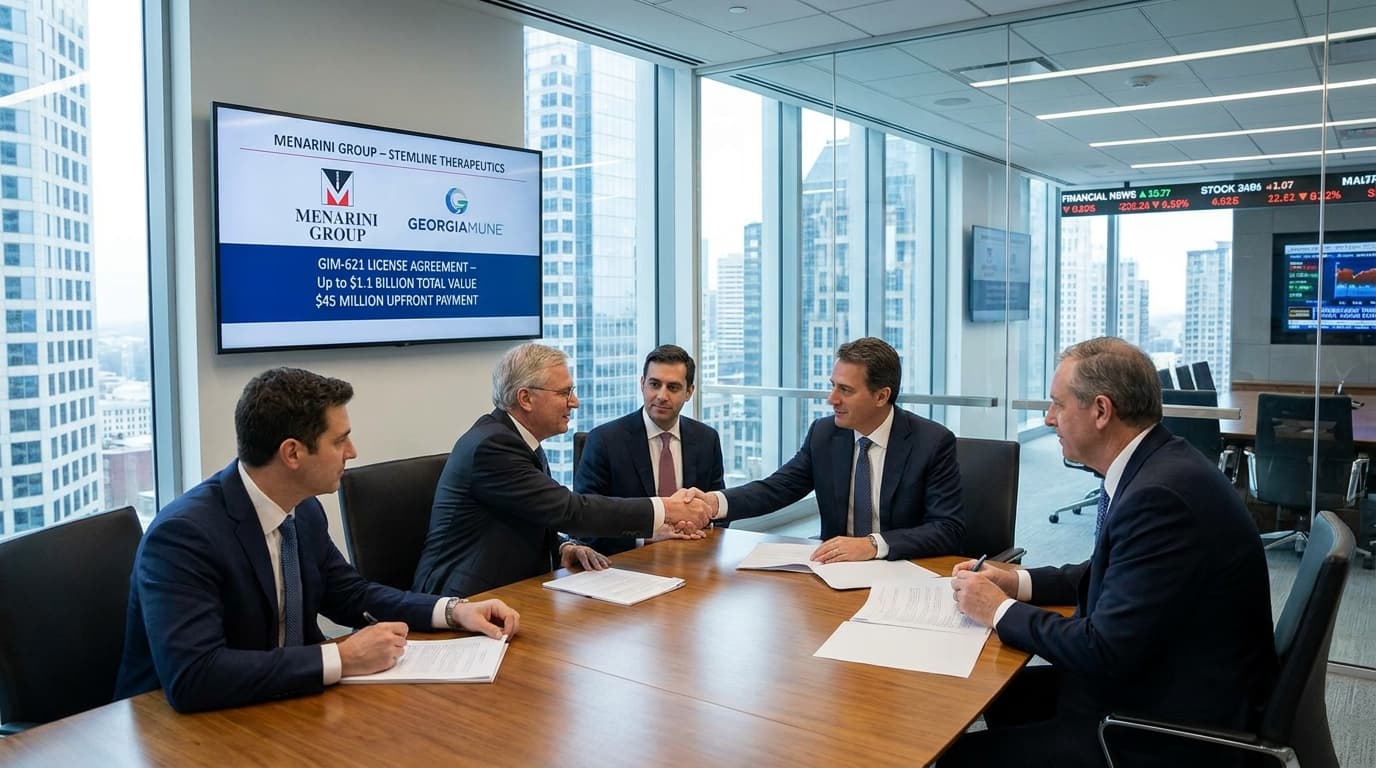
Menarini Group’s Stemline Therapeutics has added another external oncology asset, licensing Georgiamune’s preclinical candidate GIM-621 in a deal worth up to $1.1 billion. The agreement includes a $45 million upfront payment for exclusive worldwide rights to develop and commercialize the program.
Georgiamune described GIM-621 as a first-in-class oral small molecule immunotherapy for multiple solid tumors. For a preclinical asset, the headline value is large, but the structure follows a familiar pattern in which a modest upfront secures optionality while most of the economics depend on future development and commercial progress.
The deal logic
Georgiamune CEO Samir Khleif said the transaction gives GIM-621 access to Menarini’s global development and commercial support while allowing Georgiamune to keep its focus on the rest of its immunotherapy pipeline. That remaining pipeline includes three first-in-class clinical programs in early stages: the dual-functioning monoclonal antibody GIM-122 and the small-molecule Treg inhibitor GIM-531 for solid tumors, plus GIM-407, a Treg activator for autoimmune conditions including inflammatory bowel disease, systemic lupus erythematosus, type 1 diabetes mellitus and celiac disease.
The company also raised a $93 million series B round last month. Taken together, the financing and this licensing deal suggest Georgiamune is trying to fund a broader platform by selectively partnering assets rather than carrying every program forward on its own balance sheet.
Why it matters for buyers
For Menarini and Stemline, the transaction extends a business development strategy that has leaned on licensing to widen the oncology pipeline. Stemline already has three approved drugs on the market for breast cancer, multiple myeloma and a rare blood cancer, and GIM-621 adds another solid-tumor program across a portfolio that spans multiple development stages.
Menarini and Stemline have used similar structures before, including an up-to $550 million agreement with Insilico Medicine last year after another deal with the same company the year before. The signal is less about this one molecule alone than about continued demand for earlier oncology assets that can slot into an existing development and commercial organization.
Menarini Group CEO Elcin Barker Ergun said GIM-621 is a strong complement to the company’s solid tumor portfolio. The strategic read is straightforward: established oncology companies are still willing to pay for preclinical entry points when they see room to accelerate them internally, even if most of the dollar value remains back-ended and contingent.