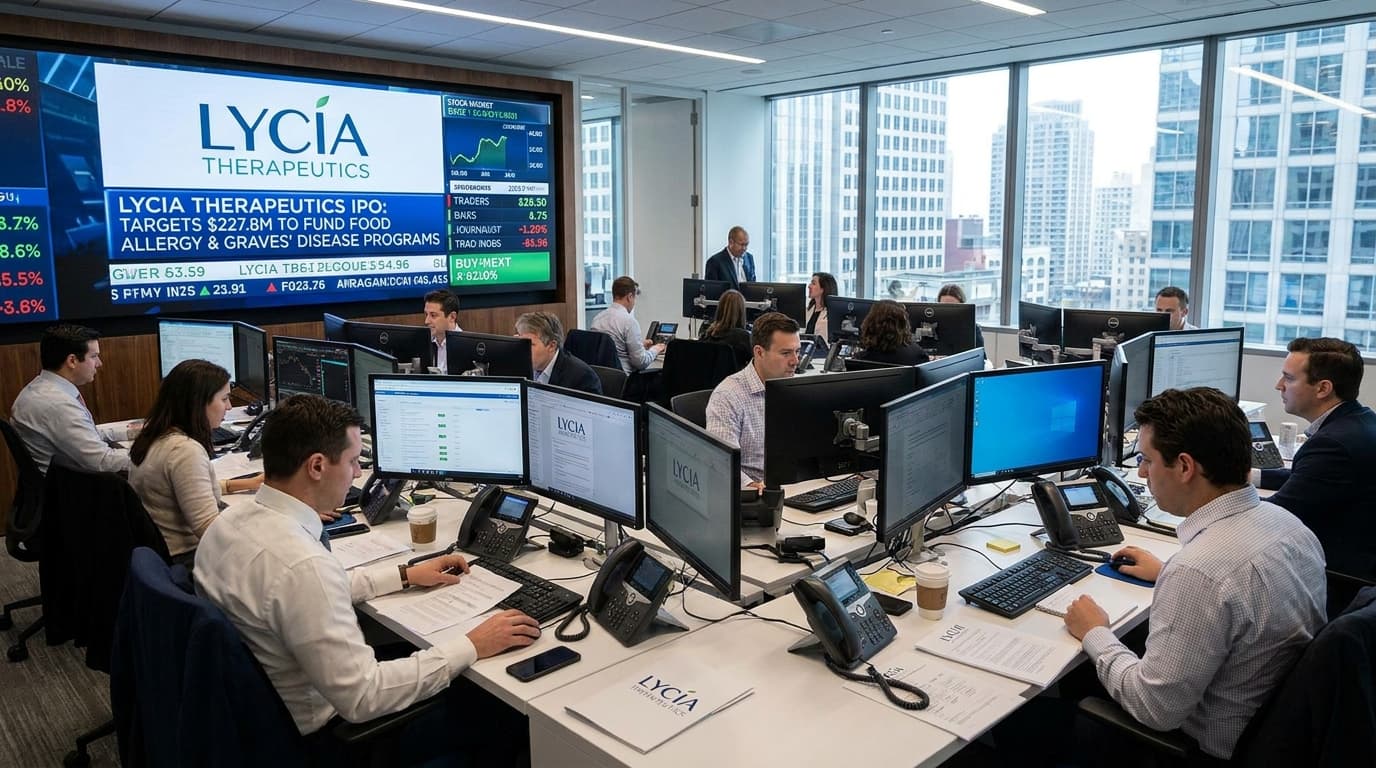
Lycia Therapeutics has set terms for an initial public offering that it says could generate $227.8 million in net proceeds, assuming its shares price at the midpoint of a proposed $16 to $18 range. The South San Francisco-based company plans to sell 14.7 million shares, with potential net proceeds rising to $262.7 million if underwriters exercise an option to buy an additional 2.2 million shares at the same price.
The financing case is straightforward: Lycia is asking public investors to fund a defined set of clinical milestones across autoimmune, inflammatory and allergic diseases. Rather than presenting the IPO as general balance-sheet support, the company tied most of the expected proceeds to three named programs, giving investors a clearer view of what the raise is meant to buy.
Use Of Proceeds
Lycia said it expects to need around $80 million to take lead asset LCA-0061 through a phase 2 study. The candidate is a catalytic lysosomal targeting chimera, or cataLYTAC, degrader designed to deplete immunoglobulin E, or IgE, for food allergy and other allergic diseases.
A further $70 million is earmarked for LCA-0062, which Lycia described as a “fast follower” cataLYTAC degrader headed into its own phase 2 study for food allergy. The company said LCA-0062 may offer “additional flexibility in dosing and duration of response” relative to LCA-0061.
Beyond allergy, Lycia said it needs $90 million for a mid-stage study of LCA-0321 in Graves’ disease. That program is a LYTAC degrader designed to selectively degrade TRAbs, which the company described as the pathogenic drivers of Graves’ disease.
The Strategic Pitch
In its filing, Lycia framed its food allergy opportunity against IgE blockers such as Novartis and Genentech’s Xolair. The company argued that those therapies have benefited patients with food allergy but remain constrained by weight-based and often cumbersome dosing schedules, as well as limitations in patients with high circulating IgE levels.
Lycia’s sharper claim is mechanistic. It said Xolair and similar drugs inhibit IgE rather than removing it entirely, while LCA-0061 is designed with an aim to eliminate total and free IgE by targeting extracellular IgE for lysosomal degradation. Preliminary data from an ongoing phase 1 trial, according to Lycia, showed rapid, deep and sustained reduction in total and free IgE, with no safety signals or dose-limiting toxicities observed.
That makes this IPO more than a funding event. It is also an attempt to finance a differentiated biological thesis in a setting where an established class already exists. If public investors support the raise, they are effectively backing Lycia’s argument that degrading IgE could produce a more usable profile than blocking it.
Capital Position
Lycia launched with $50 million in 2020 and later raised a $70 million series B in 2021, a $106.6 million series C in 2024 and a $75 million fundraise in June. The company entered the second half of this year with $148.1 million in cash.
The company had 31 full-time employees, led by CEO Aetna Wun Trombley, Ph.D., who previously served as chief operating officer of NGM Biopharmaceuticals. With that existing cash base, the IPO looks less like emergency financing than an effort to secure enough capital to push several internal programs through the same development band at once.