European biotech executives are not aligned on whether the U.S. or China will dominate future innovation partnerships, but they are far more consistent on what is holding Europe back now: capital.
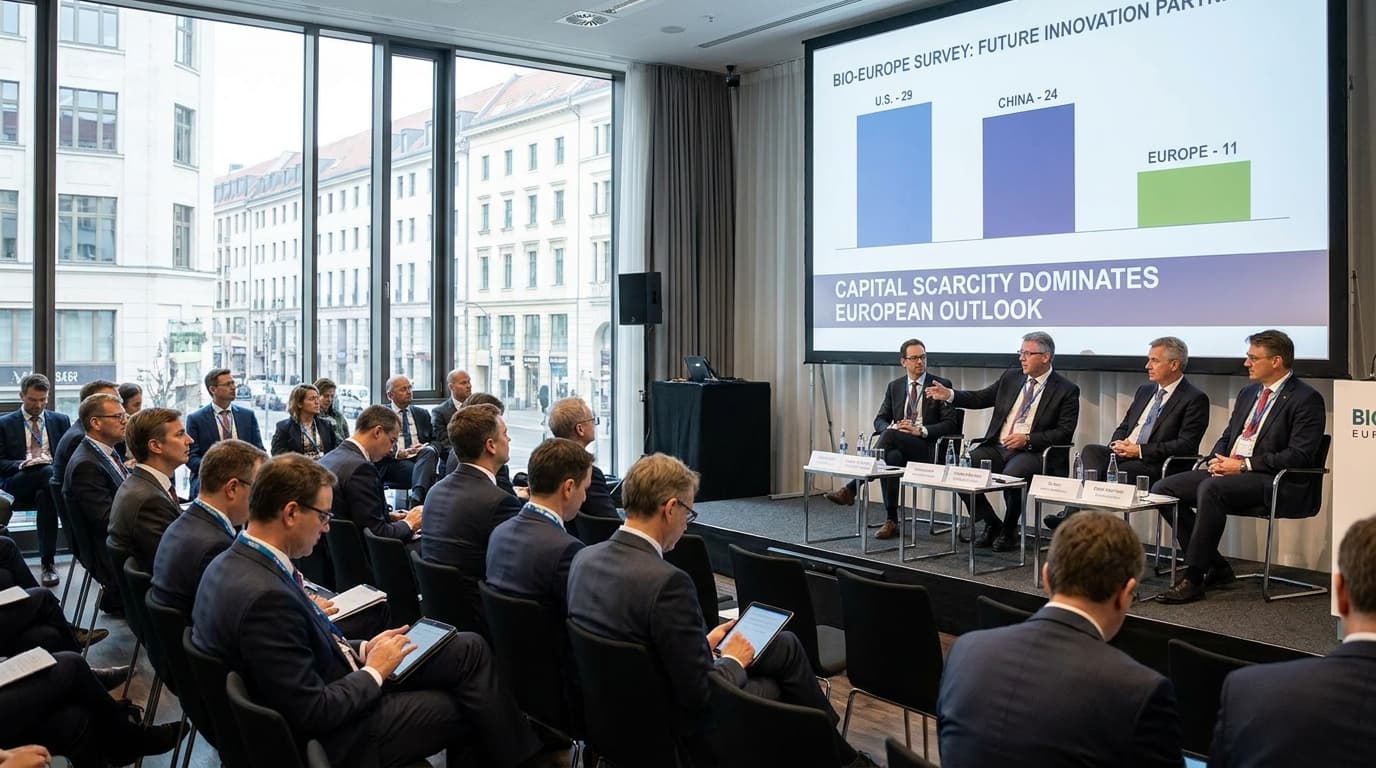
A BIO-Europe survey published Oct. 7 drew 81 responses, mainly from leaders of European, privately-owned biotechs with preclinical and early clinical assets. Asked which geography will be the most important source of future partnerships, 29 picked the U.S. and 24 picked China. Another 12 predicted there will be no clear leader. Europe trailed well behind, with just 11 respondents choosing the region.
Europe’s Problem Looks Financial, Not Conceptual
The survey suggests European executives see partnership gravity forming elsewhere even though about half believe policy and regulatory uncertainty in the U.S. has made Europe more attractive for building companies and doing deals. That apparent opening has not translated into confidence in Europe as a leading hub.
When respondents ranked Europe’s competitiveness today as a partnering and dealmaking center on a scale from one to five, the region scored 2.8, which the report’s authors called “middling.” That result fits with the survey’s other answers: executives are not mainly describing a shortage of opportunities, but a shortage of funding conditions strong enough to convert those opportunities into transactions.
Asked for the single biggest barrier to getting deals done in Europe, 34 respondents chose the availability of capital. The next most common answers were a valuation gap between buyers and sellers, cited by 13 respondents, and competition from Chinese assets, cited by 12.
The Signal In The Capital Answers
The same theme appeared when executives were asked what one industry challenge they would solve tomorrow. Access to capital was again the dominant answer, selected by 42 respondents. Clinical trial efficiency came next with 11 responses, followed by regulatory complexity with 8.
Respondents were similarly consistent about why capital is scarce. Almost 80% said risk aversion among investors is the biggest constraint on biotech investment today. The next most common answer, geopolitical uncertainty, was cited by 7%.
That pattern matters because it shifts the interpretation of Europe’s position. If executives believed regulation or trial operations were the principal obstacle, reforms in process could materially change competitiveness. Instead, the survey points to investor behavior as the bigger choke point. In that framing, Europe may be more stable than the U.S. in some respects, but it still lacks the financing depth needed to turn that stability into partnering leadership.
The report’s findings also line up with other regional assessments. Last year, the BioIndustry Association said that “U.K. investors do not want to invest in U.K. life sciences,” attributing the problem to the “widely acknowledged” risk aversion of U.K. investors.
The strategic takeaway is that Europe’s biotech challenge is not simply whether it can compete with the U.S. or China for innovation. It is whether it can build enough local risk tolerance to keep assets, negotiating leverage and future partnerships from migrating to markets where capital is easier to access.