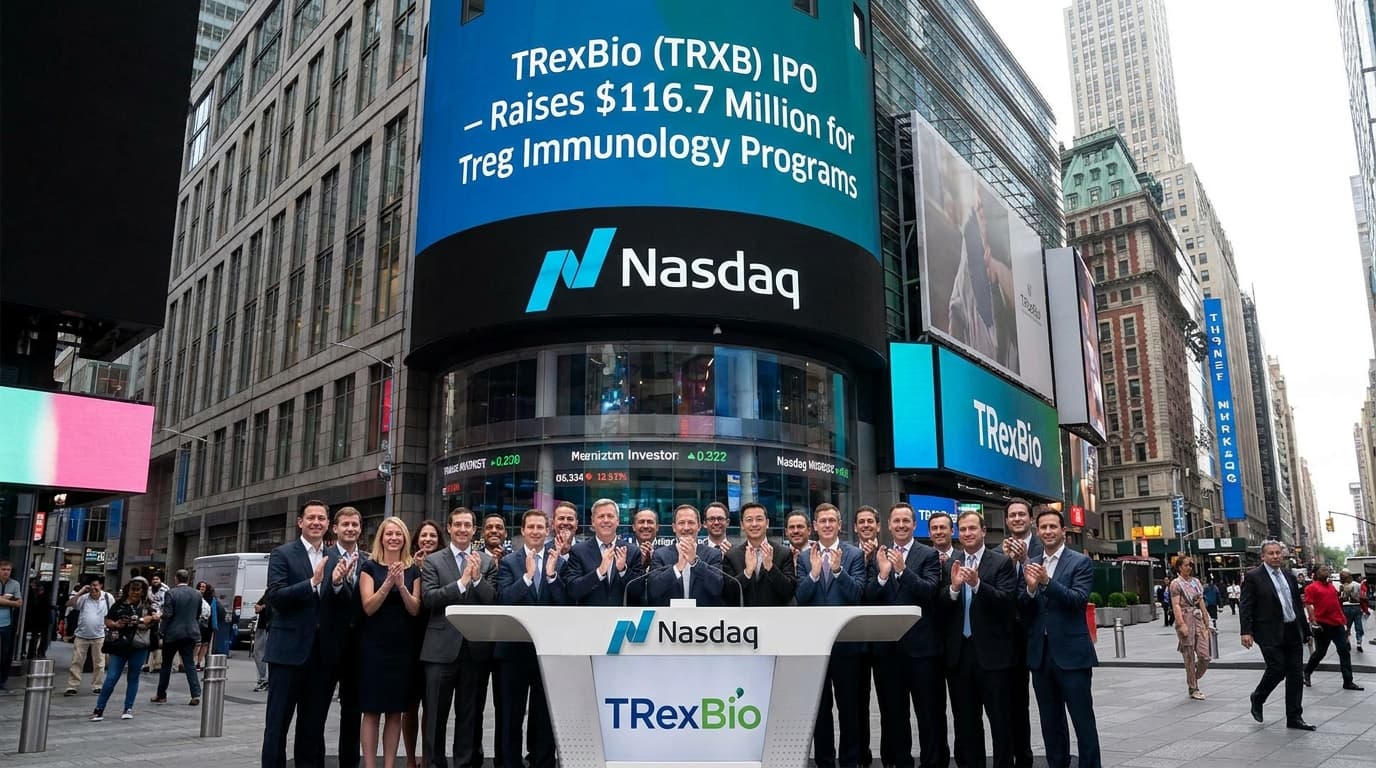
TRexBio has added $116.7 million in IPO gross proceeds to a balance sheet that already held $90.9 million at the end of the second quarter of this year, giving the South San Francisco company new capital to push its wholly owned autoimmune pipeline deeper into the clinic. The shares were priced at $14, the low end of the preliminary $14-to-$16 range, and began trading on Nasdaq under the symbol TRXB.
The financing matters less as a general reopening signal for biotech listings than as a read on what public investors will still back: platform companies that can connect a differentiated biological thesis to near-term clinical milestones. TRex is selling a specific view of immunology, arguing that activating regulatory T cells already present in diseased tissue could be a more scalable route than building Treg cell therapies through patient or donor cell processing.
The platform bet
TRex focuses on regulatory T cells, or Tregs, which counter excessive immune responses and help prevent the immune system from attacking healthy tissue. Rather than working directly with harvested or engineered Tregs, the company is developing fusion proteins intended to activate and expand Tregs in inflamed tissue while, it says, avoiding activation of proinflammatory immune cells.
That distinction is central to the commercial case. TRex argues in its IPO filing that the complexity, cost, and manufacturing time associated with Treg cell therapies are likely to limit their use in large autoimmune disease populations. Its approach is based instead on drug candidates discovered through a platform that analyzes a database of healthy and diseased tissue samples to identify targets tied to tissue immune homeostasis.
The pipeline and use of proceeds
The most advanced wholly owned asset is TRB-061, a tumor necrosis factor receptor 2, or TNFR2, agonist designed to expand and activate Tregs in inflamed tissues. In August, the company reported Phase 1a results showing activation and expansion of Tregs in the tissue of healthy volunteers. TRB-061 was also well tolerated, and no serious adverse events were reported.
Those data supported dose selection for a Phase 1b study in patients with moderate-to-severe atopic dermatitis, with preliminary data expected in mid-2027. TRex also identified alopecia areata as a priority indication, citing published studies supporting a role for Tregs in mediating the hair follicle cycle and hair regrowth.
TRex said it plans to spend about $90 million to bring TRB-061 through a topline Phase 2 readout in atopic dermatitis and alopecia areata. A second candidate, TRB-071, is a CD30 agonist designed to augment tissue Tregs and block inflammatory signaling. The company plans to start a Phase 1 test in the first half of next year and expects to use about $10 million to start and complete that study in healthy volunteers. In its filing, TRex linked CD30 biology to inflammatory bowel disease through genetic studies.
The road here
TRex was formed in 2018 and has raised about $220 million as a private company, including a $50 million financing early this year. Eli Lilly participated in its Series A in 2021 and later paid $55 million up front to start a research collaboration. That work produced TRB-051, which is designed to modulate immune effector cells. In June, TRex said Lilly plans to advance TRB-051 into Phase 2a testing in lupus with cutaneous involvement.
The Lilly relationship adds validation, but it also highlights where the value split sits. TRex's partnered program may move faster because Lilly is carrying it forward, while the IPO proceeds are aimed at proving the company can create stand-alone clinical and economic value from assets it fully controls. Lilly remains TRex's largest shareholder with a 16.8% post-IPO stake, and TRex said Lilly has expressed interest in buying additional shares at the IPO price up to 19.9% of the company, though there is no binding commitment.
The cap table also reflects a more mixed partnering history. A 2021 collaboration agreement with a Johnson & Johnson affiliate was terminated last year, according to the filing, even as Johnson & Johnson Innovation–JJDC retained a 4.6% post-IPO stake.
For now, the central test is whether TRB-061 can translate its early tissue-Treg biology into patient benefit in common inflammatory disease settings. If it can, TRex will have done more than complete an IPO in a receptive market window; it will have given investors a cleaner proof point that a drug-like Treg strategy can compete with more operationally complex cell therapy approaches.