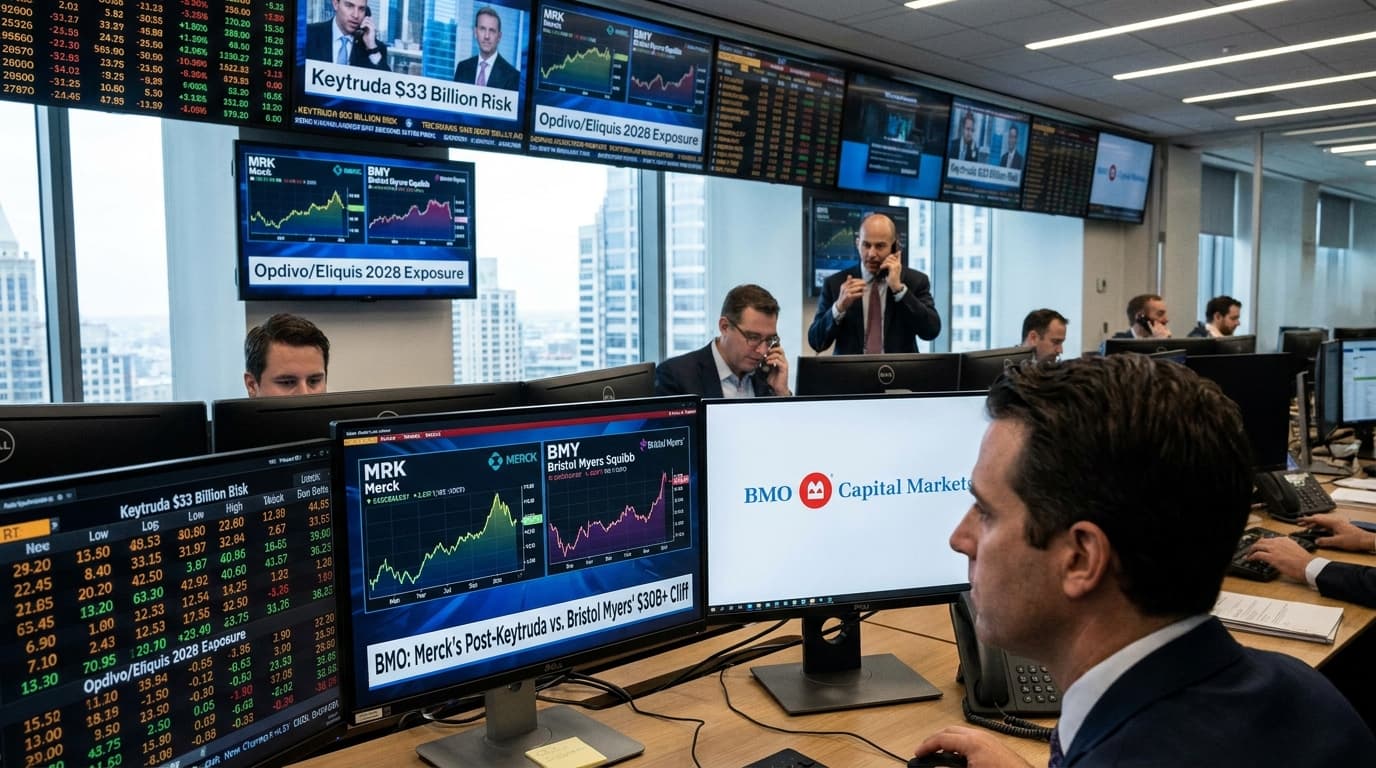
Merck and Bristol Myers Squibb are both heading toward major 2028 patent cliffs tied to PD-1 franchises, but BMO Capital Markets sees a widening gap in how prepared they are for the revenue reset. In BioSpace-reported comments, BMO managing director, head of healthcare research and senior biopharma analyst Evan Seigerman said Merck has done a better job putting sufficiently large, derisked growth products in place before erosion begins.
That call is notable because Merck is also facing the larger single-asset problem. BMO’s Sept. 9 report says Keytruda’s loss of exclusivity begins at the end of 2028 and puts $33 billion in revenue at risk. Even so, Merck has become BMO’s most favored name in its pharma coverage, with shares up 43% since the beginning of the year as of Sept. 9, making it the largest gainer in the firm’s large pharma group.
Merck’s Replacement Assets
Seigerman pointed to three of Merck’s strongest growth products: the Moderna-partnered mRNA cancer vaccine intismeran autogene, the high blood pressure medicine Winrevair and the TROP2 antibody drug conjugate sac-TMT.
For BMO, the importance of that mix is not just that each asset is large, but that they spread the replacement burden across different modalities and disease areas. The recent success of intismeran autogene, Seigerman said, demonstrates additional opportunity for oncology expansion. Winrevair has shown continued commercial strength, and BMO is modeling $9.1 billion in peak sales.
Sac-TMT appears to be moving from optionality to a more central role in the Keytruda replacement case. According to BMO’s report, the late-stage asset, discovered by China’s Kelun-Biotech, is becoming an increasingly meaningful part of the solution. Recently, sac-TMT improved progression-free survival compared to a Keytruda and chemotherapy combination in the Phase 3 OptiTROP-Lung06 trial. BMO projects peak sales of $4.3 billion for sac-TMT. The asset has also secured breakthrough status and a Commissioner’s National Priority Voucher from the FDA.
Seigerman also highlighted tulisokibart, Merck’s anti-TL1A antibody gained through the company’s $10.8 billion acquisition of Prometheus Biosciences in 2023. This week, Merck reported data from a mid-stage win in hidradenitis suppurativa that BMO said could help the drug carve out a place in a market that already includes AbbVie’s Humira and UCB’s Bimzelx. Seigerman’s read is that Merck now has a credible entry into immunology and inflammation in addition to its oncology depth.
Bristol Myers’ Narrower Path
Bristol Myers faces a different kind of cliff: smaller than Merck’s in any single product, but broader in total. Seigerman said Opdivo’s loss of exclusivity will also begin in 2028, and he put that exposure at $16-plus billion. Alongside that, Bristol Myers must contend with the 2028 patent loss of Pfizer-partnered blood thinner Eliquis.
BMO’s report calls this the greatest combined exposure among the companies it covers. Last year, Eliquis generated $14.4 billion in global sales and Opdivo brought in $10 billion in worldwide revenue. Together, the two products accounted for roughly half of Bristol Myers’ $48.2 billion revenue.
That concentration leaves less room for execution misses in the pipeline. BMO wrote that the size of Eliquis and Opdivo means Bristol Myers still requires substantial growth from newer products to stabilize revenue later in the decade. Seigerman’s sharper concern is that the designated replacement assets are materially riskier than Merck’s current setup.
Cobenfy, Bristol Myers’ schizophrenia drug acquired in the company’s $14 billion Karuna Therapeutics deal in 2023, is central to that debate. Seigerman said it is not selling that well. Cobenfy recorded $155 million in sales for Bristol Myers in 2025, below some analysts’ predictions during the drug’s late-stage development. The company is expecting an Alzheimer’s disease psychosis readout in early 2027 after enrollment challenges delayed the program, but Seigerman described that indication as a risky, binary stock move for a large company. BMO believes success there could represent a $4.4 billion unadjusted peak revenue opportunity for the indication.
Milvexian is another key swing asset. The Johnson & Johnson-partnered investigational oral Factor XIa inhibitor has seen topline results in atrial fibrillation delayed, following the early discontinuation late last year of a separate Phase 3 acute coronary syndrome trial. Seigerman said that if milvexian does not work, Bristol Myers could be back at the drawing board.
Admilparant adds further pressure rather than diversification. Earlier this week, reports circulated about several liver injuries, including one death, among patients receiving the late-stage pulmonary fibrosis candidate. Seigerman’s conclusion was that too much of Bristol Myers’ post-cliff plan now rests on three assets.
The investment signal in BMO’s comparison is not that Merck has solved the Keytruda problem. It is that the market may be rewarding companies that enter the patent-cliff period with multiple late-stage or commercial assets that are already partly validated, instead of relying on a small number of binary pipeline events to replace tens of billions of dollars in revenue.