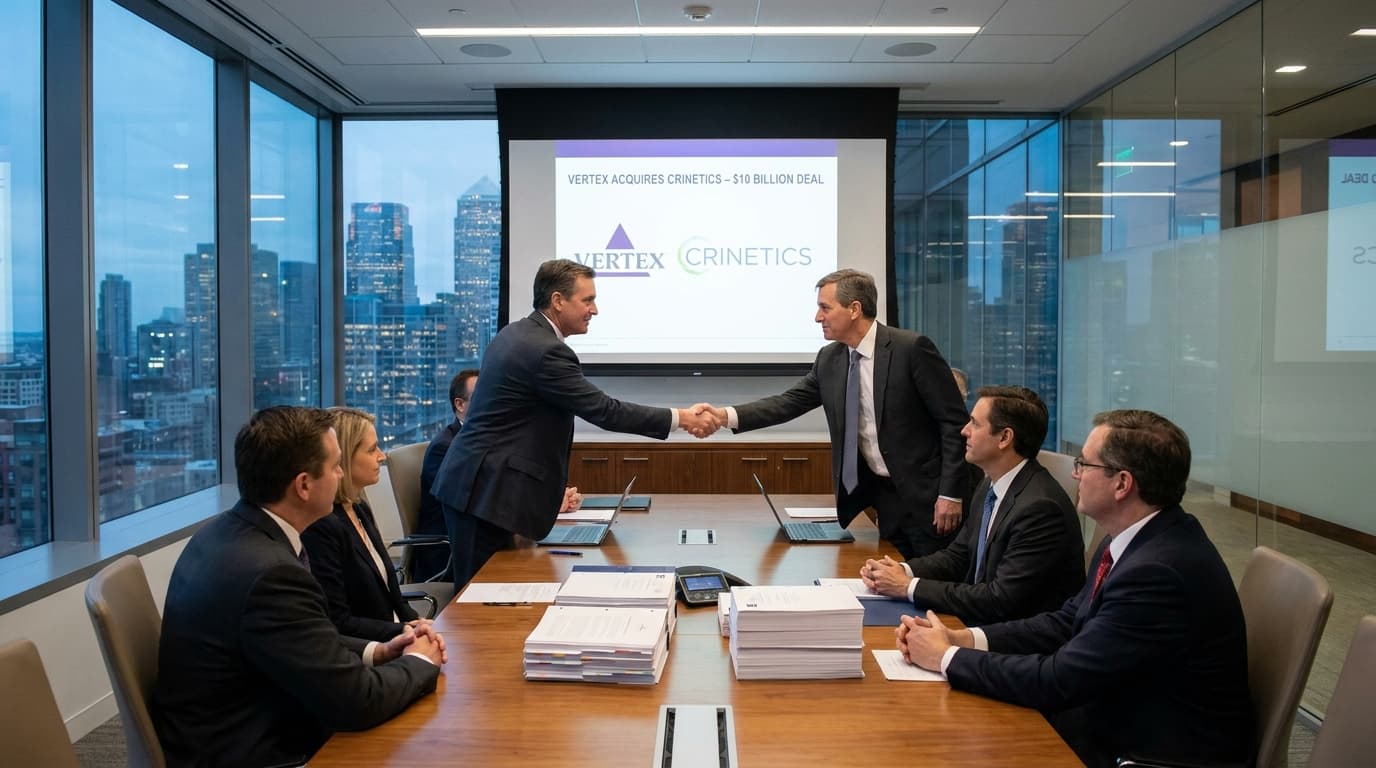
Vertex Pharmaceuticals landed one of the biggest biopharma acquisitions of the year with its July 6 purchase of Crinetics Pharmaceuticals, a deal the companies originally tallied at $10 billion. S&P Capital IQ valued the transaction at $8.8 billion when debt and other factors were included.
The size of the acquisition mattered even more because it came during a notably slower quarter for sector dealmaking. BioSpace reported that biopharmas spent just under $30 billion across 22 total transactions in Q3, down from $78 billion spent on 31 deals in Q2.
The Deal Context
For Vertex, the Crinetics transaction is notable not just for scale but for direction. The company, described as one that rarely buys, used the acquisition to move beyond its cystic fibrosis base and into the specialty endocrinology market. In a year when large-cap companies have still been willing to transact, that makes the deal read less like opportunistic balance-sheet deployment and more like a deliberate portfolio expansion into a new therapeutic area.
BioSpace said the acquisition ranked as the fourth biggest deal of the year so far. That standing helped offset an otherwise subdued quarter in which overall activity slowed toward the end of the period.
The Broader M&A Picture
Vertex may have posted the biggest Q3 spend, but Eli Lilly was the most active buyer in the quarter, striking two new deals and bringing its total for the year to 11 transactions worth a cumulative $31.7 billion, according to S&P Capital IQ. Lilly’s largest buy was Centessa Pharmaceuticals for $8.1 billion.
Tarsus Pharmaceuticals also made two acquisitions in Q3 to expand its eye disease pipeline, buying iRenix Medical for $567 million in July and Alkeus Pharmaceuticals in a deal valued at $800 million in August.
Year to date, the market has reached 74 deals and about $156.9 billion billion spent. The signal from the quarter is that capital is still available for strategic assets, but the pace has become more selective after Q2’s buying surge.