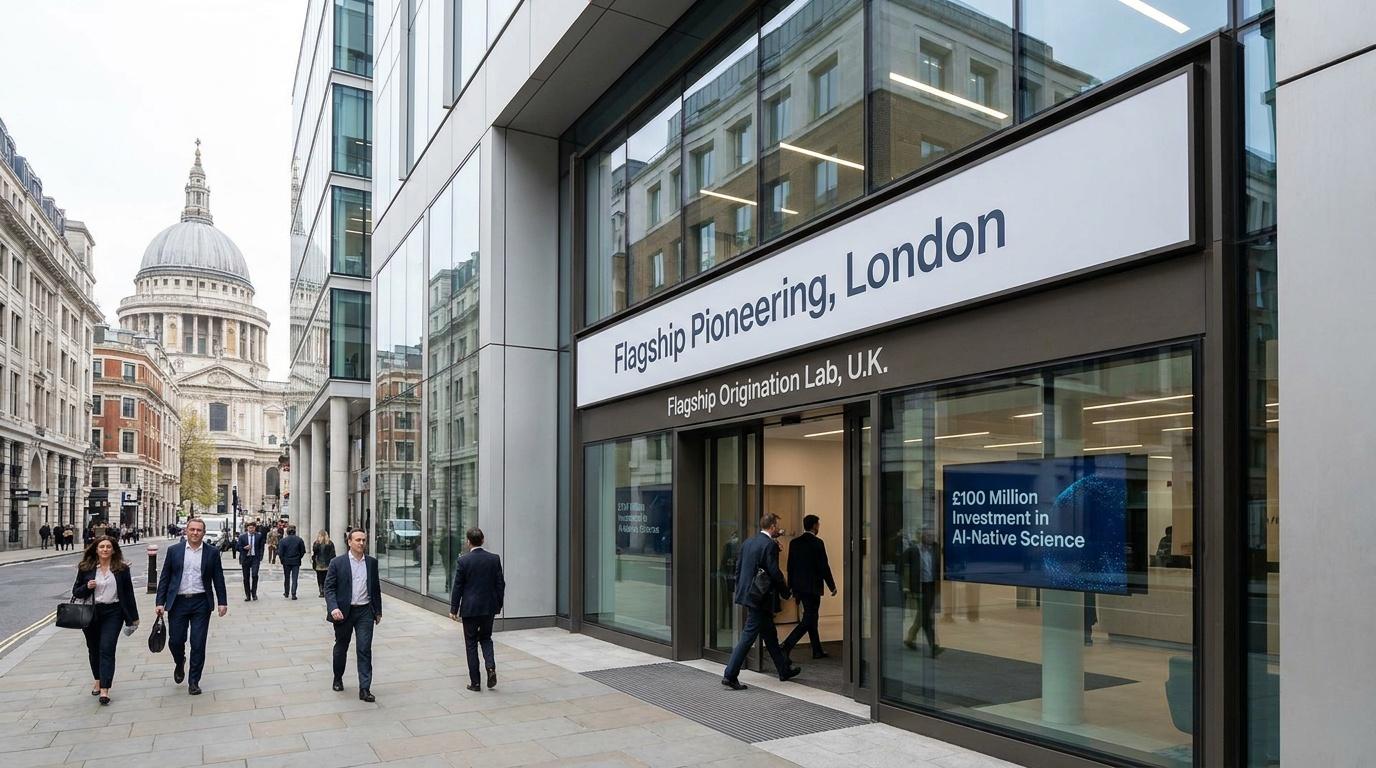
Flagship Pioneering has chosen London for the first expansion of its company-creation model outside its home base of Cambridge, Massachusetts, committing an initial £100 million to launch the Flagship Origination Lab, U.K. The firm said the unit will conceive, test, fund and build AI-native platform companies advancing human and planetary health and other frontiers of science and technology.
The lab is set to recruit and train an initial team of around 50 scientist-entrepreneurs and operators in the U.K. For Flagship, that makes the announcement more than a new office opening: it is the first time the firm has exported the model it used to originate more than 100 scientific ventures since 2000.
Why London
Flagship framed the London site as a locally rooted company-creation ecosystem connected to its broader network, including portfolio companies, its AI platform Pioneering Intelligence and its in-house drug discovery and development unit Pioneering Medicines. The choice reflects a strategy the firm had already signaled earlier this year, when founder and CEO Noubar Afeyan said Flagship was looking to expand its network in hubs with complementary talent, capital and partnerships, naming the U.K. and Asia Pacific.
The relationship with the U.K. did not start with this week's launch. Flagship said it signed a memorandum of understanding with the government in 2023, and Afeyan described the London lab as the start of a new chapter after three years of seeing what he called the country's scientific imagination, talent and ambition.
The Investment Signal
The initial £100 million matters partly because it arrives after a difficult stretch for U.K. life sciences R&D. Last year, AstraZeneca, Merck & Co., Eli Lilly and Sanofi reversed or paused R&D investments in the country over concerns about a medicine price reimbursement scheme. Fierce reported that amendments to those rules, along with a deal with the Trump administration, were enough to persuade AstraZeneca to unfreeze its investments earlier this year, while Merck, Sanofi and Lilly recently said their overall stance had not shifted.
Against that backdrop, Flagship's decision reads as a targeted bet on the U.K. as a company-formation market rather than only an R&D site. The firm said it anticipates scaling its commitment through partnership to attract an additional £500 million, which would test whether London can support not just individual biotechs but a repeatable venture creation engine built around AI-enabled scientific work.
The timing also aligns with a broader improvement in sentiment. Recent examples cited in the source include AbbVie's £120 million investment to expand its U.K. R&D presence and Moderna's move to a different London base. Flagship's entry adds a different kind of capital: earlier-stage formation capital tied to building new platforms from scratch.