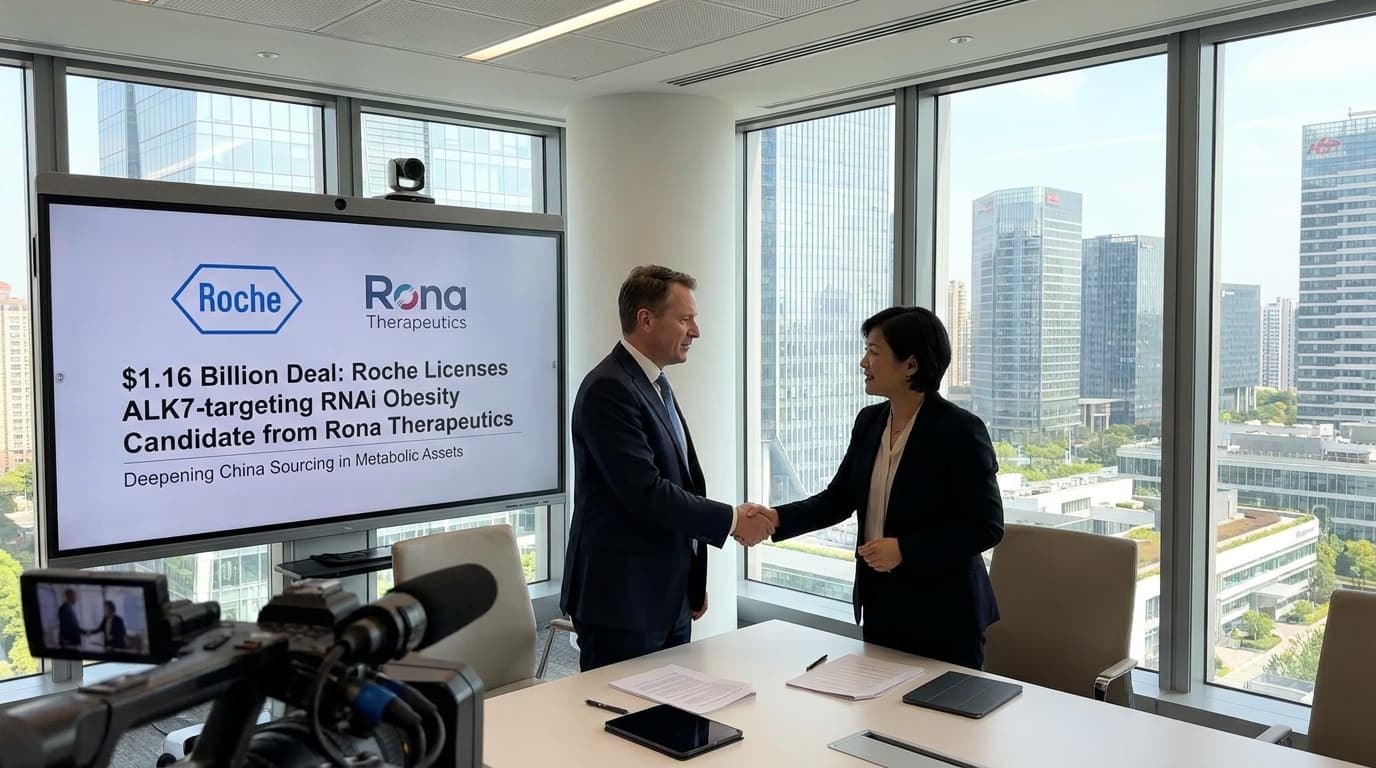
Roche has entered the emerging ALK7 obesity race by licensing an RNAi drug candidate from China-based Rona Therapeutics in a deal worth up to $1.16 billion plus tiered royalties. The agreement includes up to $100 million in upfront and near-term milestone payments and up to $1.06 billion in longer-term milestones.
Neither the codename of the licensed program nor its stage of development was disclosed. Roche did say the candidate uses Rona’s extrahepatic delivery platform, a detail that matters because ALK7 is expressed in adipose tissue and the commercial logic of the target depends on reaching biology outside the liver.
The Target And The Mechanism
ALK7 is a protein encoded by the ACVR1C gene and is preferentially expressed in adipose tissue, where it is involved in lipid metabolism. The source report says human genetic studies have linked ALK7 variants to reduced waist-to-hip ratios, and that inactivating ALK7 signaling makes mice resistant to obesity.
That biology has helped create a new development cluster around the target. In theory, ALK7-directed drugs could reduce fat deposits while preserving lean mass, and they may be used either as monotherapies or in combination with incretin mimetics such as GLP-1 receptor agonists. Rona CEO Stella Shi said the mechanism could improve the quality and durability of weight loss, framing the asset around differentiation rather than entry into a crowded incretin class.
The Competitive Picture
Roche is joining a field that already includes Alnylam, Arrowhead Pharmaceuticals, GSK and Novo. Arrowhead supplied some of the earliest human evidence in January, reporting a 14.1% placebo-adjusted reduction in visceral fat eight weeks after a single dose of its candidate. Alnylam began a clinical trial of its ALK7 candidate in March and said phase 1 data are on its readout roadmap for the second half of 2026.
The target is also attracting business-development money. GSK paid China’s SiranBio $55 million in May for a phase 1 ALK7 drug candidate, while Novo said at its investor day last month that it has “a number of assets” against ALK7 and that its most advanced candidate will enter the clinic this year.
For Roche, the Rona transaction extends a broader obesity strategy built through deals. The company entered the field through the $2.7 billion buyout of Carmot Therapeutics and later expanded its pipeline through agreements with Hanmi Pharm and Zealand Pharma. Fierce Biotech described Roche’s stated goal as becoming a “top three” obesity company.
The signal in the Rona deal is twofold. First, Roche is still willing to pay for mechanisms that promise a better quality-of-weight-loss story even before public-stage details are available. Second, China’s role here is not just low-cost sourcing; it is supplying novel platform-enabled assets in one of biopharma’s most commercially important categories. Even with limited disclosure on the specific candidate, the size of the milestone package shows Roche sees ALK7 as a meaningful option in the next wave beyond first-generation obesity therapies.