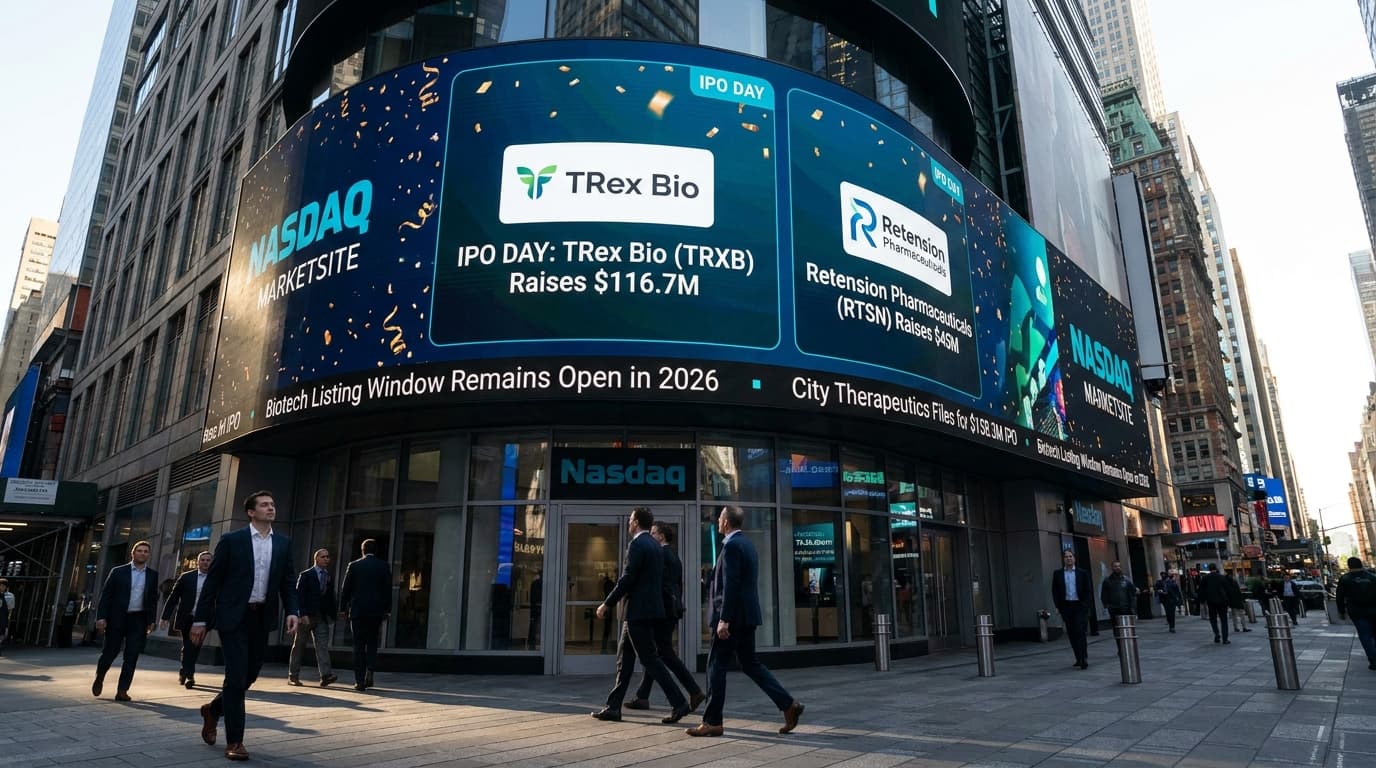
TRex Bio and Retension Pharmaceuticals both went public on the same morning, raising $116.7 million and $45 million in gross proceeds, respectively. Their offerings arrived alongside plans from RNA-focused City Therapeutics to pursue a $158.3 million listing, adding to a run of biotech IPO activity in 2026.
For investors, the detail that matters is not only that the window is open, but how these companies are getting through it. TRex priced its shares at $14, the bottom of its predicted $14 to $16 range, while still completing the expected 8.3 million-share offering. Retension, by contrast, increased its deal size to 3.8 million shares from the 3.3 million it had anticipated earlier in the week and priced at $12, the middle of its $11 to $13 range.
The offerings
TRex said its gross proceeds could rise by around $17.5 million if underwriters fully exercise their option to buy an additional 1.3 million shares at the same price. The company estimated earlier that, if the final price fell in the middle of the range, the IPO would bring $111.3 million in net proceeds, rising to $128.7 million if underwriters fully take up that option.
The South San Francisco-based company is due to list on the Nasdaq under the ticker TRXB. TRex first emerged in 2021 with a $59 million series A and has built its profile around a platform focused on modulating regulatory T cells, or Tregs, which play a key role in tissue inflammation.
Retension’s haul could rise by around $6.8 million if underwriters take up their option to buy an additional 562,500 shares at the same price. The company is set to list on the Nasdaq under the ticker RTSN.
The contrast between the two deals gives a clearer read on current biotech financing conditions than a simple count of IPOs. TRex, already backed by Eli Lilly and supported by multiple financings, was still priced at the low end. Retension exceeded its original expectations by selling more shares. That suggests public investors are still differentiating sharply by story and structure rather than rewarding the sector indiscriminately.
Where The Cash Is Going
TRex had around $91 million in the bank after an $84 million series B in 2024 and a $50 million financing at the start of this year. The company said earlier this week that it expects to spend $90 million to fund phase 2 trials for its tumor necrosis factor receptor 2 agonist TRB-061 in atopic dermatitis and to move the therapy into other autoimmune and inflammatory diseases, including alopecia areata. Topline data from an ongoing phase 1 trial in atopic dermatitis is due in mid-2027.
An additional $10 million is expected to go toward bringing CD30 agonist TRB-071 into the clinic in a phase 1 study of healthy volunteers. TRex said it hopes the program can address underlying immune dysregulation in immune-mediated diseases such as inflammatory bowel disease by triggering both the activation and expansion of Tregs.
Retension has said it expects to spend $18 million on completing a phase 2b study of RTN-001 in patients with uncontrolled hypertension and a further $10 million on a phase 3 study in uncontrolled hypertension. The once-daily, oral, small-molecule phosphodiesterase-5 inhibitor is being developed to reduce blood pressure by potentiating nitric oxide signalling.
Retension has argued that RTN-001 could differentiate itself from first-generation PDE-5 inhibitors such as Viagra, which never lived up to their early promise in blood pressure reduction, because the newer drug has been engineered for increased bioavailability and increased distribution to the muscular arteries. The company has previously said RTN-001 showed a clinically meaningful reduction in systolic and diastolic blood pressure in pilot phase 2 studies.
The Road Here
TRex’s financing history helps explain why its IPO looks more like a milestone extension than a rescue round. Eli Lilly paid $55 million in 2023 to take up its option to license an immune effector cell modulator that has since entered the clinic, and Lilly had already expressed an interest in participating in the IPO. TRex also has a collaboration signed with Johnson & Johnson a year after its launch. CEO Johnston Erwin, a long-time Lilly veteran, leads a workforce of 60 full-time employees.
City Therapeutics adds context for the broader market rather than for either issuer’s individual fundamentals. The company said in a Friday filing that it is aiming to raise $158.3 million by offering 9.7 million shares priced between $17 and $19 apiece, with proceeds potentially rising to $182.7 million if underwriters buy an additional 1.5 million shares at the same estimated price of $18. City said $30 million would fund CITY-FXI through an ongoing phase 1 study and into a mid-stage trial in patients who have undergone knee surgery, $20 million would support CITY-RBP4 through a phase 1 study and preparation for evaluation in Stargardt disease and geographic atrophy, and $40 million would support CITY-TFR2 ahead of a trial in China later this year.
The signal from the morning’s activity is that 2026’s IPO market is favoring issuers that can map proceeds to named programs, trial stages and spending buckets. Access to capital is available, but the terms suggest investors still want a concrete development plan more than a broad platform pitch.