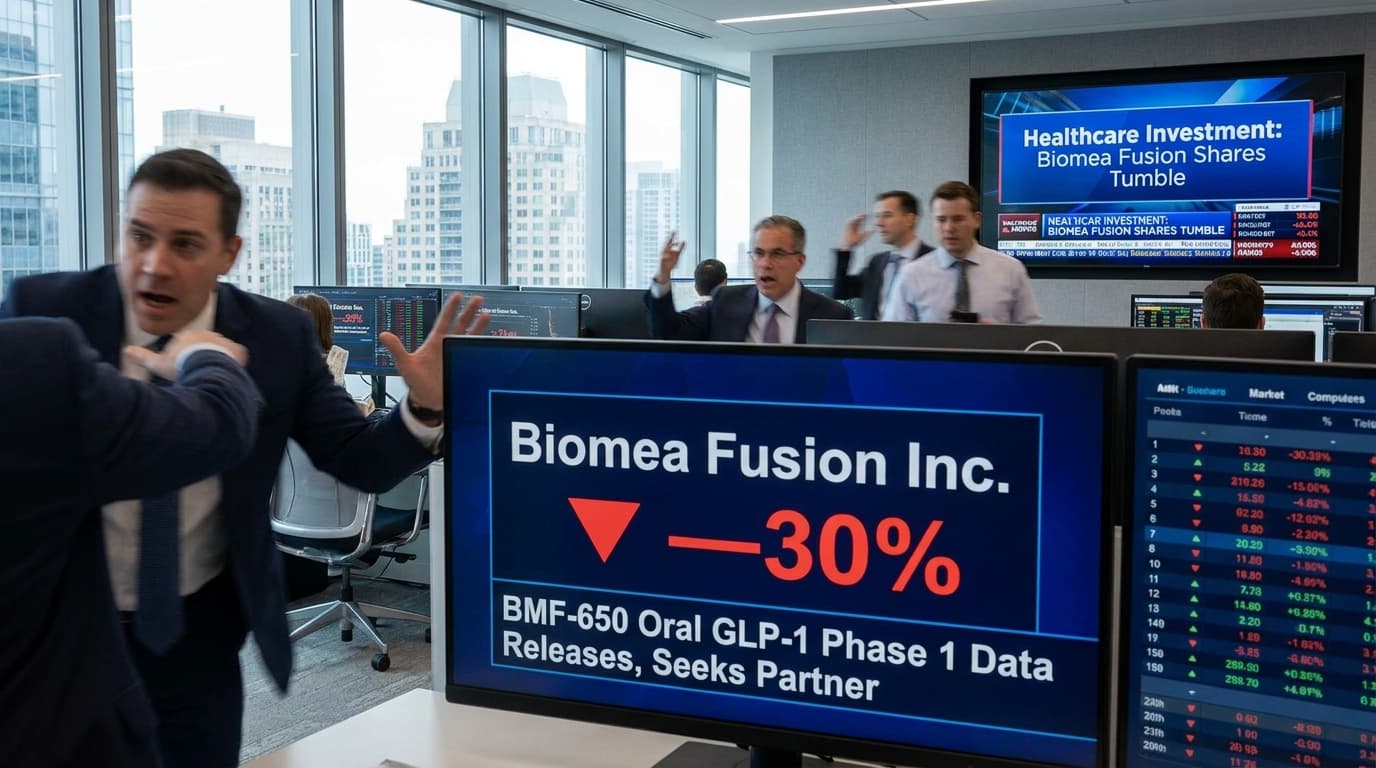
Biomea Fusion has released Phase 1 data on BMF-650, its oral small molecule GLP-1 receptor agonist, as management tries to interest potential partners in a program the company does not appear willing to finance on its own. The market response was negative: Biomea’s shares fell 30% to 87 cents in the opening hour of trading Wednesday from a Tuesday close of $1.26.
The early numbers help explain both parts of that story. Biomea is arguing that BMF-650 may offer a commercially useful balance between efficacy and gastrointestinal tolerability, particularly for people who want to switch from another drug without up-titration. But the weight-loss data so far are modest in a field where Eli Lilly’s Foundayo already reached the market in April, leaving little room for a me-too oral entrant unless it can prove a cleaner or more flexible profile.
The Data
Biomea linked BMF-650 to mean weight reductions of 1.5% to 3.2% across four cohorts at Day 29. In a fifth cohort treated under confinement, participants lost 6.1% of their weight by Day 29. That result came with an important caveat: the two placebo patients in the cohort experienced similar weight loss after consuming about one-third of the presented food.
Management did not present the moderate weight loss as a failure. Chief operating officer Ramses Erdtmann said on the investor call that the company’s goal was not to achieve maximum weight loss but to achieve good weight loss over time, while creating a compound that could be used as a switch option for patients unhappy with current therapy.
Biomea’s longer-term aspiration is more ambitious than the Phase 1 data alone suggest. Chief medical officer Juan Frías said BMF-650 can compete if it drives about 10% weight loss in longer trials, assuming it does so with a relatively benign gastrointestinal tolerability profile.
On tolerability, the company highlighted rates across 40 patients in the five cohorts of 17.5% for nausea, 10% for constipation, 7.5% for vomiting and 5% for diarrhea. Biomea compared those figures favorably with other oral GLP-1 drugs and said the rates of most gastrointestinal adverse events were among the lowest in the class.
The Commercial Picture
The strategic issue is that tolerability alone is not enough unless it opens a market segment that incumbents are not serving well. Lilly’s Foundayo gives Biomea a direct oral comparator with a major head start, so BMF-650 likely needs clearer differentiation than the current dataset provides.
Biomea’s own comments point to one possible path: positioning BMF-650 as an easier-to-use follow-on or switch therapy rather than as the strongest standalone weight-loss option. That is a narrower and more execution-dependent thesis than simply joining the oral GLP-1 race, and it requires data that clarify whether the compound’s efficacy can improve over time without sacrificing tolerability.
What To Watch
Biomea plans to limit future investment in the asset while doing enough work to increase its partnering value. Rather than advance BMF-650 independently into expensive obesity studies, the company wants to run longer-term toxicology work and potentially initiate cohort 6 with a larger placebo setting, outside confinement, and with another roughly 10 to 20 patients, potentially with a partner involved.
That capital discipline reflects Biomea’s balance sheet. The biotech ended June with $35.2 million and said that cash should fund operations into the second quarter of 2027. It also tried to raise money in September but abandoned the offering because of what it called current market conditions.
Taken together, the update reads less like the start of a self-funded obesity buildout and more like a data package assembled to support business development. The near-term question is not whether BMF-650 is ready for Phase 2 on Biomea’s own balance sheet, but whether the company can persuade a partner that a tolerability-first oral GLP-1 still has room in an increasingly crowded market.