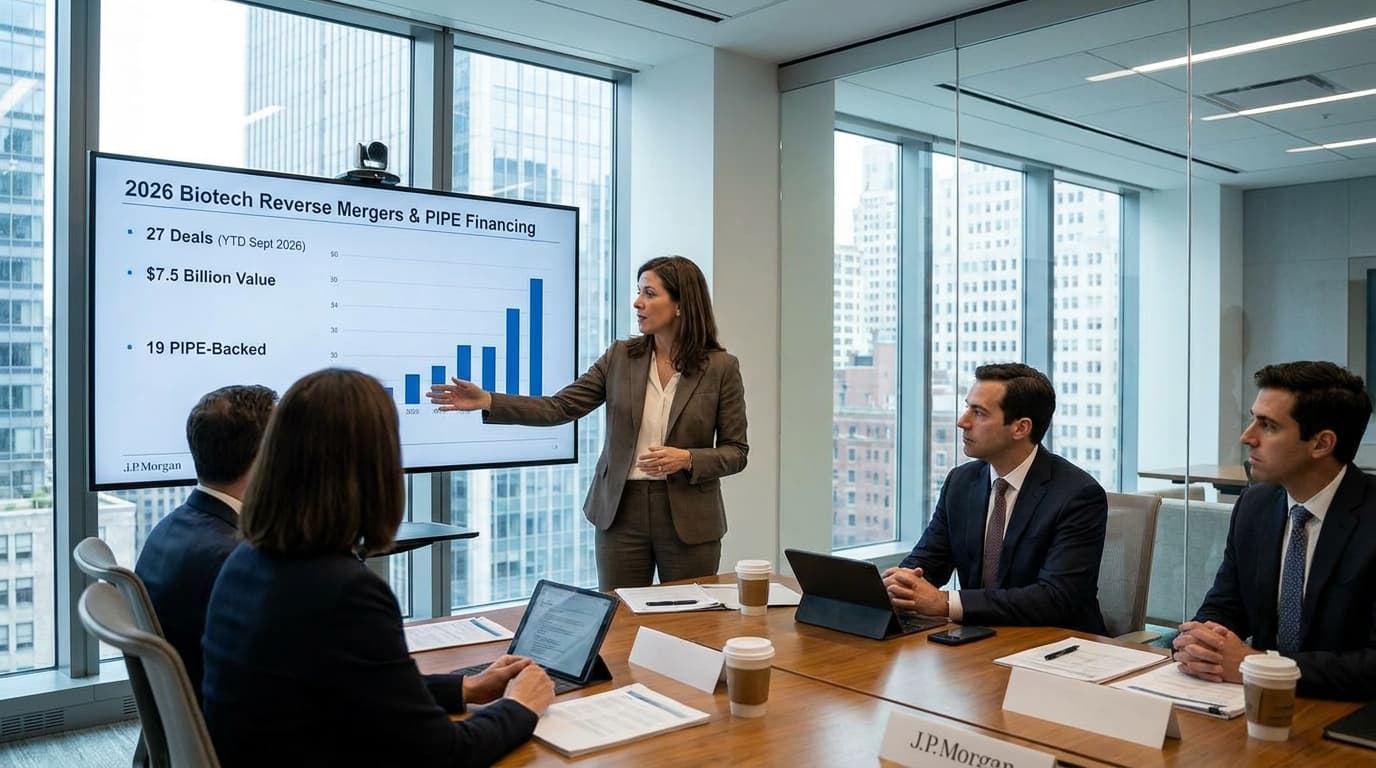
Biotech reverse mergers have accelerated sharply in 2026. According to J.P. Morgan, 27 such deals were completed over the first nine months of the year, already exceeding the total for any full year since 2021.
The raw deal count is only part of the story. J.P. Morgan said those 27 reverse mergers were worth a combined $7.5 billion, and 19 of them included private investment in public equity, or PIPE, financing. That compares with three PIPE-backed reverse mergers out of 12 deals in 2025.
The financing shift
The rebound comes after a period in which biotech funding dried up and left many publicly traded companies with limited assets beyond their Nasdaq listings. Reverse mergers offered private biotechs a way to use those listings as an alternative route into the public market, but activity had fallen from 34 deals in 2021 to 12 in 2025.
What changed in 2026 is not just volume but investor structure. PIPE financing, which involves the sale of shares in a public company to selected institutional investors, has appeared in 19 of the 27 reverse mergers tracked this year. J.P. Morgan said that is more than in any full year since 2021.
That matters because a reverse merger without committed capital can still leave a newly public company constrained. Adding a PIPE means the transaction is doing two jobs at once: providing a listing and recapitalizing the business. In a market where private fundraising has been uneven, that combination appears to be making the structure more attractive again.
Paragon Labs, backed by Fairmount, featured prominently in the trend. This year, Korsana Biosciences, Mentari Therapeutics and Velaris Therapeutics each went public through reverse mergers and raised $380 million, $200 million and $350 million, respectively.
The broader capital context
J.P. Morgan framed the reverse-merger rebound as part of a wider surge in dealmaking even as venture funding softened quarter to quarter. The bank said biopharma venture funding slipped from $9.9 billion in the second quarter to $6.7 billion in the third quarter of this year, though its analysts still estimated full-year funding could reach $33 billion, which would make 2026 the biggest year for biopharma VC investment since 2021.
Mergers and acquisitions have also been running ahead of last year’s pace. J.P. Morgan tracked $138.9 billion in upfront M&A value across 113 deals in the first nine months of 2026, versus $122.1 billion across all of last year. Eli Lilly accounted for 13 transactions with aggregate reported value north of $30 billion, while Vertex’s $10 billion acquisition of Crinetics Pharmaceuticals was the quarter’s largest deal.
The signal from the reverse-merger data is that public-market access is reopening through structures that reduce financing risk at entry. For private biotechs that are not positioned for a conventional IPO, the combination of a shell company and a PIPE now looks less like a fallback and more like an established capital formation route.