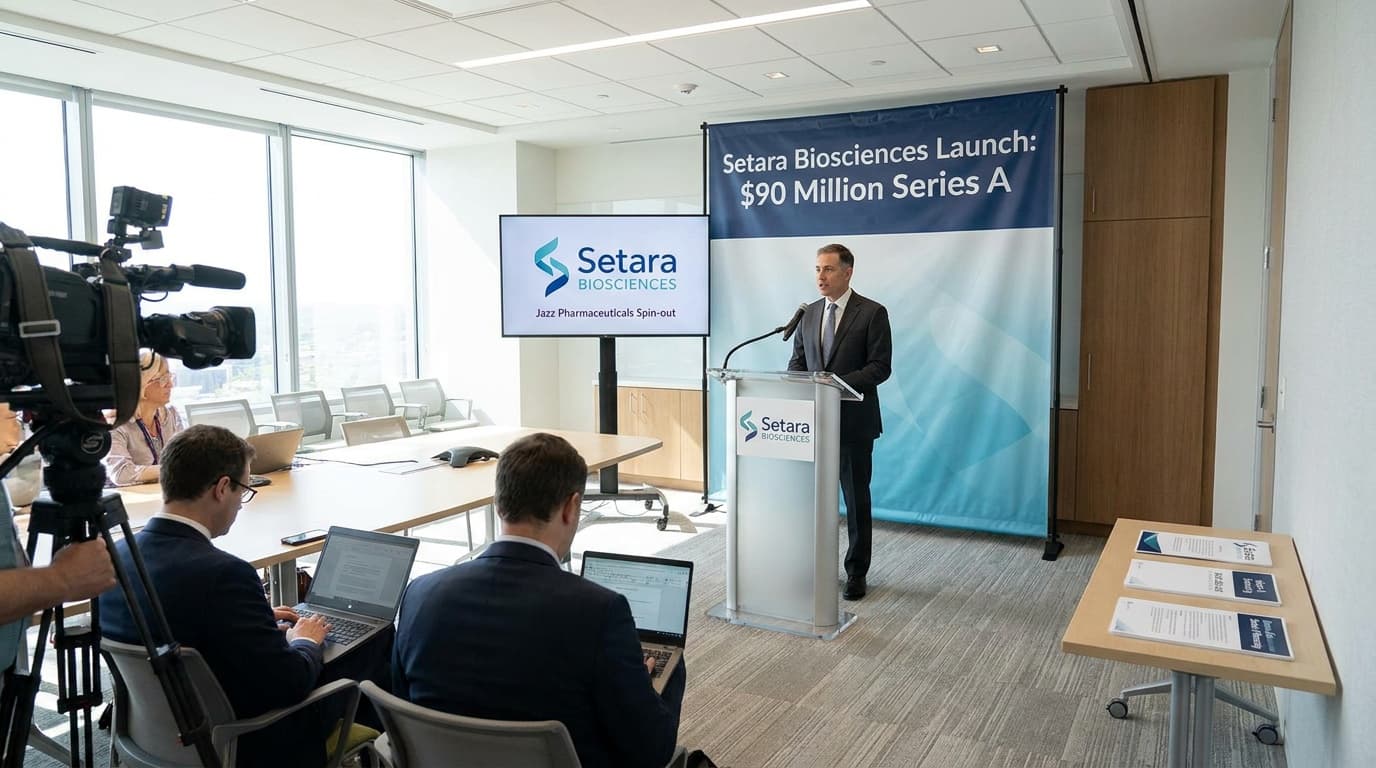
Setara Biosciences has launched with $90 million in series A financing to develop small molecule precision medicine programs that were left outside Jazz Pharmaceuticals’ acquisition of Actio Biosciences earlier this year. David Goldstein, Actio’s founder and a human genetics expert, will serve as president and executive officer.
The setup follows the structure Jazz outlined when it bought Actio for lead program ABS-1230, a therapy for KCNT1-related epilepsy. That deal offered up to $1.3 billion, including $820 million in upfront cash, and Jazz said at the time that it would spin out the remaining assets while retaining a stake in the resulting venture. Setara is that spinout.
Pipeline Focus
Setara’s lead asset is STAR-0871, previously known as ABS-0871, a TRPV4 inhibitor being developed for Charcot-Marie-Tooth disease type 2C and overactive bladder. In CMT2C, the company is targeting a rare genetic neuropathy associated with vocal cord anomalies, impairment of respiratory muscles, hearing loss, and weakness in the hands and feet.
The program has already completed a Phase 1 trial in healthy volunteers. Setara plans to start a Phase 1b study in patients with CMT2C in 2027, while also beginning a Phase 2a study in overactive bladder at the same time. The asset already has rare pediatric disease, orphan drug and fast track designations from the FDA.
That development plan is the clearest strategic signal in the launch: Setara is not positioning STAR-0871 solely as a rare disease asset. The company is using a genetically anchored program to pursue both a narrowly defined indication and a more common condition, an approach that could widen the commercial ceiling if the biology translates.
Setara also acquired earlier-stage programs from Actio focused on genetic epilepsies and expansion indications, including migraine. Its investor group includes Deerfield Management, Canaan, Droia Ventures, EcoR1, Euclidean Capital, Regeneron Ventures and Jazz.