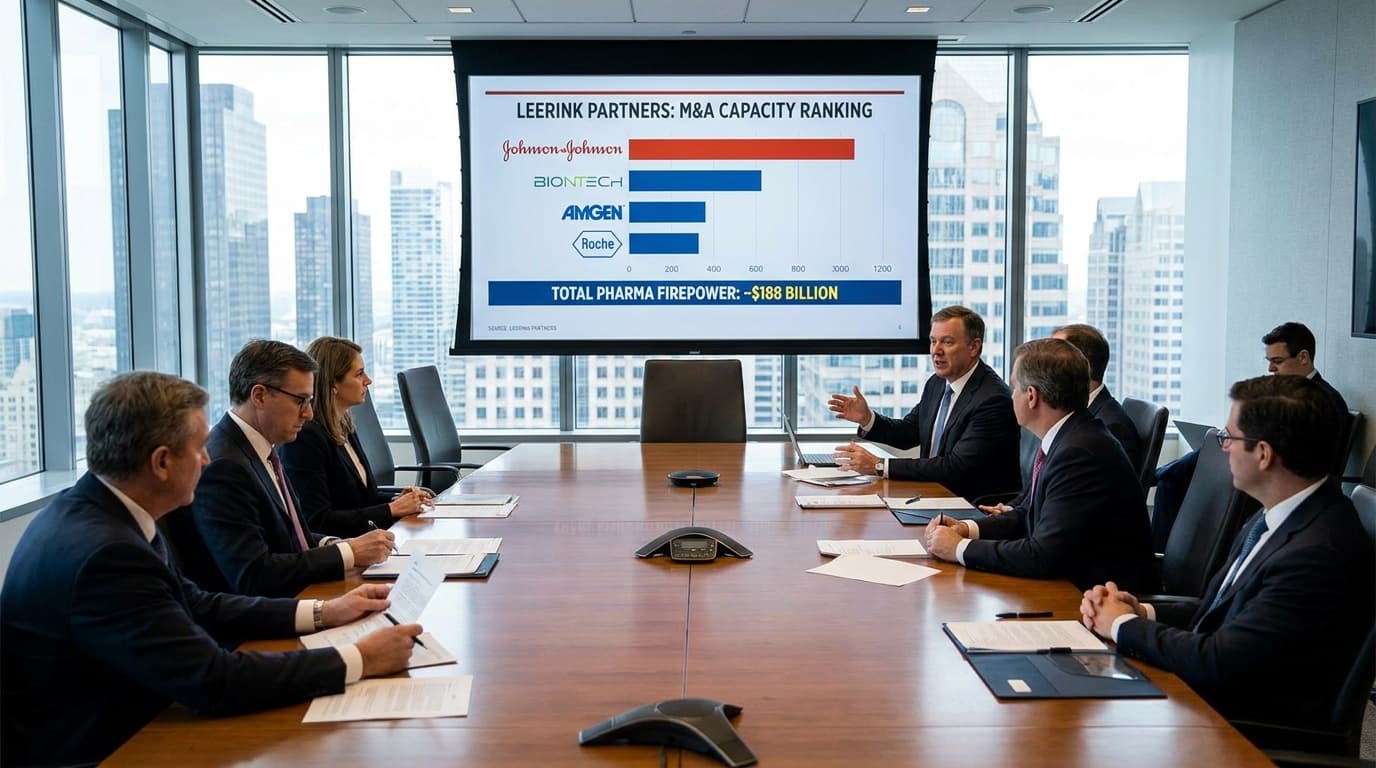
Large-cap biopharma companies still have substantial acquisition capacity after a year of active dealmaking, according to an October 18 analysis from Leerink Partners, which estimated the group has about $188 billion on hand to spend. Within that set, Johnson & Johnson ranked as the most likely buyer when Leerink combined cash levels with market cap and executive commentary.
The report arrives after a year in which pharma companies had already spent $97 billion across 28 deals, a pace Leerink said sits well above the 2009 through 2025 annual average of 19 deals and $69 billion spent. Sector firepower is down modestly from the $199 billion recorded at the end of June 2025, but Leerink still expects robust activity over the next year because many large-cap biopharma companies remain hungry for M&A.
Where the buying capacity sits
Leerink said Johnson & Johnson leads the pack with $21 billion in cash on hand. BioNTech, Amgen and Roche follow in terms of gross cash balance.
Its read is not based on cash alone. Leerink also weighed company size and what management teams have said publicly about deal appetite. On that basis, Johnson & Johnson moved to the front of the line. CEO Joaquin Duato said in September at the Morgan Stanley meeting that the company wants more early-stage deals to strengthen its position later in the decade, while adding that J&J can achieve double-digit growth this decade without M&A. That framing matters strategically: it suggests acquisitions are being evaluated less as a near-term growth patch and more as a way to extend durability into the next decade.
Leerink also pointed to several other management teams signaling room for larger moves. According to the report, leaders at AbbVie, Eli Lilly, Amgen, AstraZeneca and Merck have all indicated a potential willingness to pursue transactions above $10 billion. The only company in the analysis to definitively rule out M&A was Genmab, which has said its near-term focus is on deleveraging.
What is driving the deal mix
Leerink said this year’s transactions have spread across inflammation and immunology, oncology, rare disease and central nervous system, while business development in cardiovascular or metabolic disease has declined. It also noted that more mid-size biopharma companies have stepped up to pursue substantial acquisitions for the first time.
That shift suggests the next leg of sector dealmaking may be driven by portfolio shaping rather than a single therapeutic rush. Lilly is an example of that posture. The company had completed 11 deals by the end of the third quarter for $31.7 billion spent so far this year, making it the busiest pharma in Leerink’s tally. Chief scientific and product officer Dan Skovronsky said in August that business development is an important component of Lilly’s R&D strategy, and Leerink expects the company to look beyond metabolic disease toward areas such as inflammation and immunology, CNS or oncology.
Debt remains a constraint for some would-be acquirers, but Leerink does not see it as a major brake on the sector. It said Bristol Myers Squibb, Novartis and GSK maintain flexibility despite high debt. AbbVie carries the highest net debt balance at around $60 billion, yet Leerink still believes the company has enough leverage capacity to execute. CEO Rob Michael said in September that AbbVie is open to late-stage or even on-market opportunities if they fit, naming immunology, oncology, neuroscience, aesthetics and obesity as areas of interest.
The signal from Leerink’s report is that biopharma’s M&A cycle is no longer just a cash story. Balance sheet capacity still matters, but management willingness, therapeutic diversification needs and a readiness to buy earlier-stage assets appear to be defining which companies are most likely to act next.