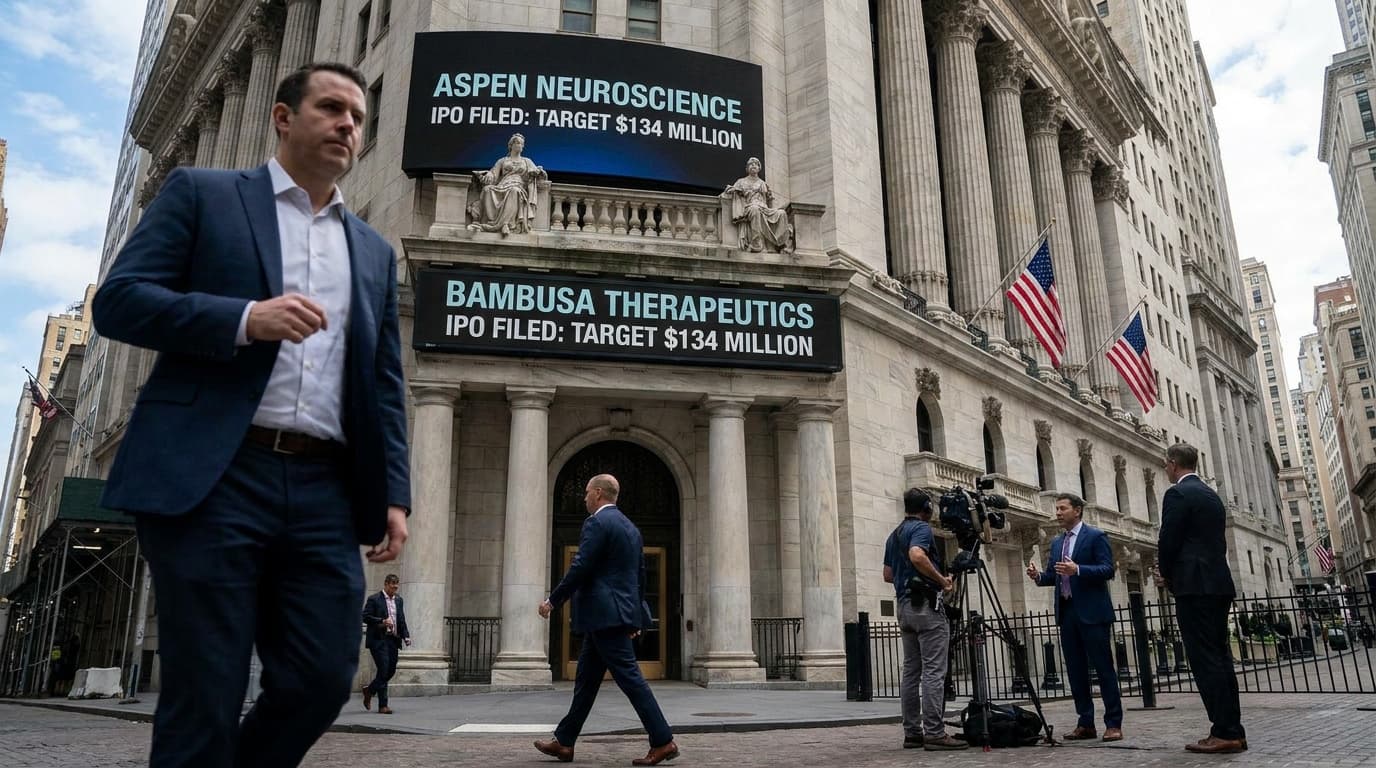
Bambusa Therapeutics and Aspen Neuroscience reached the public market from nearly identical starting plans, but the outcomes diverged at pricing. Bambusa upsized its IPO and sold shares at the midpoint of its $15 to $17 range, grossing $168.9 million. Aspen, by contrast, sold 9.375 million shares at $15 each and raised about $140.6 million in gross proceeds after originally aiming to sell 9.4 million shares at $15 to $17.
The split matters because both companies had been pointing to offerings that would have grossed $150.4 million at the midpoint. Bambusa came out ahead of that initial target and secured extra runway for bispecific research and development, while Aspen accepted lower proceeds as it pushes a more capital-intensive cell therapy program into phase 3.
The financing picture
Boston-based Bambusa had originally filed to sell 9.4 million shares for $15 to $17. By exceeding the $150.4 million midpoint scenario, the company added to the cash available for a pipeline led by BBT001, a bispecific targeting IL-4Rα and IL-31 for conditions including eczema. Bambusa is moving BBT001 toward a phase 2b trial.
San Diego-based Aspen entered the IPO process with the same headline structure: 9.4 million shares at $15 to $17. It ultimately landed at the bottom end of the range and sold slightly fewer shares than expected. That still produced about $140.6 million in gross proceeds, but it fell short of the midpoint benchmark that Bambusa surpassed.
The contrast is a reminder that biotech IPO demand is still selective rather than uniformly open. Investors appear willing to expand support for a company with a bispecific story they will fund above the original midpoint target, while another issuer can complete its raise only by trimming expectations.
What the money supports
For Bambusa, the added capital goes toward a pipeline whose assets originated at Biotheus, the Chinese drug developer that BioNTech acquired for $800 million in 2024 to secure full rights to a PD-L1xVEGF-A bispecific antibody. Members of Bambusa’s leadership team, along with many employees, previously worked together at BioNTech, which gives the company a management story tied to prior bispecific development experience.
Aspen’s use of proceeds is more concentrated. Before finalizing the offering terms, the company outlined plans to invest $110 million in a phase 3 trial of sasineprocel in Parkinson’s disease. Sasineprocel is an autologous induced pluripotent stem cell-based therapy designed to replace patients’ lost dopaminergic neurons with dopaminergic neuron precursor cells. The phase 3 trial will enroll people with sporadic and genetic Parkinson’s.
Aspen CEO Damien McDevitt told Fierce that the IPO was also intended to increase visibility for the unmet medical need in Parkinson’s disease. That framing suggests Aspen sees public-market access as serving two functions at once: financing a late-stage study and putting a complex therapeutic approach in front of a broader investor and clinical audience.
NuvOx Therapeutics also amended its IPO paperwork the same day, keeping plans to offer 2.86 million shares at $6 to $8. Its updated filing included revised phase 2b brain cancer data and financial results for the first nine months of the year, adding another sign that the biotech listing window remains active but company-specific in how capital gets priced.