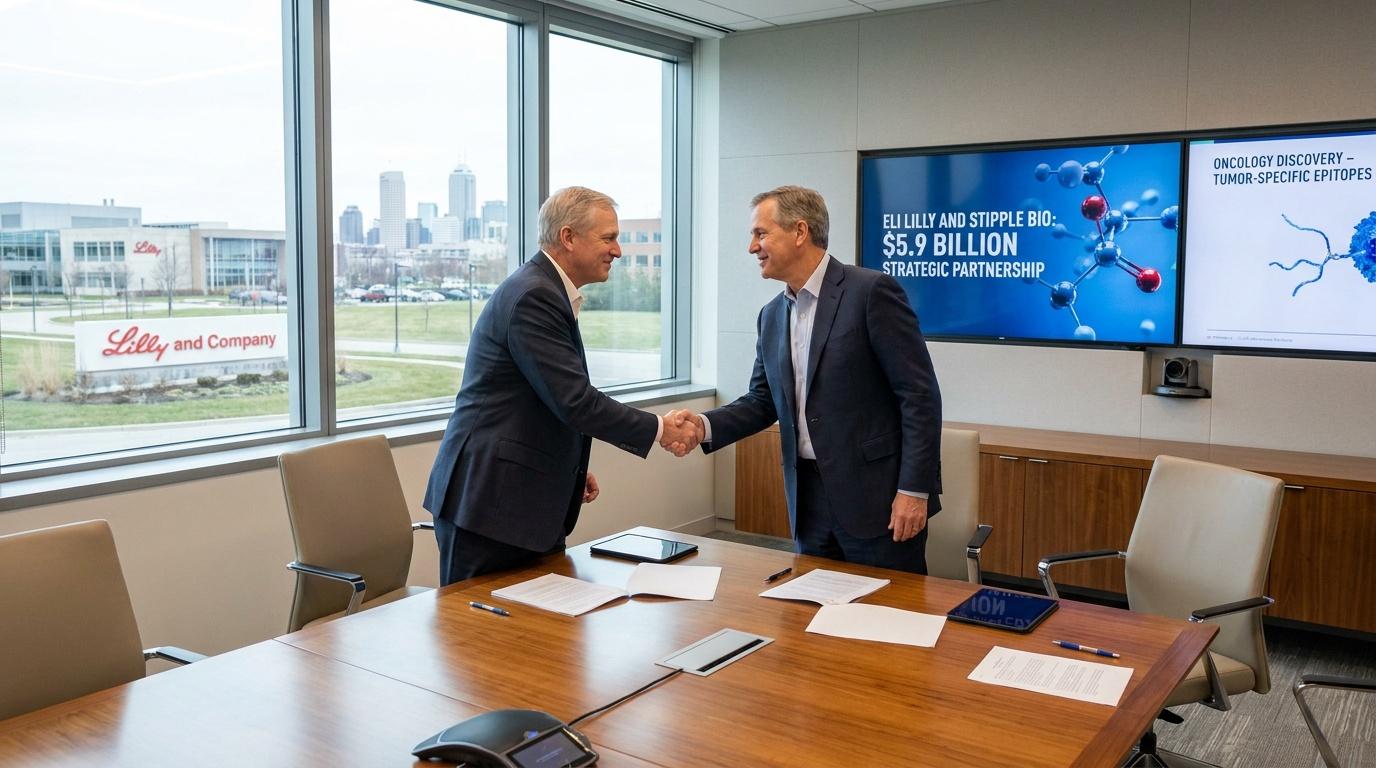
Eli Lilly has agreed to a partnership with Stipple Bio that could reach $5.9 billion in value, giving the drugmaker exclusive worldwide rights to develop and commercialize products from a multi-target oncology collaboration. The companies did not break out the upfront payment or Lilly’s equity investment, but said the package also includes research, development and commercialization milestones plus tiered royalties.
Stipple was founded by Fred Hutch Cancer Center’s Aaron Ring and University of California, San Francisco’s Aashish Manglik. Its Pointillist platform is designed to discover cell-surface epitopes specific to cancer cells rather than targeting surface proteins more broadly.
Why Lilly is paying for this kind of platform
The commercial premise is that better target precision could improve the therapeutic window. Stipple argues that working at the epitope level may avoid the on-target, off-tumor toxicity that often limits the safety and efficacy of cancer drugs aimed at proteins that are overexpressed on tumors but still present at low levels in healthy tissue.
That is a meaningful strategic angle in solid tumors, where many known targets are biologically relevant but hard to dose against aggressively because healthy-tissue expression narrows the margin for error. If Stipple’s approach consistently finds epitopes unique to cancer cells, the payoff would not just be novel targets but potentially higher usable dosing.
The collaboration covers multiple undisclosed modalities and indications that have yet to be determined. Stipple’s internal pipeline already includes antibody-drug conjugates and T-cell engagers for solid tumors, including pancreatic cancer.
The financing context
Stipple is still early. In April, the biotech raised a $100 million series A co-led by RA Capital, a16z Bio+Health and Nextech Invest. At that time, the company said the financing would extend its cash runway into 2029 and support plans to start multiple early-stage trials of its lead candidate, STP-100, while identifying additional tumor-specific cell-surface epitopes for future programs.
Lilly’s interest therefore reads as a portfolio bet on target discovery before substantial clinical de-risking. That fits the company’s recent business-development pattern: over the past six weeks, Lilly expanded its Gate Bioscience alliance by $870 million, committed up to $1.1 billion to partner with Metis TechBio and agreed to buy Calytrix Bio on Monday for up to $1.5 billion.
The signal is that Lilly is still buying access to enabling biology and platform optionality, not just near-registration assets. In oncology, where crowded target classes can compress differentiation, a platform that changes what can be targeted may be worth more than a single lead program.